Reprint from Our Time Press, March, 1996 From the Publisher The mother buried with her child in the African Burial Ground in lower Manhattan looks up to us out of a grave carved from a harsher and meaner place, centuries ago.
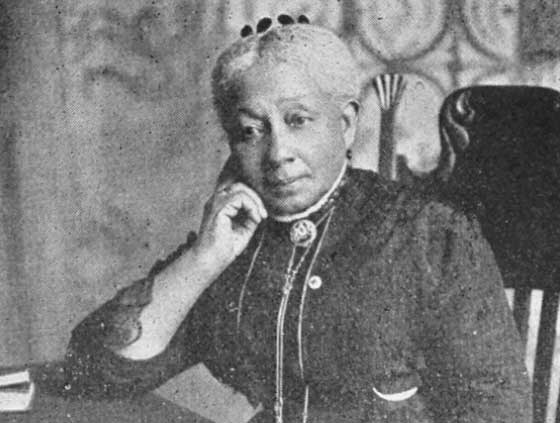
The Weeksville Lady, dressed and mannered for Sunday service, stops for a moment to capture onto tintype, a satisfied confidence, looking into the future. Dr. Susan Smith McKinney-Steward sits in contemplation of a life of accomplishment.
The women in these pages, past and present, show the strength and determination that has nurtured and sustained our people before and since their arrival on these shores.
As the black woman is increasingly released from racist and sexist constraints, she continues to emerge as a source of strength and wisdom. This can be seen most clearly in the churches.
These houses of worship are the richest and most powerful institutions in the black community, and when we look out over the sea of hats on Easter morning and throughout the year, we know where the money and power come from.
It stems from the careful husbandry of sums as small as the dimes collected by Mother Green of Bridge Street AME. Her dime drive of 50 years ago, gathered $1,000 and provided the sanctuary with a brass rail called “The Tree of Life.”
And like trees, black women have stood by us. Providing a leeward side against harsh winds, shading from a too bright sun, and when the rain became too much, soaking through her leaves, she stayed and cried with us.
“What do women want?” is the troubling question still asked by men. Respect might be one answer, equality another. Perhaps simple recognition of their worth as full beings, with strengths that can be relied upon, weaknesses to be helped with, and vulnerabilities to be protected.
There has been much talk recently about having to wait to exhale as a release from the tension between the sexes. Negative tensions that cannot be corrected should always be released and let go of, but there are creative tensions that should be understood, built upon, and enjoyed.
The athlete’s rule of “no pain, no gain,” applies most fully in personal relationships.
When you consider the prize, a developing self, a secure center, a hopeful future, and a partner through life’s long maze, then you work through the pain, taking longer and surer strides.
This is not an easy process, but soon you will begin to breathe together. Wanting to give to each other what you want for yourselves.
As black people continue the recovery from the racist web in which we have been held, as black men continue to throw off sexist stereotypes and behaviors, and as men and women continue to grow and heal, we have a new world to look forward to.
And the most exciting part of all is that we will be continuing the work of our ancestors, building it together. David Mark Greaves
by The Rev. Dr. Emma Jordan-Simpson (Part II of Four)
The Black suffragists who were members of the Concord Baptist Church of Christ before 1920 were the beneficiaries of the work and witness of church women who began planting and cultivating the seeds of freedom and wholeness soon after the church’s founding in 1847.
The actions and commitments of these women illuminate a tradition of activism that first begins with a deep love for the wellbeing of the people. Do the people have a place to live? Have the people eaten? Are the people well?
Their efforts to answer those questions set in motion the building of an infrastructure of ministry support that would benefit those who came after them.
Maria Hampton and Hagar Washington were founding members of Concord Church. After Cecilia Broughton joined the church, these three women organized with other women in the community in 1866 to create the Female Union Relief Association for the Colored Poor of Brooklyn.
Many Black churches created burial societies and mutual help organizations because Black people had to depend on each other for care and support in times of need. In their advertisement of the fund for the Colored Poor of Brooklyn, the women promised strong administration of its resources.
Their initial public campaign to raise funds for relief was quite successful, bringing in $72.24 (about $1,488.00 in today’s currency).
Delighted with their efforts, Pastor William T. Dixon published a personal letter of thanks addressed to Brooklyn’s “generous public” in gratitude.
This may seem like a simple story of a successful charity effort. But when we consider what develops in ensuing years, this fund that was started in 1866 should be viewed as a catalyst for the creation of other such efforts that worked to strengthen the fabric of community.
With each such effort, they reimagined how Black Brooklynites might be made whole. They only had each other which, for the women, was a good place to start.
The Concord Mutual Relief Fund was created in 1877 to pay special attention to the needs of the poor members of the church.
The Fund’s Trustees were male and female. By 1888, Concord Church had 600 members and a number of thriving organizations led by women like the Dorcas Home Missionary Society and the Helping Hand.
The church and these organizations were the training grounds for women in leadership.
There, women learned to raise money, to strategize to meet community needs, and to organize with women in other churches around the issues affecting their lives. Mrs. Anna Perkins joins Concord in 1884, bringing wisdom and experience with her.
An older woman, she was quick to become a constant presence and supporter of younger women. Never President or Chair, Mrs. Anna Perkins, was always ‘secretary.”
Though the Dorcas Home Missionary Society was considered a mature organization within the church when Perkins became active in 1885, by 1909 Perkins was known as its “General Secretary.”
Dorcas expanded its purpose under her “mothering.” It grew beyond the church to engage black women in the community in its work.
The Recorder of Indianapolis notes that the Dorcas started to provide assistance within the church, “but soon, its helping hand extended beyond the limits of its home circle. Wherever the cry of the orphan is heard or the needy is found, the society lends its aid.”
However, church organizations within Concord like Dorcas did more than provide aid to the needy. They did more than feed the hungry and care for the sick.
When they mentored younger women to be leaders, they sent a better letter to the future than the letter they received.
They used their skills to address issues like racial violence, racial uplift, civil rights, and women’s rights. Church work prepared Black women whose names and stories we will never know, to change the trajectory of our communities with faith and service.
They addressed the whole of Black lives and taught others to do the same.
Next, we will turn to a key figure in Black women’s suffrage in Brooklyn who was sitting under the influence of Mother and General Secretary Anna Perkins – powerhouse Alice W. Wiley Seay, founder of the Empire State Federation of Women’s Clubs and one of the leading builders of the Brooklyn NAACP Chapter.
This story was originally published by THE CITY Migrant Crisis
New African arrivals, many with specific dietary and language needs, need stronger support from the city’s response systems, advocates have warned for months.
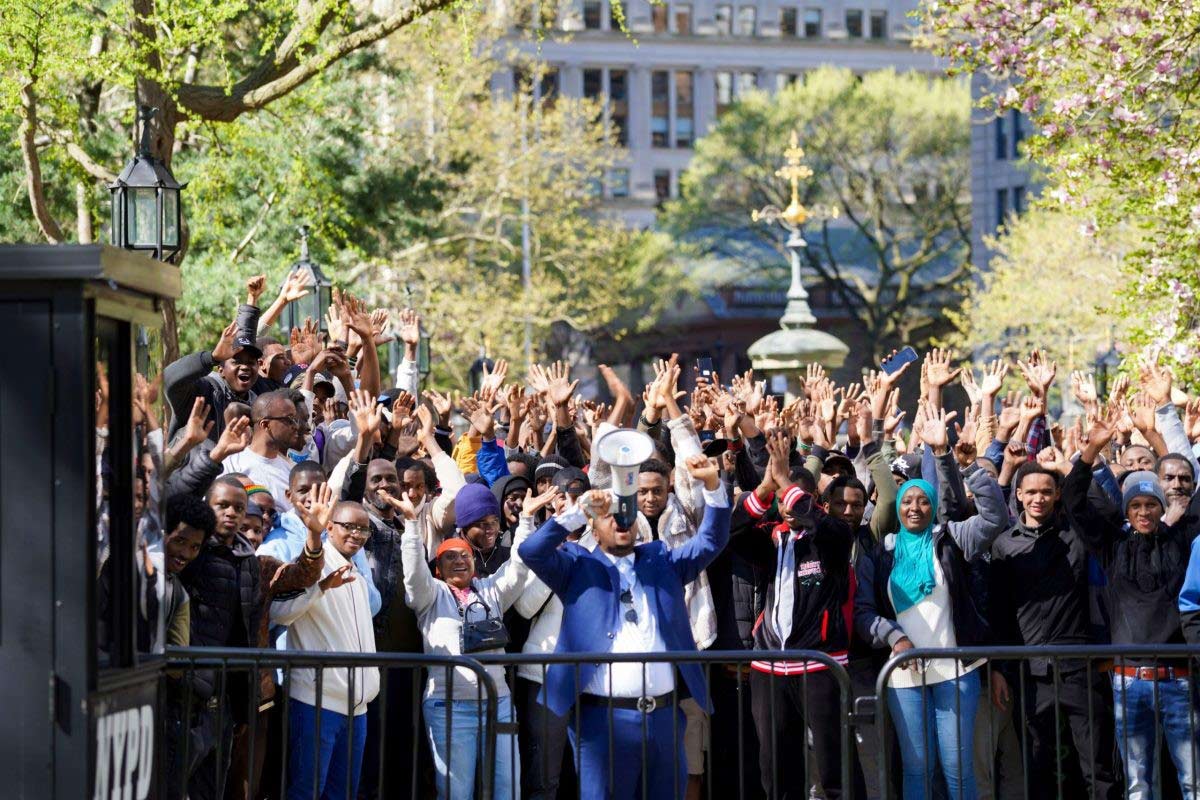
by Gwynne Hogan Hundreds of African migrants descended on City Hall Tuesday morning ahead of a City Council hearing on the experiences of Black migrants arriving in the five boroughs.
Word about the hearing spread through WhatsApp messages and groups, as did some misinformation. Several migrants who spoke with THE CITY said they thought the Council might vote to give them work permits.
One teen shared a WhatsApp video in French incorrectly telling people they would be given $5,000 or $10,000 debit cards for food supplies.
“I came to find out,” said the 18-year-old from Guinea, who shared only his nickname, Ab. Others said they’d come to support those testifying on their behalf.
“We’re here, we don’t work, we’re in the shelters, we’re suffering,” said Abdul Naite, who arrived three months ago and is from Guinea. Speaking in French, he added: “We’re here to reclaim our rights.”
The hearing, hosted by the Council’s immigration and hospital committees, aimed to spotlight the experiences of African migrants, who now account for 16% of the 64,000 migrants living in New York City shelters, up from 13% last fall, testified Molly Schaeffer, who directs the city Director of Office of Asylum Seeker Operations.
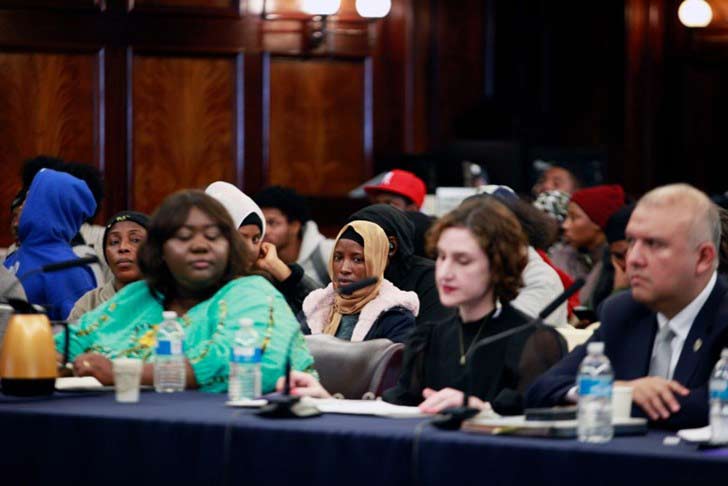
Migrants at a City Council hearing on the experience of Black asylum-seekers. Credit: Alex Krales/THE CITY
The number of African migrants crossing the U.S. border has soared in the past two years, as Europe has cracked down. The New York Times reported 58,462 African migrants entered the U.S. over the border in fiscal year 2023, up from 13,406 the prior year, with the top countries of origin being Mauritania, Senegal, Angola and Guinea.
In migrant shelters in New York City, most residents still hail from South America, with 41% coming from Venezuela, 17% from Ecuador, and 9% from Colombia, according to data from City Hall through late March. But African nations now follow, with 7% of residents from Guinea, 5% from Senegal and 3% from Mauritania.
Advocates have warned for months that those new African arrivals, who often have particular dietary needs and speak a range of languages, are falling between the cracks. There are relatively few community organizations prepared to help support them while the city has been slow to adjust its services.
Schaeffer said the city is providing prayer rooms for Muslim shelter residents as well as places for residents to wash their hands and feet ahead of prayers.
“We’re really trying to incorporate the practices of individuals inside the shelters,” she said. Many advocates who testified described inadequate language access for African migrants inside shelters and when interacting with other city services. While many new arrivals speak French, others only speak indigenous languages like Wolof or Pulaar. Adama Bah, the founder of Afrikana, a volunteer run group, said she’s constantly being called to translate for migrants in shelters.
“We keep telling them the language line is not working but they keep telling us it’s working,” Bah said. “They’re constantly calling and telling the staff members to speak to Adama, she’s on the phone. Every staffer in the shelter system knows that I’m translating when I call.”
The majority of African migrants living in city shelters, 81%, are adults or older teens, according to Schaeffer meaning they’re disproportionately subject to strict 30-day time limits on shelter stays. By comparison, 91% of Venezuelans in shelters are families with children, she said.
Given the city’s strict time limit on their shelter stays, many African migrants have taken to living in ad hoc settings inside of mosques or commercial spaces. The surge in African migrants in shelters has carried over into shelters for younger New Yorkers, since many new arrivals are under the age of 21.
Inside and outside the hearing many migrants expressed exasperation over federal rules the New York City Council has little control over, making them unable to work legally for at least six months while asylum paperwork is processed.
“Months where you can’t work, you can’t live. It’s not dignified,” said Abdoul Gadiry Diallo, 43, testifying in French through a translator. “It’s very humiliating. We have family that count on us.”
This story was originally published by THE CITY – by Gabriel Poblete and Rachel Holliday Smith April 16, 2024
‘Containerization’ is coming to New York City. Imagine not seeing giant piles of plastic garbage bags on every street.
The days are numbered, officials hope, for two ubiquitous features of New York’s sidewalks: towering piles of trash and scurrying rats.
The city is making moves toward complete trash “containerization,” the long-held dream of garbage management experts and city planners. If implemented correctly, it could transform your curbside. But there is a long way to go, and lots of logistics to sort out. Here’s a guide on the basics:
What is ‘containerization’? The idea is simple: Instead of putting flimsy, plastic trash bags on the curb, New Yorkers would instead put garbage into hard, plastic containers. Trash collectors then empty those containers directly into a truck and cart it away.
Trash containers on 148th Street between Broadway and Amsterdam Ave., April 12, 2024. Credit: Alex Krales/THE CITY
Revolutionary? Not really — containerization or something like it is the standard in every other major city in the country, and many around the world.
“Some advocates said this would be impossible, and other advocates said it would be incredibly easy, and both of those groups were mistaken,” said Joshua Goodman, a deputy commissioner at the Department of Sanitation.
“It is absolutely achievable. But it is not as simple as ‘why can’t you just copy/paste what they do in Barcelona?’”
Why do this? Garbage bags can break, leaking stinky trash goo. They’re practically open smorgasbords for rats, and they can hide dangerous objects that injure trash collectors. Pulling off containerization could mean New York exits those notorious lists of the most rat-infested cities in the world, and the rancid smell of summer trash becomes a thing of the past.
Containerization could also help reverse the rate of injuries for sanitation workers, who are among the most likely to get hurt on the job out of all city workers.
Where is it going to happen, and when? It’s already started for commercial businesses and for a handful of residents. But the rollout for the rest of the city will begin later this year.
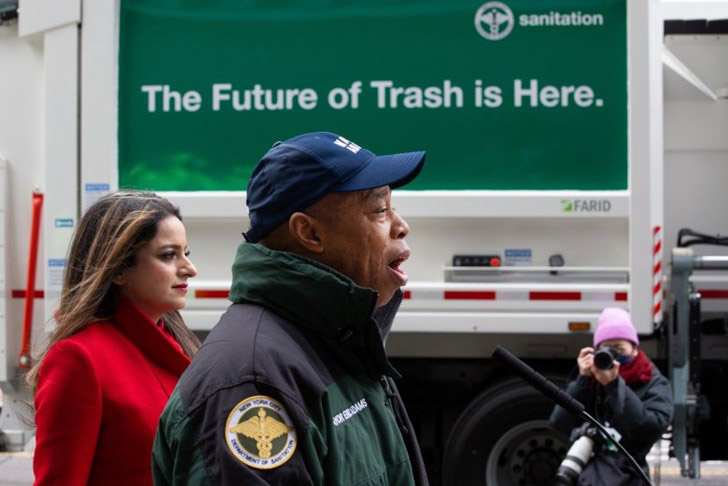
For a sneak peek at what containerization will look like for residents, see West Harlem. City officials began a pilot program for permanent, installed trash containers there last year on just 10 blocks and a few local schools. And earlier this year, Mayor Eric Adams and sanitation officials announced that Hamilton Heights will get stationary, on-street containers next year.
Last summer, the city mandated that all food-related businesses had to put out their trash in containers, then expanded it to all chain businesses last fall and finally put the commercial container rule into effect for all businesses as of March 1 of this year.
Going forward: Starting this fall: All residential buildings with fewer than 10 apartments must set out their trash bins with secure lids. And come 2026, the bins used must be the official New York City bins. (More on that later.)
Starting in the spring of 2025 in Hamilton Heights: Larger residential buildings of more than 31 units will instead have to use stationary, on-street containers, with a dedicated container for each of the buildings. Buildings with 10 to 30 apartments will have the choice between the containers or the bins.
TBD: Universal containerization. There is no date or timeline yet set by the city for full, citywide containerization.
What about recycling and compost — will that go in containers, too? Not yet. Right now, the same rules apply for both compost and recycling: if you put it on the curbside in a bin, you can set it out a little bit early, at 6 p.m. But the option to bag it is still there if you put compost or recycling out at the normal set-out time of 8 p.m. What will it look like on New York streets?
The containerization era will look like: the installation of big containers on residential streets, new side-loading garbage trucks on the street, standardized rolling bins for smaller buildings — and tens of thousands of fewer parking spots.
One of the policy changes resulting from the West Harlem pilot is to assign containers to each property, rather than shared containers among buildings. Buildings utilizing containers will have to place them in front of their properties.
The city is currently going through the bidding process for a vendor to manufacture, install and maintain the public containers, with about 600 to 1,500 to be installed in Hamilton Heights. They’ll be roughly 2,000- to 3,200-liter square bins (about 530 to 845 gallons) that must meet be capable of being lifted by side-loading trucks and have accessible domed lids.
For smaller buildings, the city’s already reached an agreement with a vendor for city-approved, standardized bins. They will be sold for around $50 and will be available sometime this fall.
While the city had initially estimated 150,000 parking spots citywide would be lost to accommodate the bins, Goodman said that recent policy changes have cut down the estimated lost parking spots to somewhere between 44,000 to 69,000.
However, there has been some criticism of the city’s new trash rules. The Center for Zero Waste Design, an organization aimed at curbing waste, has released its own recommendations. Among those: the city should not permanently carve out curb space for larger buildings and should use shared street containers for smaller buildings rather than bins that’ll clutter the sidewalk.
Clare Miflin, the organization’s founder, expressed concern that some of the new sanitation department policies would not incentivize trash reduction, which should be the ultimate goal.
“It’s just about trash and hiding the trash,” Miflin said. “It’s not about how can we incentivize people to put stuff in the recycling — it’s incentivizing people to put stuff in the trash.”
What about trash from businesses? Commercial properties just started to have to use hard containers to put out their trash. All businesses must use a bin with a secure lid. That rule went into effect on March 1, 2024. The fine for not complying is $50 for the first offense, $100 for the second and $200 for all offenses after that.
Back in 2019, the City Council passed legislation to split the city into 20 trash zones, with just three vendors allowed per zone. That effort is meant to slash the miles traveled by commercial carters.
While implementation of that system had been paused because of the pandemic, the first zone of Jackson Heights, Corona and Elmhurst in Queens is expected to come online later this year.
What about the smell? Is this really going to help with rats? The idea is to cut down on both. On rats, early data is positive. In the Harlem containerization pilot program, city officials say rat sighting complaints decreased by 68% in the year trash went into the bins.
As for the smell, look to the East River, where Roosevelt Island has been whisking its garbage away in pneumatic tubes for decades — and doesn’t have that summer garbage stink notorious elsewhere in the city.
But I already put my trash in a container now. Can I keep doing that? For now, you can use your own container. But in 2026, everyone in buildings with nine units or fewer will have to use the official bin chosen by the city this spring. Those bins, created by Otto Environmental Systems, will cost about $50, and the city is aiming to sell nearly 3.4 million of them.
How well has this worked in other cities? It depends on the city, but there are many examples of large, dense cities handling trash better and more smoothly using containerization or another direct-to-the-truck option. As Curbed pointed out in its “case for containerized trash,” San Francisco has a three-bin system run by a private company and has 99% compliance, according to the city.
In Spain, Barcelona places shared trash containers on its street for all trash and recycling, Amsterdam has underground shared trash containers and in Taipei, Taiwan, residents are required to throw their bags of trash straight into the garbage truck.
The DSNY studied garbage collection in dozens of global cities and found mixed results, notably that shared containers often overflow and are surrounded by loose bags. But it concluded that the problem is “solvable with a truck that can side-load shared containers and accept loose bags.”
Those side-loading trucks are part of New York’s strategy, as mentioned above.
Looking back: How did the trash problem get so bad? There’s a long history of garbage in this city and lots of reading material on the subject. The short answer is: 19th century street designers nixed alleyways when creating Manhattan’s famous grid, giving residents nowhere to put piles of trash.
According to this worthwhile read from the New York Times last month, the grid creators may have overlooked alleyway planning because they were much more concerned about another project on their plate: the Erie Canal.
In the 20th century, once trash-on-the-streets became the norm — and later when plastic bags reigned supreme following a notorious 1968 Sanitation worker strike — the pick-up system became hard to change politically and logistically, as Streetsblog has written. For example, New York never had the right trucks to efficiently load big, hard-sided trash bins until very recently. And for decades, agencies didn’t talk to each other about tackling the street trash problem.
Benjamin Miller, a former policy director for the sanitation department, told the outlet: “It’s a question of, simply, inertia, lack of imagination and motivation and prioritization.”
Five years ago, the NASA Goddard Space Center in partnership with Dr. Reginald Blake and City Tech conducted a summer-long study of Bedford Stuyvesant and the urban heat island effect. Urban heat islands occur when cities replace natural land cover – such as trees and grass – with a dense concentration of concrete, asphalt, buildings, and other materials that absorb and retain heat.
The result of this phenomenon is that surface temperatures in urban heat islands are normally 3 to 7 degrees higher than in communities that are not urban heat islands. That slight uptick in heat causes an uptick in your energy bills, but more importantly, it also causes an uptick in heat-related illness and death.
Every day for the summer of 2019, Dr. Blake and his team flew a special drone over the community, charting air temperatures and surface temperatures, and logging that information. I had a chance to be a part of the project.
And, while I was fascinated with the work, I was also surprised that such an important and interesting project could be happening right in Bedford-Stuyvesant.
I decided to contact my friend and brother-in-community, Barry Cooper so that he could bring his Little Bro Summer Camp children to be a part of the day-to-day analysis.
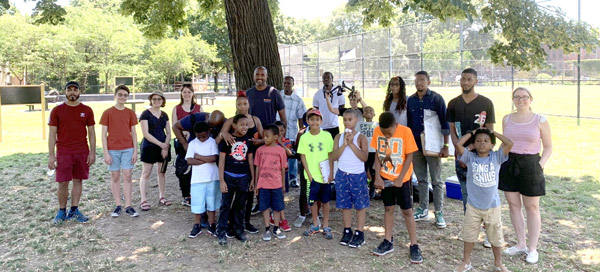
On July 15, 2019, Barry bought a couple dozen kids to take part in the study. We gave each of the kids a digital thermometer and told them to chart various surface temperatures. They checked the sidewalks and the trees.
They checked the swings in the park and the benches. They logged their data, and then we sat around and discussed it all; a very simple act of including children from the neighborhood with regard to the very real work of environmental justice.
Isha Ma’at – Owner and Curator of Make Manifest
I bring this up because just last month I was in a store on Fulton Street when a teenage boy approached. I didn’t recognize the boy at all, but he recognized me.
He said, “You were one of the men that we measured surface temperatures with.” His statement took me back to that time, anytime before COVID seems like eons ago.
We had a brief conversation, and before we parted ways he said, “I’m going to plant some tomatoes with my grandma soon.” His parting words were a stark reminder of how incredibly easy it is to have environmentally responsible adults, by simply introducing environmental responsibility to children.
All across this community, residents and community-based orgs are accepting the task of enhancing the environmental profile of Central Brooklyn. And what are seemingly small steps are actually yielding large results.
Take Nicole Greaves, for example. Nicole is a lifelong resident of the community. She and I actually attended High School together. Today, she’s the Community Engagement Specialist with Bridge Street Development.
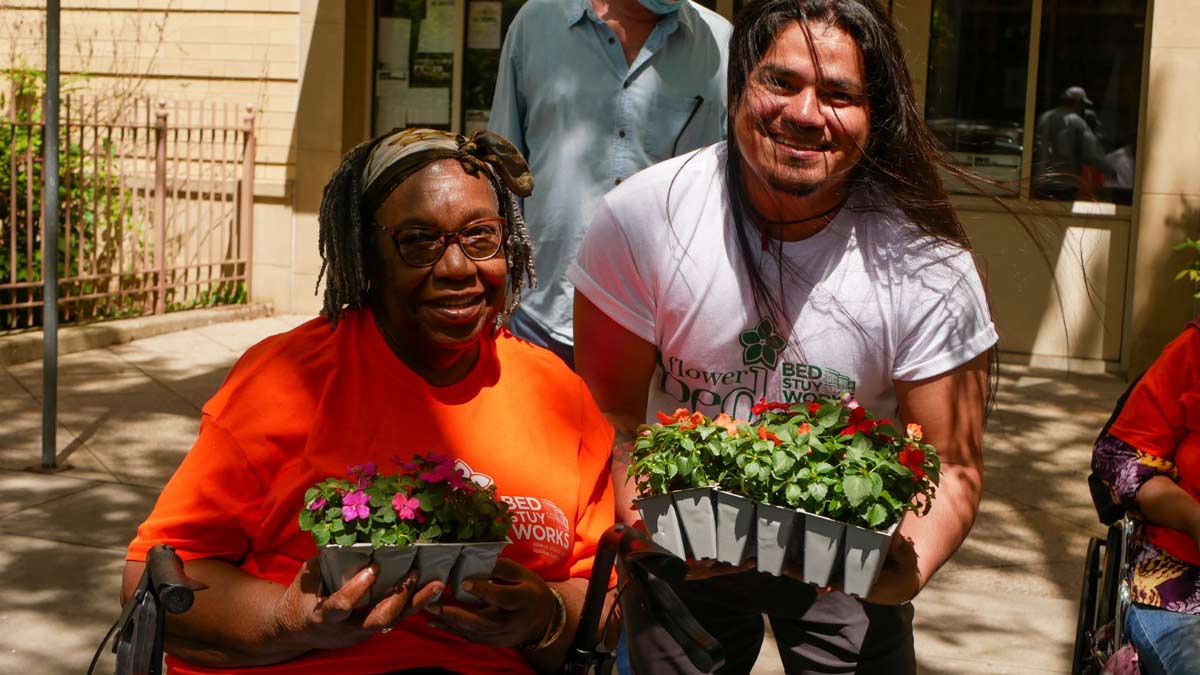
Among the many programs and partnerships Nicole oversees, for the last eight years, she has worked with the Bed Stuy Works Alliance of Resident Block and Tenant Associations on an initiative called Flower Bed-Stuy.
She explains the initiative, “Flower Bed Stuy is an annual event that is sponsored by the Alliance. It’s our annual community give back for our participating block, tenant, and resident associations.”
While the Alliance meets monthly and offers participants a wide range of information and discussions on everything from deed theft to what to do once you become an empty nester, Flower Bed Stuy is an opportunity for these associations to heed the call and improve the spirit of their block and community through gardening.
Nicole states, “One of the goals of the Alliance is to bring people together so that they can make their community safer, but also understanding that when you beautify a space you improve it.
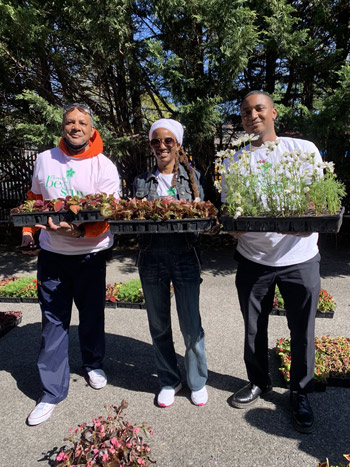
Gardeners Gregory Anderson and Nicole Greaves, from Bridge Street Development Corporation, with Councilman Chi Ossé.
We all know that there is a lack of green spaces, and with the ongoing issues of mental health in our community we want to create these spaces, knowing that gardening is therapeutic.
We always want to use this initiative as a chance to bring the residents out onto the block, and to use gardening as a conduit to create connection and fellowship between neighbors.”
According to Nicole, the initiative has grown every year. “When I first started, we had close to 30 Block Associations that would participate.
This year, we are planning on over 50 Block Associations and 6 Merchant’s Associations to participate.
And, considering that each Block Association has a membership of roughly anywhere from 50 to 100 residents, Flower Bed Stuy easily connects with literally thousands of Bed Stuy residents.”
The resources that make Flower Bed Stuy a success come from various sponsorships and the donations of local elected officials. And, according to Nicole, the best part of the initiative is the effect that the flowers have on the community.
“My reason for working on Flower Bed Stuy, starting years ago as a participant, and then moving into a volunteer role, and now as an organizer is that I really enjoy walking around the community during the summer and seeing the flowers!
It is the most beautiful thing to go from one block to the next and to see that blocks are actually using the flowers to improve their blocks.
And so, I know for me walking and seeing these flowers makes me feel good and I’m sure it makes others feel good. And, I’ve seen it. I’ve seen people not throw trash because there were flowers.
I’ve seen people redirect their dogs away from the tree beds because there were flowers. So having the flowers actually causes people to respect the space, and to respect Bed Stuy.”
One of the regulars that you might see at Flower Bed Stuy is Chi Ossé. Chi is a lifelong resident of the community and also serves as the District’s Councilmember.
In his work, Chi gets the opportunity to advocate for, and ultimately pass legislation that can enhance the environmental profile of his neighborhood.
And, that opportunity isn’t lost on him. “My office absolutely understands that environmental protection includes everything from the macro level of combating climate change to the local level, including clean air, green spaces, and rat mitigation.
We support City and State efforts to make buildings more energy efficient and invest in renewable energy to power our electric grid.
Locally, we partner with groups like ACE to maintain clean parks, we invest in the Black environmentalist hub the Magnolia Tree Earth Center, and we implement our Rat Action Plan to ensure our neighborhoods are healthy and liveable.”
While Nicole works to use flowers to beautify the community, and while the Councilmember rolls out initiatives to keep the community energy efficient and healthy, Isha Maat is using her establishment to reinforce the concept of sustainability.
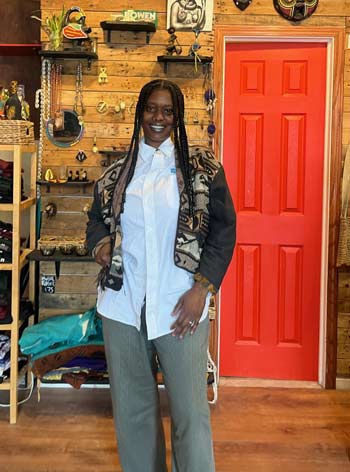
The owner and curator of Make Manifest on Tompkins Avenue is relying on her Caribbean roots and her holistic perspective to use her space to bring to light the concept of waste not, want not. For the second year, Isha will be using the Sunday before Earth Day to produce Sustainable Sunday.
She explains the concept, “Sustainable Sunday is an opportunity for the community to perform small acts of sustainability. So, there will be a clothing swap where people can bring clothes and take clothes.
NASA Goddard Prof Reginald Blake, far left, and Marlon Rice, center, with the kids from the Lil Bro Summer Camp – July 2019
There will be an upcycle craft workshop where people can take cardboard to create vision boards or to use to create art. There will be a space to upcycle your clothing, kinda like customization in order to make something old into something new.”
For Isha, the concept of sustainability isn’t a new concept. It’s simply the traditional methodology of African peoples across the world. “I think sustainability is a big part of the nature of the diaspora. So in the Caribbean, we are always utilizing things to make other things out of it.
So, I think we come from a culture where we recycle naturally. When I was young, tubs and containers would turn into planters in my grandmother’s garden. So, it’s just really sustaining that culture of always looking to continue the use of something and not to waste just because.”
Crystal Jeffery had a career in law enforcement. That career was halted ten days before her 24th birthday when she was grazed by two bullets while on duty. After early retirement from NYPD, Crystal began a journey into entrepreneurship, finding success in real estate and even opening and operating a security training school.
The Brooklyn native made the decision to become a Board Member for the Magnolia Tree Earth Center in 2020 because she wanted to serve her community and to help rejuvenate the organization and its mission to provide environmental education to underserved communities.
“I come from a family of farmers in Walterboro SC who lived off of their land. It’s funny how as you get older your DNA shines through. I always say that I represent a seed that was planted many moons ago and grew into a tree. I became interested in environmental justice and education by being a Board Member at MTEC.
The more I learned about MTEC and Hattie Carthan the more I fell in love with the mission of the organization. It fits in with what I’m about and represents. Urban Farming, ecological studies, horticulture, vocational studies, and wellness. Becoming your own resource for yourself, your family and your Community to live off of. Hattie Carthan once said why look to the government when you can help yourself.
She rallied several responsible people to help her to pioneer an environmental movement.” What the former police officer and entrepreneur didn’t expect was how being a part of an organization designed to educate would actually be an educational experience for her. “As I began to do the work, I learned so much about the importance of our environment. I honestly lacked interest in the sciences.
I was always a mathematician in school who loved playing with numbers which is what prompted me to be an exceptional entrepreneur. My Earth Science teachers Mr Finkelstein & Mr Miller would be proud!”
Across the community, regular residents are continuing to do their part to keep Central Brooklyn green-minded and sustainable. And, as simple as it seems, this is the model of success – an all-hands on deck approach to ensuring that awareness and education are always made available through opportunity and programming.
Sustainable Sunday is happening on Sunday, April 21, 2024, at Make Manifest, located at 382 Tompkins Avenue from 1 pm – 6 pm. Flower Bed Stuy will happen on Saturday, May 4, 2024. For more information on that event, email Nicole Greaves at ngreaves@bsdcorp.org