By Nayaba Arinde
Editor-at-Large
April’s International Black Women’s History Month designation has been quietly and proudly existing since its invention in Atlanta in 2016.
“If they don’t give you a seat at the table, bring a folding chair,” said Bed Stuy’s Congresswoman Shirley Chisholm. In this vein, if the mainstream actively ignores the foundational contributions of Black women, this majority-minority creates the platform on which to do so.
Sha Battle is the creator of April’s International Black Women’s History Month.
“I felt that Black History Month was not enough to celebrate the contributions that Black women have made to world history,” Ms. Battle told Shahidah Foster in Baucemag.com. “Many of our contributions have never been acknowledged.
I knew that March was Women’s History Month and, while I am so happy about that, I felt like we [Black women] needed our own month to celebrate the contributions that we as a culture, have made to world history. So, I decided that we would create April as International Black Women’s History Month, and embrace every achievement varying from domestic engineering to medicine to politics to inventions to entrepreneurship and everything in between.
I had no idea that Black and minority women had contributed so much to this world because most of it is not taught in schools.”
In April 2016, Georgia native Ms. Battle received a commendation that International Black Women’s History Month was recognized by the city of Atlanta.
It stated that this month is a “celebration that is designed to recognize and applaud the achievements that African American women have made to society,” plus women who have excelled in “such disciplines as Science, Technology, Engineering, and Mathematics,” and in general recognizing “generations of Black women who throughout American history have used their intelligence, imagination, sense of wonder, and tenacity to make extraordinary contributions to the everyday means of how we live.”
As claimed-named months go, Black Women’s History Month is steadily growing in popularity with a purpose.
Slings and arrows constantly deflected, the powerful sisterhood builds up its proud membership of Black activists, educators, medical innovators, professionals, risk-takers, sports high-achievers, everyday working women, home-and-family-maintainers, and quiet storm entrepreneurs.
Black women have always been the backbone of Black resistance and fortitude. No question.
Off the top of the head, folks can reel off many indomitable Black women who have changed global socio-political events; or their own personal worldviews.
It usually starts with mothers of course. Or perhaps a sister, aunt, female family member, or friend.
Then there are those like the trailblazing “unbought and unbossed” Bed Stuy rep. Congresswoman Shirley Chisholm.
Other foundation-shakers like- South Africa’s Liberation leader Winnie Mandela, former First Lady Michelle Obama, Dr. Betty Shabazz, historic heroine Harriet Tubman, fighter against neo-colonialism Ambassador Arikana Chihombori Quao MD, the former African Union Ambassador to the United States; the “Mother of the Civil Rights Movement,” Ella Baker, co-founder of the Southern Christian Leadership Conference, defiant seat-taker Rosa Parks, and racial justice activist/journalist Ida B. Wells-Barnett.
On a more local level continuing to defy rickety old stereotypes, are astounding game-changers including news anchor Cheryl Wills, national social justice advocate Tamika Mallory, and activist social observer Amanda Seals.
Brooklyn’s own Dr. Monica Sweeny from the Bedford-Stuyvesant Family Health Center rose to high echelons in her medical field. Respected are beloved educators like cultural activists such as Regent Adelaide Sandford, the late Medgar Evers College’s own Dr. Marcella Maxwell, and Viola Plummer–co-founder of the December 12th Movement, the international human rights organization.
Known as a grand cultural ambassador is famed public speaker, author, and singer Nana Camille Yarborough using art to forge unity and political awareness. With a Blacknificent playbook left by so many, young women are inspired.
Currently with the recent influx of largely West African migrants cross-cultural consultant Ndeye Maram NGom utilizes her “17 years of experience in facilitating understanding and collaboration across diverse cultural landscapes.”
The first-generation Senegalese American born and raised in the Bronx uses her expertise to build culturally aligned communities and workplace environments.
Calling herself a “Community architect,” she said she has been working with the migrant populations from Canarsie to the Bronx with her nonprofit Mbollo Org providing resources and advice, from food to phone numbers for crucial services.
Funding efforts from her own pocket, it is what she is meant to do, she added.
Ms. NGom told Our Time Press, “Black Women’s History Month shines a spotlight on the often-overlooked contributions, achievements, and experiences of Black women throughout history.
It provides an opportunity to celebrate the resilience, strength, and leadership of Black women, who have played pivotal roles in shaping society despite facing systemic discrimination and marginalization.”
Ms. Ngom went on to say, “By dedicating a month to specifically honor Black women’s history, we acknowledge their invaluable contributions to various fields, including civil rights, literature, science, politics, and the arts.
It also serves as a reminder of the ongoing need to amplify Black women’s voices, address issues of intersectional discrimination, and work towards greater equity and inclusion for all women.”
With two weeks to go, the lesser-known Black Women’s History Month can be used to highlight the great achievement of unsung heroines and everyday grafters, as a starting point for community support and recognition.
April’s International Black Women’s History Month

Faith Ringgold Passes at 93
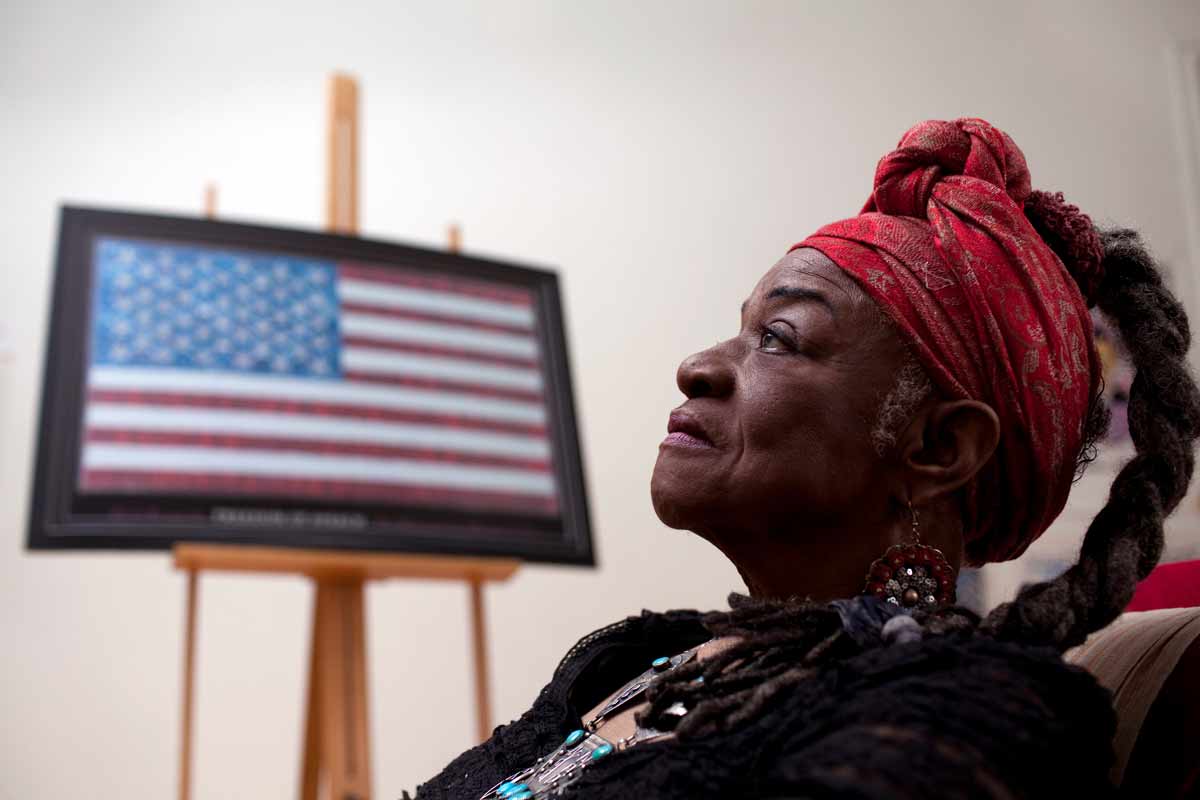
Interwove Art with Activism in her Narrative Quilts
Faith Ringgold, 93, the beloved and pioneering quilter, author, and multimedia artist, passed at her home in Englewood, N.J., on Saturday, April 13.
Born Faith Willi Jones on October 8, 1930, in Harlem, Faith Ringgold was a pioneering painter, mixed media sculptor, performance artist, author, teacher and activist whose powerful works address issues of race, gender, and social justice.
Ringgold’s innovative use of quilting and storytelling techniques revolutionized the art world by bridging the gap between fine art and craft traditions.
During the early 1960’s Ringgold traveled to Europe. She created her first political paintings, the American People series from 1963 to 1967 and had her first and second one-person exhibitions at the Spectrum Gallery in New York in 1967 and 1970.
Following a second trip to Europe in the early 1970’s Ringgold began making tankas (Tibetan paintings framed in richly brocaded fabrics), soft sculptures, and masks.
She used this medium in her masked performances of the 1970’s and 1980’s. Although Ringgold’s art was initially inspired by African art, it was not until the 1970’s that she traveled to Nigeria and Ghana to see the rich tradition of masks that have continued to be one of her greatest influences.
Ringgold made her first quilt, Echoes of Harlem, in 1980, in collaboration with her mother, Madame Willi Posey who was a prominent Harlem fashion designer. Ringgold’s quilts were an extension of her tankas from the 1970’s.
These paintings were not only bordered with fabric but quilted as well – a unique fusion of painting and quilting mediums. Ringgold’s first story quilt, Who’s Afraid of Aunt Jemima?, was written in 1983 as a way of publishing her unedited words.
The addition of text to her quilts had developed into a unique medium and style all her own. Over the next forty years Ringgold continued to innovate and reinvent her style, creating new original series of paintings and storyquilts at least once every decade.
Ringgold’s first children’s book, the award-winning Tar Beach, was published in 1991 by Crown.
It has won more than 20 awards, including the Caldecott Honor and the Coretta Scott King Award for the best-illustrated children’s book of the year. An animated version with Natalie Cole providing the voice-over was produced by HBO in 1999.
The book is based on the story quilt of the same title from the 1988 Woman on a Bridge series. That original painted story quilt, Tar Beach, is in the permanent collection of the Solomon R. Guggenheim Museum in New York City.
Ringgold was the recipient of over 100 awards and honors; author of 20 children’s books; and subject of the recent critically acclaimed touring exhibition “Faith Ringgold: American People” (2022–2024). Faith Ringgold has been exclusively represented by ACA Galleries since 1995.
Qiana Mickie: Growing Community Farms and Gardens in Brooklyn

By Fern Gillespie
The theme for Earth Month 2024 is “Planet vs. Plastics.” For Qiana Mickie, Executive Director, of NYC Mayor’s Office of Urban Agriculture, “Planet vs. Plastic” is part of her everyday mission of advocating environmental justice, urban agriculture, and food justice in the five boroughs.
This Hampton University marketing grad has spent almost 15 years promoting fresh, healthy, locally grown foods in New York City’s urban community gardens and farms. Since Mayor Eric Adams appointed Mickie in 2022, her Urban Agriculture Office has been situated in the Mayor’s Office of Climate & Environmental Justice. Our Time Press spoke with Qiana Mickie about the community impact of urban farms and gardens on Brooklyn.
OTP: How did you get interested in agriculture, urban gardening and food justice?
QM: My first job as a teen was pruning and weeding in city parks, playgrounds, and gardens throughout the five boroughs. As I got older, I continued to volunteer and learn more about environmental justice and social justice. When I became a mother, I began to see the differences in healthy food access between my current neighborhood, Harlem, and other parts of Manhattan.
I began volunteering with a group called Harlem for Change, which kick-started my interest in bringing farm fresh food into my neighborhood. This opportunity led me to community advocacy training provided by Just Food, a local nonprofit. As a community advocate and later, Executive Director of Just Food, I continued to learn and get more involved with food justice and policy on the city, state, federal, and international levels.
OTP: What are the benefits of turning empty lots in urban neighborhoods into gardens?
QM: Empty lots can often be eyesores in neighborhoods or if left unattended, can draw unwanted effects of neglected areas like garbage. Space is so limited in the city; we should be proactive about converting empty lots into havens for our communities. Red Hook Community Farm is striving to grow enough food for many people in their community.
Some urban farms are small businesses and have paid staff to manage the farm and operations. Urban gardens tend to be smaller in size and the land is stewarded by individual volunteer gardeners with the collective mission to grow edible or non-edible items like flowers for themselves or smaller number of community members.
OTP: What are some of the outstanding urban farms and gardens in Brooklyn’s Black neighborhoods?
QM: According to NYC Parks/GreenThumb, there are approximately 245 GreenThumb community gardens in the city network – the most in any borough! There are also wonderful gardens and farms in neighborhoods like Bedford-Stuyvesant and Brownsville, and East New York, such as East New York Farms and the Powell Street Garden, stewarded by the gardeners of Isabahlia Ladies of Elegance Foundation, to name a few.
I’m inspired by the youth leaders making great healthy compost and growing food on NYCHA properties like Howard Houses and Bayview Houses through the efforts of Green City Force and Compost Power. I hope everyone feels their neighborhood garden is outstanding and it’s our ongoing work to ensure more neighborhoods have great gardens and growing spaces.
OTP: You are involved with a City MWBE program dealing with urban gardening entrepreneurship. Why are you promoting urban gardening entrepreneurship for minority business owners?
QM: Many urban agriculture stakeholders have great skills that are needed such as growing, landscaping, and culinary arts. While many in urban agriculture like to volunteer their services, an increasing number of people want to leverage their skill sets and training to build a sustainable business.
As part of Mayor Adams’ M/WBE agenda, MOUA is building bridges to free resources and information sessions, such as the NYC SBS Jumpstart M/WBE information sessions, for eligible small businesses in food, agriculture, and sustainability, to help increase the city’s M\WBE vendor pool and improve pathways to city-based procurement.
New York City is a city of small businesses. Having more urban agriculture-based entrepreneurs in the city is what’s good for their business viability, New York City communities, and the environment.
OTP: What are some of your NYC urban agriculture successes since starting the department?
QM: In less than two years, we have developed and released the city’s first urban agriculture report; created the “Reimagine Farm to School in NYC” initiative – which is leveraging New York State and USDA Farm to School funds to increase agriculture education for students in the classroom and in urban/rural farms; and developed the city’s first farmer-focused training to help more small-scale New York farmers apply for school food procurement contracts.
The Farm to School effort is in collaboration with NYCPS Office of Food and Nutrition Services. MOUA has utilized this opportunity to demonstrate how to increase food equity in the school food pipeline and programming.
OTP: You outreach to schools. What is the feedback you receive from Black children on urban gardening?
QM: More time than not, I hear from students, including Black and Brown students, how curious they are about learning to grow food in gardens or indoor environments like hydroponics or aquaponics, and how excited they are to learn new healthy and tasty recipes from locally grown produce.
More and more, children want to learn from growers and farmers of color who look like them – and are especially excited to meet and see urban farmers working in their own neighborhoods. It makes urban agriculture much more tangible. The positive feedback from children and parents about having more access to fresh food and agriculture education is the inspiration for our continued efforts to reimagine farm-to-school activities and support the development of more learning and school gardens like the Learning Garden in Bergen Beach, Brooklyn.
America’s Dark Renaissance
View From Here
David Mark Greaves
Here we are trapped in America’s history of Europeans bringing to the continent an innate belief in White supremacy, the genocide of the indigenous people, the enslavement of Africans for four hundred years, Reconstruction, lynchings, Jim Crow, and then suffering its gradual suppression during the Civil Rights Movement.
And now White supremacists, emboldened by the authoritarianism of Donald Trump, see a chance to regain control of the country, where it will be led by those who lust for power over others, and with self-interested political and financial agendas and no use for democracy.
So we are engaged in a battle with the darkest part of the American experience, fighting an enemy who has active international allies, primarily China as FBI Director Christopher Wray recently testified, who enter our social media and use sleight of mind to shape our behavior and world view.
Regarding African Americans, John Henrik Clarke said in a 1996 Our Time Press Interview, “If Black people don’t unite and begin to support themselves, their communities and their families, they might as well begin to go out of business as a people.
Nobody’s going to have any mercy. Nobody’s going to have any compunction about making slaves out of them.”
That is true for Blacks and the majority of White people should take note and see it as a metaphor for what Trump and his minions have in store for them because it’s not just White supremacy now, it’s authoritarianism, which means they’re coming for you.
They’ve already started with banning books and abortions and making it harder to vote.
This is a battle we must win as a nation, and yet, since 50,000 votes in the “swing states” can decide the election, that victory is far from certain.
We can send money and moral support, but our big weapon, our vote, is a hostage in the Electoral College, an agitated spectator to the drama unfolding across the country.
What we can do, the majority who believe in democracy, the would-be abolitionists, suffragettes, and civil rights workers, is follow Dr. Clarke’s admonition and ensure our communities and families are strong and resilient, and our city, state, and federal representatives, have the mettle to prepare for and deal with the most dangerous enemy we have ever faced, the nation in the mirror.
One year on, how war is pushing Sudan towards famine
By Nita Bhalla
www.context.news
What’s the context?
After 12 months of conflict in Sudan, five million people face the risk of famine in one of the world’s most acute forgotten crises
More than half of Sudan’s population is in need of aid
Sudan has the largest number of displaced people globally
Five million people face famine in coming months
NAIROBI – In just one year, Sudan has been brought to its knees: thousands of people have been killed, millions have lost everything they own and with critical infrastructure reduced to rubble, five million people are now on the brink of famine.
Aid agencies accuse the warring factions of using food as a weapon of war and are calling on the international community to do more to help the millions caught up in one of the world’s most acute humanitarian crises, and one of the least heeded.
Here’s what you need to know about the conflict, how it has affected people and why a famine is now looming.
What triggered the war?
Fighting between the Sudanese army and the country’s main paramilitary group, the Rapid Support Forces (RSF), began on April 15 last year.
The army backs General Abdel Fattah al-Burhan, the de facto ruler, while the RSF supports his former deputy, General Mohamed Hamdan Dagalo, known as Hemedti.
Tensions arose between the two sides over disagreements on transitioning to civilian rule after the overthrow of long-time autocratic ruler Omar al-Bashir in a popular uprising in 2019.
Areas of contention include integrating the RSF into the regular armed forces and defining the chain of command and civilian oversight.
Both sides have blamed each other for starting the violence: the army accused the RSF of unauthorized mobilisation of forces, while the RSF said the army attempted a power grab with Bashir loyalists.
How have civilians been affected?
More than 13,000 people have been killed, according to the Armed Conflict Location & Event Data Project (ACLED), while more than 8.5 million have been forced to leave their homes.
Of those displaced, nearly two million have fled to neighboring Chad, South Sudan, Egypt, Ethiopia, and the Central African Republic. Even though the war is a year old, thousands continue to stream across borders every day, according to the United Nations.
For those who remain, time is running out.
The war has decimated critical infrastructure and crippled access to essential public services.
Now, nearly 25 million people – more than half the country’s population – need some form of aid.
Around 80% of hospitals are no longer functioning due to bombardments, supply shortages, and attacks on health workers.
Nearly 19 million children are out of school, while their classrooms have been repurposed as shelters for the displaced.
Water treatment plants, telecommunications towers, and power stations have been destroyed.
Prices for food, clean water, medication, and fuel have sky-rocketed, the Sudanese pound has lost more than 50% of its value, and people have no money anyway because nearly half the population is unemployed.
Why is Sudan on the brink of famine?
Before the conflict, Sudan was already facing a humanitarian crisis due to extreme weather shocks, social and political unrest, and rising food prices.
Humanitarian agencies say both factions are carrying out indiscriminate airstrikes, decimating food processing infrastructure and irrigation systems. Farmers are being attacked and forced to leave their homes and livelihoods.
Businesses, markets, and warehouses storing seeds, fertilizers, and grains have been looted, and in Khartoum, banks and shops have also been pillaged or damaged.
The expansion of the conflict into the breadbasket region of Al Jazirah state has also exacerbated the food crisis.
Now around 18 million Sudanese face severe levels of acute food insecurity and five million people in parts of Khartoum and Darfur face famine in the coming the months.
“We can use words like ‘famine-like conditions’, but to be brutally frank, this does mean children are already dying,” said Dominic MacSorley, humanitarian ambassador for CONCERN Worldwide.
Are they getting any help?
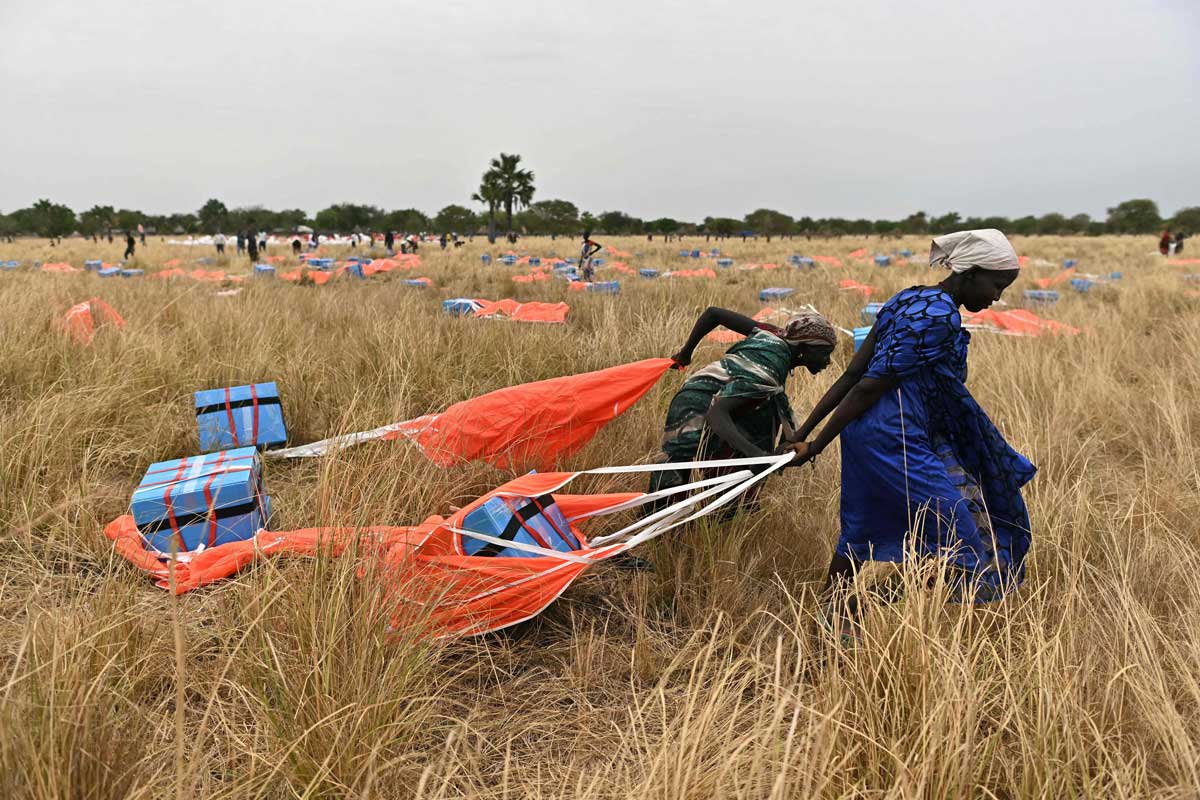
While several humanitarian organizations work in Sudan, getting to those most in need is very difficult. Aid is looted, offices and vehicles are attacked and staff risk injury or death by getting caught in the crossfire between the factions.
The World Food Programme says millions of dollars worth of aid was lost when its warehouses were looted and food and nutrition supplies, vehicles, fuel, and generators were stolen.
Since the start of the war, U.N. officials say there have been more than 1,000 incidents that affected aid operations, with more than 70% due to conflict or intentional violence against humanitarian assets or aid workers.
Can famine be averted?
Yes, but the international community needs to step up efforts to provide much-needed funds, aid workers say.
Only about 6% of the $2.7 billion needed for humanitarian aid has been provided by foreign donors, according to the U.N. financial tracking service.
Aid workers also need unfettered access to deliver food, seeds, fertilizers and tools to vulnerable communities.
Most importantly, the Sudanese need a ceasefire.
The prospects for peace, however, do not look promising.
Talks, led by the United States and Saudi Arabia, have so far come to nothing and previous agreements to protect civilians have not been heeded.
Foreign donors will meet in Paris on April 15 and aid agencies want immediate action from the international community to prevent famine.
“The Paris Conference cannot be one of empty and hollow promises,” Sofia Sprechmann Sineiro, secretary-general of CARE International, said in a statement. “It must result in decisive, meaningful, and inclusive commitments to respond to this devastating crisis to prevent famine.”
(Reporting by Nita Bhalla; Editing by Clar Ni Chonghaile.)