Home Blog Page 162

Bad Times

Netflix Good Times reboot backlash

By Nayaba Arinde
Editor at Large
Armchair activism has a new meaning.
Television viewers are being encouraged by Dr. James McIntosh and Betty Dopson’s Committee to Eliminate Media Offensive to African People (CEMOTAP) to Netflix and dial by picking up their remotes and their phones and cancel Netflix for over the new ‘Good Times’ animated reboot.


“The trailer was so bad we urged people not to look at any of the episodes,” activist and WBAI’s radio host of Mindfield, Dr. McIntosh, told Our Time Press. “However, people who watched tell me the episodes are diabolical and disrespectful. We are asking people to call in to cancel their Netflix subscription.”


An energetic CEMOTAP Zoom on Saturday afternoon, May 18th, had dozens of participants condemning the cartoon’s content.


The people who control the portrayal control the narrative.
The trailer itself shows the drug-dealing baby, a buffoon of a father, a mother portrayed as a little simple, an overly unintelligent son, a daughter who is a Black activist-type caricature, and there appears to be an overlying theme of celebrated ignorance.


To a barrage of criticism by groups like the NAACP, and New York and Ohio-based CEMOTAP, Netflix rolled out the ‘Good Times,’ last month. Rebooted 50 years after the original, the NAACP-panned animated version is still set in the Chicago projects.


“This show is the most embarrassing depiction of the worst racist stereotypes you can think of,” former Assemblyman Charles Barron told Our Time Press. “Voicing a character Wanda Sykes, and producers Steph Curry and Seth McFarlane should be ashamed of themselves, but they are not.” Councilman Charles Barron said that the focus should be on the real decision-makers.


“They are using Steph Curry as a flack-catcher; he doesn’t make cartoons; he is a basketball player. McFarlane and Ted Sarandos do make shows. Anybody who has Netflix should cancel it and tell them why in a letter.”


The showrunner Ranada Shepard told The Hollywood Reporter, “Just watch the series, please, just give it a chance. Because there’s so much good there.”
Omowale Clay, Chairperson of the December 12th Movement Human Rights organization, told Our Time Press that Black people should never allow dehumanizing depictions of themselves, which have a deeper intent and focus.


“Whenever we are attacked, we must fight back. This is sanctioned. Black elected officials can get on this. It is safe for them. Netflix has already produced all the episodes, so the City Council Black, Latino Asian Caucus can easily say something about this because it is such a blatant attack on Black people.


“It is not a question of if we can fight back. We must. The first wave of genocide is to dehumanize a people. And that is what they are doing.”
Brooklyn City Council Member Crystal Hudson, co-chair of the Black, Latino, and Asian Caucus, did not respond to Our Time Press by press time.
‘Good Times’ fan faves include the late Esther Rolle, Bernadette Stanis, Ralph Carter, Janet Jackson, J.J. Walker, and John Amos.


The cartoon characters’ voice-over actors include Wanda Sykes, Marsai Martin, Jay Pharoah, and J.B. Smoove.
Bernadette Stanis (Thelma Evans) told TV host Sherri Shepherd that she was asked to voice a character, she was told that the new show is about the grandchildren and the great-grandchildren of the original cast, “Jimmy [J.J. Walker] and I, did a tiny little because we thought it would be something else… But when I saw the trailer, it was totally different because the two generations were so positive.

I was going to be a doctor. Jimmy was going to be a famous painter, and [Michael] was going to be a mayor or a judge. But, when we saw what the second and third generations were going to be, it was nothing like what we thought.”
There are thousands of cable, network, streaming, and internet options. At any given hour of the day or night, anti-Black community content can be viewed or heard.


Meanwhile, Black media is already under assault in New York. The local and national golden age of Black media with Black newspapers and radio has been somewhat decimated, and so having mainstream media feeling comfortable to disparage a culture so blatantly is what is inspiring the campaign to cancel subscriptions.


Dr. McIntosh said that the ‘Good Times’ reboot is just not funny. Not incisive. It is not empowering, and despite all the pronounced Black involvement, it is racist in its delivery, if not its intent.
In an open letter to Netflix co-CEO Ted Sarandos, CEMOTAP Co-Chairs Dr. McIntosh and Sister Dopson expressed outrage at the “ill-advised and ill-named release of the Netflix ‘Good Times Reboot.’”
They slammed the “superficial and negative relationship to the original ‘Good Times’ TV series.”


They further critiqued Sarandos and Seth McFarlane as “ridiculing” African people, which historically “has often preceded actual violence against the people ridiculed.”
With meticulous detail CEMOTAP listed points of concern, including portraying Black people as ugly and stupid; violent, and criminal from birth; rude, crude, lewd, and hypersexual.


CEMOTAP concluded in the letter, “Since you have released all ten episodes of this atrocity, there is no room for negotiation. We are going …to withhold our dollars from your enterprise.”
Dr. McIntosh and CEMOTAP are encouraging folk to call Netflix and cancel their account, circulate their open letter published (pro bono) in Our Time Press (May 16th, 2024), participate in their Zoom on Saturday, June 1, 2024, and attend their Wednesday, June 5, 2024, demonstration at the Netflix Corporate office on Broadway in Manhattan.
Harlem Honors Malcolm X In the Streets!

By Amadi Ajamu
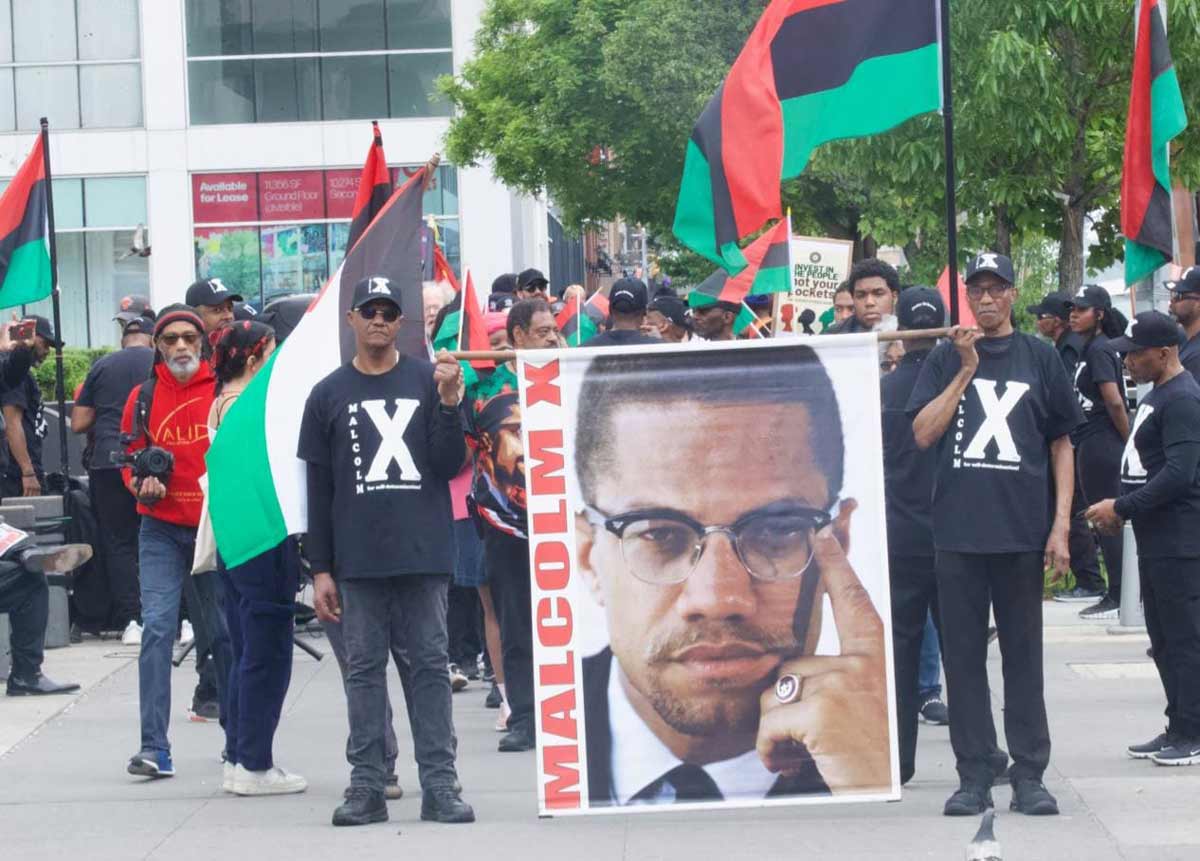
The 34th annual May 19th Malcolm X Birthday Black Power rally and march gathered in front of the Adam Clayton Powell Jr. State Office Building on 125th Street at high noon to rally before the “Shut ‘Em Down March to close businesses on 125th Street, in a ‘Commercial Moment of Silence’. in honor and respect for Malcolm X on his 99th Birthday. Under the organizational leadership of the December 12th Movement, over 95% of the stores were informed and shuttered at the appointed 1 PM start time and remained closed until 4 PM.


A broad coalition participated in this annual gathering of organizations and communities who have faithfully and consistently demonstrated their love and respect for Malcolm X on the streets of Harlem, where he taught and fought for the Black nation, including Palestinian Solidarity veteran and student organizations, Life Camp, Man Up! and Stop The Killing anti-violence activists, Malcolm X Commemoration Committee, For Our Liberation, Black Men Building, veteran Black Panther Party activists, Free Mumia Coalition, community activists, everyday concerned people of New York and many others who traveled from out of state to attend.


As the throng of marchers made their rounds up and down the 125th Street corridor, behind the Malcolm X banner, waving the Red, Black, and Green Pan African flag and, in a show of solidarity, the Palestinian flag, they encountered several stores that resisted the community demand for a ‘Commercial Moment of Silence’ and had to be firmly reminded. So, they stopped and paid them a visit, chanting, “Shut ‘Em Down! No Disrespect for Malcolm X!”


A small delegation then entered these businesses, including Banana Republic, Ashley Furniture, Wing Stop, H&M, and KFC, and had a thorough discussion on community relations. Subsequently, they understood their mistake, acquiesced, and pulled down their gates. KFC even had to give their customers their money back! “Black Power! Whose Streets? Our Streets!”


The few diehard businesses that remained adamantly opposed to honoring Malcolm X’s legacy and refused to close were CVS, DSW, Blink, Captain Louie’s, and the Deli on the corner of 125th St and 5th Ave. They will need follow-up attention.


At the closing rally, Omowale Clay, Chair of the December 12th Movement, stated, “Before October, it was a different world; after October, it’s a whole new world. Look at West Africa, from Burkina Faso to Niger, to Mali, to Chad; they are throwing off the yolk of French imperialism. If African countries changed their currencies tonight, France would collapse tomorrow. Just like reparations would break the back of U.S. imperialism.


But, we came to celebrate Malcolm. We told our comrades who were fighting for the liberation of Palestine that history didn’t start on October 7th. It’s always helpful when you can start history when you want it to.

We know when the history started with the Nakba. We understand what it means to be under the heels of fascism. Today people are talking about fascism because it has moved into the white community. Colonialism is fascism. The Trans-Atlantic slave trade was fascism. Lynchings in Alabama are fascism.

Police murders of ten-year-old kids are fascism. We also understand it can get worse because it will be Black people and people of color who will be the scapegoats of the decline of America. The ones that actually built America. They’re now getting ready to blame us for the fall of America.


Last year, our revolutionary hero, Viola Plummer, was right here. She taught us very well. She said, ‘Never give up.’ She said, ‘Finish the gig.’ So what was she saying to us? We learned a lot of lessons in Ferguson, MO. Little Ferguson outside St Louis, where they drove Black people out.

Where a local government was still controlled by white folks, Little Ferguson rebelled, and they cast a shadow across the whole world. Because they were determined to throw oppression off. Little Cuba sits there in the middle of the Caribbean. But it casts a massive shadow across the whole world.


Why? Because the people are united. They united to end imperialist rule on their land. But to do that, they needed a structure. All of us who consider ourselves revolutionaries must build a structure. We have got to fight for some ideological unity.

How do you think October 7th happened? All of their mechanization and technology, and their ‘superiority’ fell flat. Because there was a structure that has been fighting since the beginning of the Nakba in 1948.”
As we move toward Malcolm X’s centennial next year, Clay proposed beginning this structure by building a United Front Against Fascism.


For more information, contact the December 12th Movement at (718) 398-1766 or D12M.com

Commissioner Dr. Ashwin Vasan Warns of Social Media’s Mental Health Dangers for Youth

Fern Gillespie
New York City youth are facing a mental health crisis, and City agencies are pointing to social media as part of the problem. Mayor Eric Adams’ administration has filed a lawsuit to hold five social media platforms — TikTok, Instagram, Facebook, Snapchat, and YouTube — accountable for fueling a nationwide youth mental health crisis.

New York City has joined hundreds of school districts from across the country in filing litigation seeking to force tech giants to change their behavior and to recover the costs of addressing this public health threat. The city spends more than $100 million on youth mental health programs and services each year.


Research has shown that social media can sometimes have dangerous mental health effects on Black youth. A study conducted at Yale School of Medicine said Black teen girls using social media platforms often experience “racism and bias, such as being associated with Black stereotypes, cultural invalidation, and being accused of ‘acting white.”

Many of the Black teen girls also believed that their hair type or skin tone wasn’t valued because “mainstream narratives perpetuate white normative beauty standards.” The Journal of Applied Developmental Psychology found that Black teens reported experiencing an average of five instances of racial discrimination per day, mostly online. A study by the Society for Adolescent Health and Medicine reported that African American and Latinx adolescents aged 11–19 years have experienced depression and PTSD symptoms from being exposed to traumatic events online.


Our Time Press concludes its three-part series on “Black Youth: Computers, Coding and Social Media” with Dr. Ashwin Vasan, Commissioner of the New York City Department of Health and Mental Hygiene, discussing why he believes the unfettered access and use of social media by youth is a mental health hazard.


Why was it important that the Adams Administration file a lawsuit against social media tech giants for having a damaging mental health influence on New York children?
From setting dangerously unrealistic expectations of body image, to catalyzing and accelerating bullying and abuse, to causing social isolation and exacerbating depression and anxiety, we know that social media can have dangerous ripple effects on our young people. We are working to hold companies accountable while giving communities the tools they need to support healthy habits for the next generation. But it will take all of us to shift the culture.


Why do you think there is a mental health crisis for NYC youth? During 2021, The Adams administration reported that 1 in 10 NYC high schoolers reported a suicide attempt. Also, 38 percent of the city’s high school students reported feeling so sad or hopeless–almost 70 percent higher for female students. Why was the rate of hopelessness higher for NYC Latino and Black students?


There are so many things that impact youth mental health, and while we continue to explore the many factors we are committed to expanding access to mental health resources for students, like NYC Teenspace —a free digital mental health resource for anyone with a New York City zip code between 13 to 17 years old.
Do you think experiencing the COVID crisis and being quarantined had an impact on youth’s increase in social media and also mental health?


The effects of the pandemic will be studied for years to come, but we know the disruption to important social connections and routines had a profound impact on young people.
How can social media tech giants make their platforms safer for young people?
Social media companies can put in place design safety features that protect the mental health of young people and remove toxic elements, while still offering the benefits of community and support to young people.


What do you consider healthy social media use for young people? What is healthy screen time?
There is not enough evidence to determine if social media is sufficiently safe for children and adolescents at any age. We understand that these sites can foster community, but unregulated access can have damaging impacts on still-growing minds. Using the features within these apps, like privacy settings, blocking content that you find distressing and setting limits on screen time can help; stepping away from a screen and engaging with the community around you can be a positive switch.


Reports state that social media use now begins with infants. What is the most important rule that parents and caregivers can do to safeguard youth on social media?
Families have to decide what works best for them but we encourage delaying access to social media until at least 14. For New York City teenagers, that means shifting to high school, commuting more and increased independent socialization.


How can educators, healthcare workers, faith leaders and community organizations get involved in creating positive outlets for youth to balance their use of social media?


As a doctor, as a public servant and, above all, as a parent, I want to do everything I can to protect kids and families. I know firsthand that it can be difficult to navigate these conversations but I encourage open-minded conversation about social media use, and for adults to lead on screen-free time. It’s not always easy, but I make an effort to be present and off my phone while I’m with my own children.


For more information on NYC youth and social media, check out the advisory issued by the NYC Department of Health and Mental Hygiene that includes links to toolkits and curriculum.

Designer’s Brooklyn Sightings Help Set BAM’s Stage for DanceAfrica’s Authenticity

By Bernice Elizabeth Green
What attracts audiences to BAM’s DanceAfrica year after year are the quality performances and the fullness of an experience that is beyond entertainment.
And the evidence will be in full view this Memorial Day weekend, May 24-27, when DanceAfrica 2024: The Origin of Communities/A Calabash of Cultures, under the artistic direction of Abdel R. Salaam, comes alive on stage in BAM’s Howard Gilman Theater, 30 Lafayette Avenue. (Tickets and Information: BAM.org/DanceAfrica)


Baba Salaam and BAM have brought together several events in its showcase this year, including Community Workshops and Classes, May 25-30; the Late Night Dance Party, May 25; DanceAfrica Bazaar, May 25-27; and FilmAfrica, May 24-30.


On the line-up are the DanceAfrica Spirit Walkers, The Billie’s Youth Arts Academy Dance Ensemble, and the Women Of The Calabash. The artistic vision is brought to life with costume designs by Wunmi Olaiya, lighting design by Al Crawford, music and sound design by David Margolin Lawson, creating an immersive experience that celebrates the depth of Cameroonian culture and set design by Jasiri Kafele.


Where the “fullness” actually wells up is in the soul and vision of Baba Salaam, starting from when he, as a journeyman, gathered inspiration and research for the BAM presentation. As a culture caretaker, he usually returns to America from a region in Africa, carrying a calabash of memories, but choreography is not always distilled from “steps.” In fact, when he observed the dance movements of the Baka People of the equatorial rainforest of central Africa, he said, “It was like looking at a group that was improvising everything that they did.” And this has been carried down the line through hundreds of thousands of years.


So, when Baba returned to the United States this year, the souvenir he brought back was the “relic” of experience and the memory of it. How could that experience be reinterpreted on stage? It was up to the set designer to convey to BAM audiences Baba Abdel’s vision and experience. That set designer is from Brownsville.

He never set foot in Africa, never traveled to a rainforest, and grew up immersed in Brooklyn’s 1980s Hip Hop and art movement scene in BAM’s Fort Greene neighborhood. Yet, his background fulfilled the requirements.
In some ways BAM set designer Jasiri Kafele, introduced by Abdel to Our Time Press, on Tuesday, is as close to the Rainforest as anyone can get.


“Never been to Africa, never been in a rainforest,” he told us, “But I am part of a community that, with the drumming, the dancing, the singing, the words, is privy to the aesthetic.”
Born at Brookdale Hospital and raised in Brownsville, Kafele says of his interest in art, and his craft skills, “Everyone has a throughline skill; art always has been mine.” At first, he says it started out as recreational with his interest in the Hip Hop scenes around Brooklyn. “Poetry led me into graphic design. From that interest came photography. I worked with others in Fort Greene to start the Black Arts and Culture movement.


“We did poetry at the Brooklyn Moon, Royston’s, Frank’s Place, while Moshood hosted fashion shows up and down the street.” So, with this background, BAM, may not have been on his planned path, but it was within reach.


Within the last few years, Kafele, a decorative painter by trade, has worked on DanceAfrica. Many DanceAfrica followers may remember a set with an array of Adinkra symbols. And there were the DanceAfrica performances with the now famous Olmec head. Those were Kafele’s designs and executions. But this year, Salaam challenged Kafele with the idea he brought back from where the Baka people call home.


“The way this works,” Kafele told us, “Abdel gives me info about an idea he has and the idea for the art itself. My job is invested in making sure his vision comes to life. Once I get lost in the concept of how it can be done, I am committed.” But this year, Abdel asked Kafele for an idea that quadrupled the size of any other set design he had worked on for Dance Africa.
“He sent me pix of his trip and said, ‘I want a rainforest.’”


In a previous interview, Abdel told Our Time Press, “I’m looking at how we survived in this environment for thousands of years. Visiting a village in the Baka region, the trek for DanceAfrica was not only to note and code the dancers but also to experience the very origins of civilization and “discover how we survived in the environment for so long unaffected.” The Baka people never leave their villages. They lived as their ancestors lived thousands of years ago.


Baba told Our Time Press, that it was the forests that “nurtured, protected and healed.” It, in effect, was their lifeline. He said the roofs of the huts are made of long, palmy leaves, no nails. The solar panel is the sun itself. The stage was the ground itself. At night, the stars and moon, after campfires expired, were their flashlights.


But with a limited budget, “you can’t just go out and purchase a forest,” Kafele told us in jest, adding, “So you start thinking what you want to do, and the stage tells you what it wants to be.”
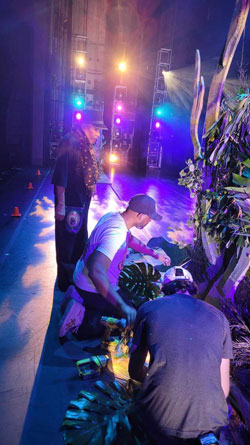
This weekend in the Gilman auditorium, attendees will be looking at lots of foliage, real, not plastic, and it will maintain its composure and color. Already set up, Kafele assures it will look the same at showtime. I selected them according to their size, thickness, and ability to withstand time. The leaves are hardy.”


And the huge shadowy tree renderings? “Those were my first 30-foot trees. I made them based on trees in my neighborhood. I free-styled.”
Kafele told Our Time Press that part of the foliage creating the Baka hut Abdel described to him was from a downed tree in Philadelphia. “We were driving and spotted the tree at the side of the road. I hopped out and put it in the back of my vehicle.”


So, you saw your assignment, you saw Africa…not only through many picture books but … right around you, we offered. Kafele responded, “Well, that is exactly the point. Of course, there are changes while you are doing what you are trying to do.”
An inspired Abdel has merged his and Kafele’s vision of the DanceAfrica rainforest with the 2024 DanceAfrica presentations. “There is this particular dance with raffia, a huge rounded raffia wrapped around them from the neck all the way to the floor. There are turns, winds and spins as the raffia swirls. It looks like the raffia is growing.”


There will also be a Spirit Walker dance, combining West African movement, Hip Hop, and some house music fused together.
But one of the stars, too, will be BAM’s rainforest scenery, Kafele’s design interpretation of Abdel’s memory of a sustainable fixture of nature – the rainforest.

Total $7 Million Boost for Bed-Stuy Needs

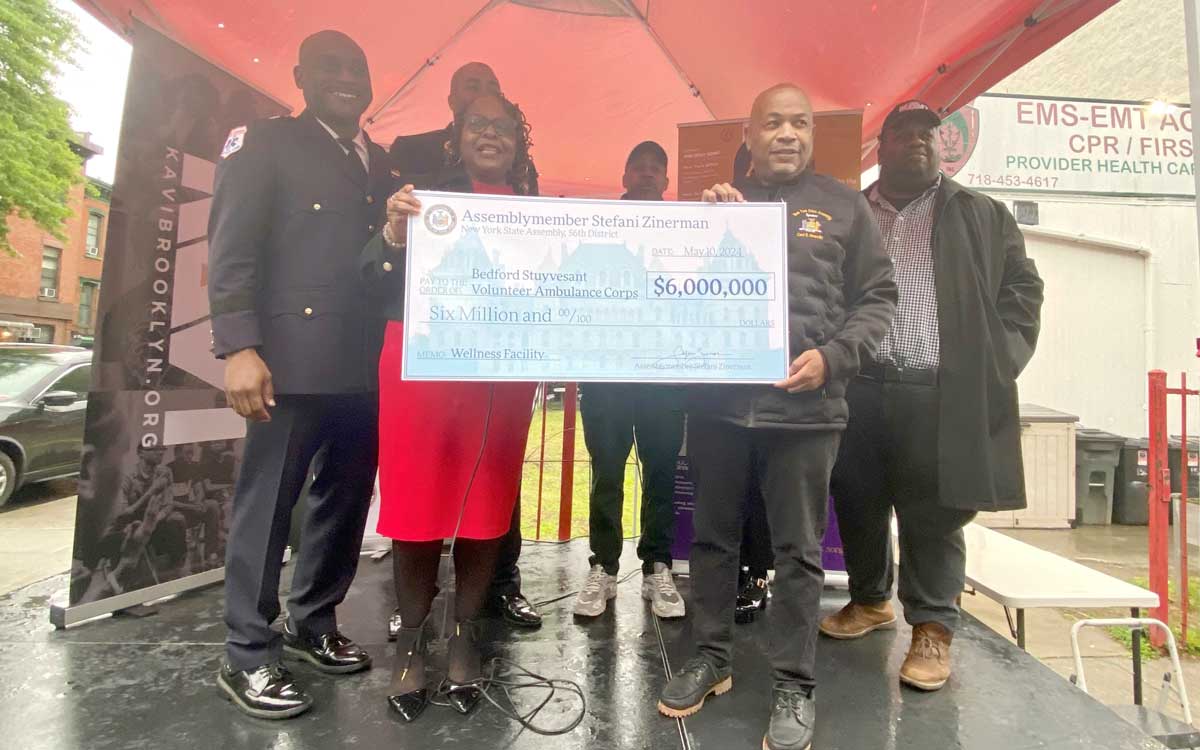
Speaker Carl Heastie and Assemblymember Stefani Zinerman, last Friday, announced $6 million in funding for the Bedford Stuyvesant Volunteer Ambulance Corps (BSVAC) facility, a new multi-service health and wellness center for Bedford Stuyvesant and surrounding communities.

“For decades, the federal government has gotten out of the business of supporting public housing in New York City and throughout the nation,” Leader Jeffries said. “And as a result of that fact, there are a whole host of infrastructure repairs, capital improvements, and modernization projects that have lacked the resources in order to improve the quality of life of residents. I’m proud that we were able to fight hard and secure $1 million in support of fire safety improvements at Marcy, and an additional $850,000 to secure fire safety improvements at Tompkins, and together be able to overhaul completely the fire safety infrastructure for thousands of families in these two incredibly important developments.”
-Congressman Hakeem Jeffries


“The Assembly Majority remains committed to providing for families across our state and that means ensuring access to equitable and affordable healthcare,” said Speaker Heastie. “Assemblymember Zinerman fought hard for this funding as she understands this investment will expand critical care, maternal support and violence prevention efforts in communities that need it most.”


“BSVAC represents the best of us,” said Assemblymember Zinerman. “I’m honored to be here today to thank them for all they do and commit $6 million to support their lifesaving work in our community. This investment will not only help us expand emergency services, but it will also provide more support to mothers and ensure access to care is never a problem in Bed-Stuy.”