

by Segun Shabaka
Assata Shakur’s passing last week was a bittersweet moment in that we lost a Black freedom fighter who joined the ancestors but will more so be remembered as the Black woman who escaped captivity to live free for four and a half decades out of the reach of a $2 million United States bounty on her life.
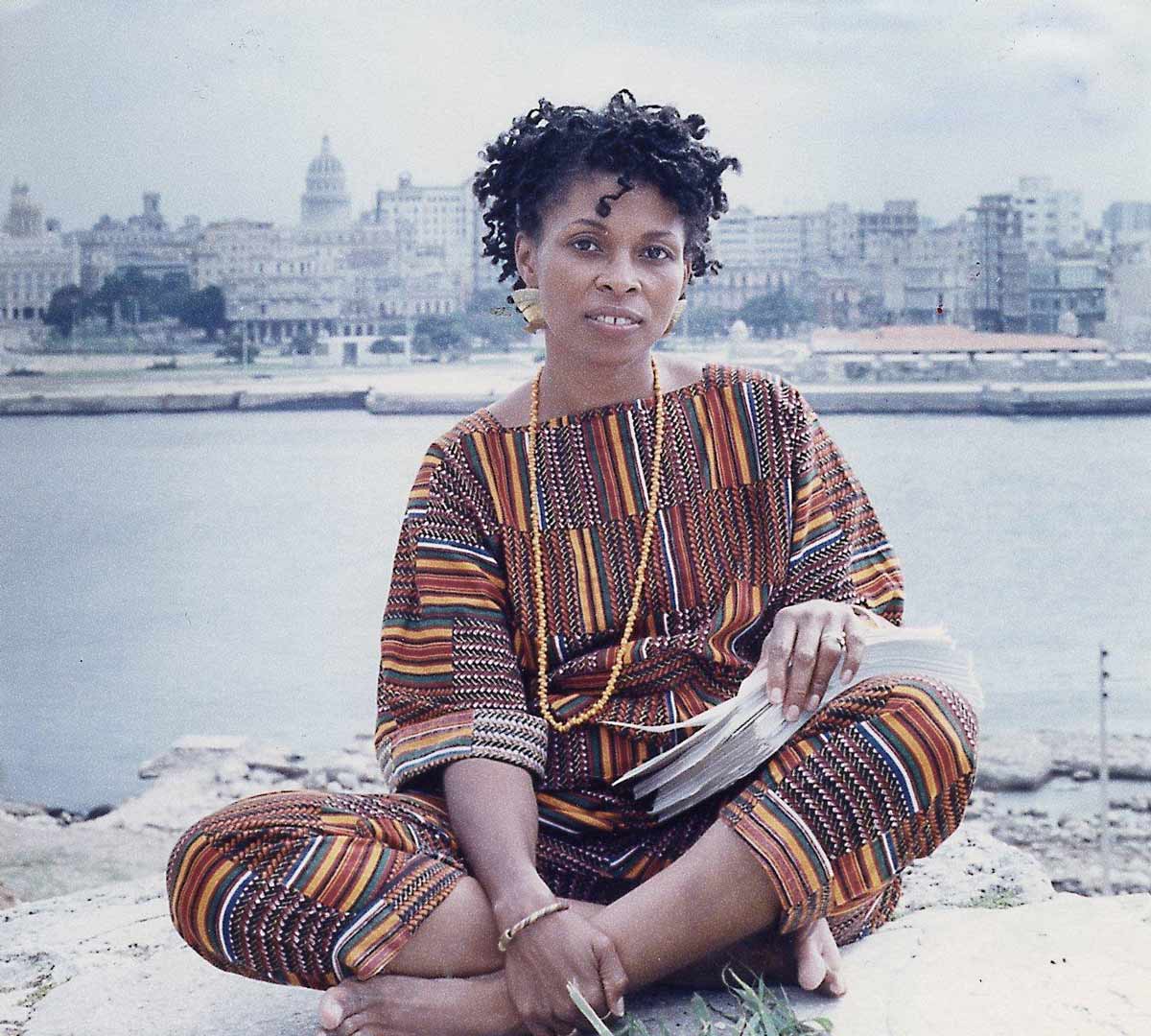
I met Assata Shakur once in Cuba, while traveling there in 1985 as an undergraduate student with City College. If one were to see the photo we took, you would think we were old comrades (and in some ways we were). As many of us visiting students and staff sat to take a picture with iconic sister, the unexpected happened when my turn came.
Assata put her head on my shoulder. The noise and words of surprise that ensued from crowd could be heard throughout the venue. I smiled. I often wondered who had a copy of that picture. It, in addition to photos I took with Prime Minister Maurice Bishop of Grenada a few years earlier, are pictures I wish I had copies of. Because of her safety I never tried to connect with Assata again on my many visits to Cuba.
It wasn’t as if Assata Shakur and I did not have some history. While teaching at the EAST’s Uhuru Sasa Shule, under the direction of the visionary headmaster and institution builder, Jitu Weusi, we took a group of students to her trail in New Jersey. We were in the back of the courtroom where she was barely visible.
The East’s history was rich with supporting all segments of our community, including our forgotten incarcerated family. (Remember what Haji Malcolm X taught us – “America means prison.”) At the East, we not only sent free copies of Black News, but also offered employment once freed and allowed for memorial and funerals at our facilities.
But it was when Sister Assata was incarcerated that I as editor (from 1978-1985) of Black News and Executive Director of the East became more involved and entangled in her case. When Assata was freed from prison I received and published in volume 4 Number 11 edition of Black News a statement from The Movement, another from the Black Liberation Army Coordinating Committee as well as a Black Solidarity Day Statement from Assata herself, along with her picture on the cover with ASSATA LIBERATED.
This put us on the Joint Terrorist Task Force list. A few years later we received a letter on the Justice Department’s stationary that they had tapped our phone for 2 years. The East organization had already experienced a number of spies and infiltrators.
This was heightened when Bibi Angola, who was part of Assata’s legal team came to my office in the early part of 1979 for assistance in putting out a book on Assata’s writings entitled, Assata Speaks, which was published several years before Assata’s autobiography (’87). The FBI was further under the false impression, based on the agent/informant Sayeed they planted into Bibi Angola’s life by flattening her tires that Assata Shakur was being harbored in the Uhuru Cultural Center at 357 Marcus Garvey Blvd., formerly Sumner Avenue. This would lead to a late April of 1980 massive conversion and raid by the FBI on the Harlem home of nurse Ebun Adelona.
These plans started as agent/informant Sayeed continued to lie that Assata was being harbored in the Black News office in the armory over several weeks we were working on the book. With these lies, he stayed out prison and was given money, several vehicles (he crashed) and other resources. It came to a head when former EAST member Shukuru came to town.
She made several calls on the Black News phone to plan a gathering with her nursing friends on that Saturday evening at the Harlem home of Ebun. We are pretty sure they mistook Shukuru to be Assata.
Earlier that day while in a class at the Uhuru Center I received an urgent call from Afeni Shakur (Tupac’s mother) warning me that ‘if I had anything in the Uhuru center, I needed to get it out because the FBI was about to raid it.’
Later that day the Harlem raid took place. That raid in late April of 1980 was supposed to take place at the Uhuru Center but the hundreds that gathered every Saturday at the armory and fear of a community backlash delayed it. Sayeed went back to prison and Assata would surface to safety in Cuba in 1984.