

By Mary Alice Miller
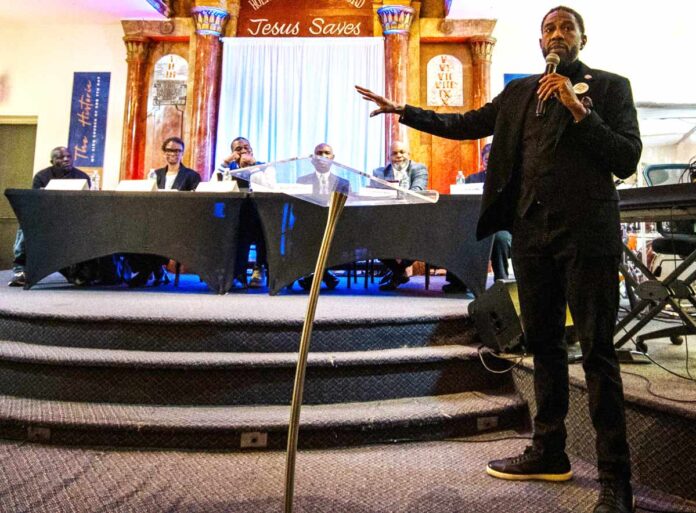
The Brooklyn Center for Quality Life recently hosted a national online forum entitled “Immigrants Are the Bargaining Chip Keeping the Government Shut Down: Long Lines, Empty Wallets, and Political Games” to discuss their “Don’t Shut the Door” Campaign and the impact of immigration on Black communities.
The federal government remains shut down, and according to the BCQL, “immigrants are being used as the bargaining chip to reopen it. The fight over immigration policy has brought the machinery of government to a grinding halt, with real consequences for real people: TSA workers going unpaid, airports in chaos, and families in our own congregations living in terror. And the White House is making it worse.”
Pastor Gilford Monrose opened the forum by describing the purpose of the Don’t Shut the Door campaign.
“As proud citizens of the Caribbean, Afro Latinos, and Africa, we commit to supporting and uplifting our brothers and sisters who are still navigating the immigration system or living undocumented. We believe in keeping doors open, advocating for justice, and creating pathways for a brighter future for all,” said Monrose.
Monrose said, “We are in a peculiar situation. Never before in the history of the work we have been doing we have immigrants who have been naturalized or first or second generation who are now saying we are going to close the door behind us so you are breaking the law by being undocumented and should follow the law.”
Monrose continued, “This kind of message is dangerous and damaging to people who need to go to houses of worship to find hope, inspiration, aspiration. We want to define the role of faith leaders in advancing just and humane immigration policies and build solidarity across congregations throughout America.”
Brian St. Jean, Community Outreach Coordinator for the NYS Office for New Americans (ONA) spoke about services offered.
The NYS Office for New Americans, founded in 2012, is the nation’s first statutorily created immigrant services office. It assists all new Americans with accessing and navigating a variety of free services and support through a statewide network of community-based providers.
“We help fund community-based organizations throughout NYS to provide the services that we offer,” said St. Jean.
According to the ONA website, New Americans are immigrants, refugees, asylees, undocumented individuals, and all new comers who reside in the United States. Many New American families are mixed status, meaning different family members have different immigration status.
About 25% of NYS residents are immigrants.
St. Jean outline ONA’s program areas: citizenship and civic engagement; developmental disabilities services; English language learning; immigration legal services; mental health support; and workforce development.
Pastor Mullary Jean-Pierre talked about Temporary Protected Status (TPS), and its impact on Haitians.
“TPS provides lawful immigration status and work authorizations to individuals who cannot safely return back to their home countries,” said Jean-Pierre. That is the situation with the Haitian population. We cannot return back to our home country for many, many years.”
Jean-Pierre spoke about the conditions that make it dangerous for Haitians to return to the country, from the 2010 earthquake where about 250,000 Haitian citizens lost their lives, to current widespread gang violence and political instability which has led to a humanitarian crisis with rape, underage gang members who have guns.
Jean-Pierre said, “We don’t have a stable government, a political structure that can receive people, the 350,000 Haitians who are now TPS holders. With the collapse of essential public institutions, we don’t have enough institutions to be able to help 350,000 Haitians who may be deported.”
Concluding his presentation, Jean-Pierre said, “We can’t go back because of the conditions, but we’re adding value to the country here. If they deport them you’re going to weaken or worsen the labor force, disrupt business operations because the sectors that we dominate most in is hospitality, hospitals and airports.”
Bishop Orlando Findlayter said when a group of local clergy started in 2009, “advocating specifically and primarily for Black immigration reform, people from the Caribbean, Central America, South America, and Africa. Why? Because when people hear immigration, normally two things come to mind: the Latino community and people coming across the border. People forget that New York is a border state. No one talks about the northern border. People cross the northern border all the time.”
Findlayter pointed out that “most people from the Caribbean, Central America, South America, and Africa don’t cross a border. Their entrance to the United States is a Visitor’s Visa. They apply for it, get it, come here, and overstay that visa. The reason most people overstay the visa is because the legal immigration system is broken.”
Findlayter said, “There is a need for comprehensive immigration reform. People who want to do the right thing are told to get to the back of the line. What line?”
Findlayter gave statistics on the population of undocumented people in the United States and their tax and consumer spending contributions on the national, state, and local levels.
“We don’t say illegal alien. We say undocumented. Language matters. Illegal alien designation is designed to dehumanize a person. If I can dehumanize you, I can mistreat you, use you, abuse you, and then disregard you,” said Findlayter. “We want to educate, train, and support faith leaders. Let us work together to provide you with the information so that you can equip your members, your parishioners, your community on how to navigate this complex system.”
Findlayter pointed out that, “The president and vice president are not against immigration. They are not against immigrants. Both of them are married to an immigrant. They’re just against immigration from certain parts of the world.”
There are 44 countries in the world where you don’t need a visa to come to the United States – 40 of those 44 are European countries and 4 are Asian countries. Not one country in Africa or the Caribbean can you come here without a visa.
“We are asking faith leaders to work with us to call this what it is: the immigration policy of the United States is racist in nature. If they dehumanize us that is an excuse to abuse us,” Findlayter said.
“We want to gather monthly, clergy and community, to work together to figure this out,” said Findlayter.