
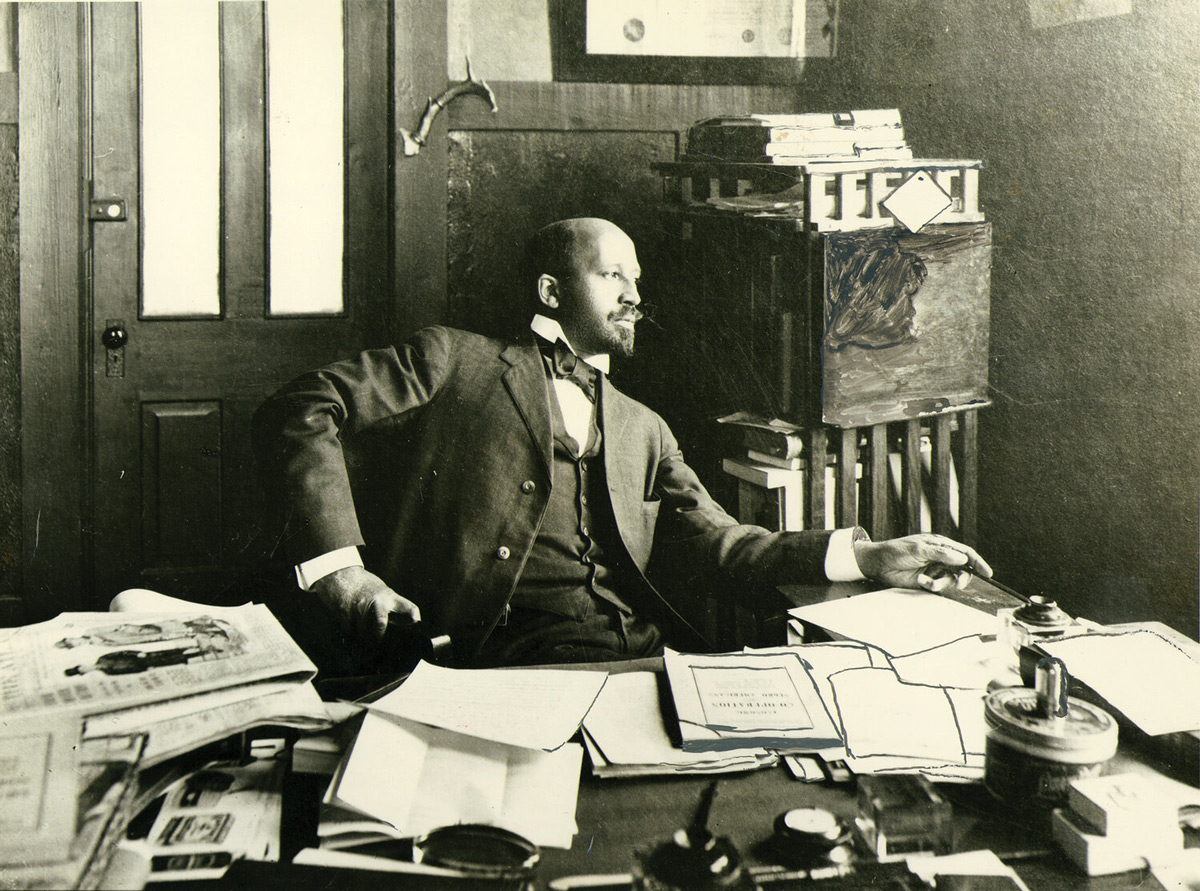
On the 155th Anniversary of W.E.B. DuBois’ February 23 Birthday
Brooklyn’s Delano Burrowes delivered Simon’s Rock 2023 Annual W. E. B. Du Bois Lecture
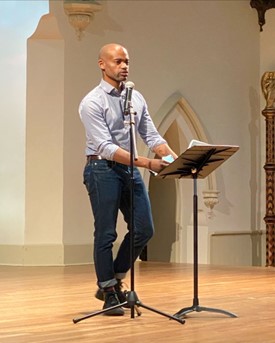
On February 20 at 7 pm, Brooklyn-based writer and artist Delano Burrowes delivered the 26th W.E.B. Du Bois Memorial Lecture at Bard College at Simon’s Rock.
The talk, entitled, “The Languages Black Folks Speak: Letting Go of the Myth about Finding our True Voice,” was given at the college’s Daniel Arts Center.
Burrowes, who grew up in Great Barrington, connects his work to Du Bois’s concepts of double consciousness and “how Black people internalize the idea that their existence is inherently seen as a problem.”
Burrowes is the nephew of the late Reverend Esther Dozier, the first female pastor of Clinton A.M.E. Zion Church’s, now the DuBois Center.
Under Rev. Dozier’s leadership, the Church promoted Black history and the life and legacy of W. E. B. Du Bois, who had been largely ignored in his hometown for decades. Dozier who initiated the town’s annual celebrations of Du Bois that continue today.
The annual lecture, established by Bard’s College in 1996, is free and open to the public.
The War Within: DuBois’ struggle with First World War Examined in New Book
Yesterday, February 22, on the eve of Dr. W.E.B. DuBois’ birthday, historian Chad Williams, in a virtual talk, explored DuBois’ complex relationship with the history and legacy of World War I.
For nearly two decades, DuBois attempted to write what he believed would be the definitive history of the African American experience in World War I. He started the work, but never completed it.

He struggled with his early thinking — that African Americans full involvement in, and support of the Allied cause, would lead to “democratic change” and “full citizenship” or a better life in America. For many decades, says Williams, DuBois was haunted by his original thesis and struggled with his original stance.
Williams’ forthcoming book, The Wounded World, is described as “a sweeping story of hope, betrayal, disillusionment, and transformation” in its examination of “one of the most significant scholar-activists in African American history.”
In revealing a side of DuBois rarely talked about, Williams also shared World War I and what it reveals about the struggle for democracy, racial justice, and peace in the 20th century.
Dr. Williams is the Samuel J. and Augusta Spector Professor of History and African and African American Studies at Brandeis University. He was one of two dozen scholars who participated in the Center’s inaugural Du Bois Forum retreat last summer.
Historical Reckonings
As an author, W. E. B. Du Bois may be best known for his 1903 book, The Souls of Black Folk, but Black Reconstruction is widely regarded as his magnum opus. Published in 1935, Du Bois’ sweeping analysis of the Reconstruction Era was met with bitter criticism by some and ignored by others, including the American Historical Review.
In December, the journal published a long-overdue review of Black Reconstruction, written by historian Elizabeth Hinton. In this recent AHR podcast, she and Chad Williams (both Du Bois Forum scholars) joined Kendra Field (DFC historian-in-residence), Eric Foner, and Sue Mobley for a discussion about the book.
In another attempt to correct past omissions, the American Historical Association has published a long overdue obituary of Du Bois written by David Levering Lewis, winner of two Pulitzer Prizes for his two-volume Du Bois biography. Dr. Lewis is the honorary chair of the Du Bois Freedom Center’s national advisory council.
Deconstructing Power: W. E. B. Du Bois at the 1900 World’s Fair is on exhibit at the Cooper Hewitt, the Smithsonian’s design museum. It includes some of the remarkable hand-drawn data visualizations that Du Bois and his Atlanta University students created for the Paris Exposition’s Exhibit of American Negroes. The NYC exhibit is on view until May 29.
The War Within: DuBois’ struggle with First World War Examined in New Book
Yesterday, February 22, on the eve of Dr. W.E.B. DuBois’ birthday, historian Chad Williams, in a virtual talk, explored DuBois’ complex relationship with the history and legacy of World War I.
For nearly two decades, DuBois attempted to write what he believed would be the definitive history of the African American experience in World War I. He started the work, but never completed it.
He struggled with his early thinking — that African Americans full involvement in, and support of the Allied cause, would lead to “democratic change” and “full citizenship” or a better life in America. For many decades, says Williams, DuBois was haunted by his original thesis and struggled with his original stance.
Williams’ forthcoming book, The Wounded World, is described as “a sweeping story of hope, betrayal, disillusionment, and transformation” in its examination of “one of the most significant scholar-activists in African American history.”
In revealing a side of DuBois rarely talked about, Williams also shared World War I and what it reveals about the struggle for democracy, racial justice, and peace in the 20th century.
Dr. Williams is the Samuel J. and Augusta Spector Professor of History and African and African American Studies at Brandeis University. He was one of two dozen scholars who participated in the Center’s inaugural Du Bois Forum retreat last summer.
From the webdubois.org website created by Dr. Robert Williams
W.E.B. Du Bois (1868-1963) is widely recognized as a significant figure: for his
pursuit of social justice, for his literary imagination, and for his pioneering scholarly research. He is read with profit today in the academic fields of sociology, literature, and history, and in the trans-disciplinary realms of urban studies and gender studies. Nevertheless, Du Bois was, and remains still, a contentious figure.
W.E.B. DuBois challenged the oppressive dimensions of the society in which he lived. His increasingly radical stances on the political and economic issues of his day, as well as his emigration to Ghana, heightened his controversy in some circles. For many, time has not lessened the more provocative aspects of his life.
In a world that can be improved to promote the highest ideals of knowledge, peace, and love, I would like to think that the progressive spirit of Du Bois lives on. . . .
On Dr. William Edward Burghardt DuBois
Born in Great Barrington, Massachusetts 155 years ago on February 23, 1868, W.E.B. DuBois was a scholar, author, sociologist, journalist, Pan-Africanist civil rights Africanist. He co-founded the NAACP, a vanguard of the Civil Rights Movement. He was “one of the most significant African-American activists during the first half of the 20th century” and “argued for immediate racial equality for African Americans”. The first Black American to earn a PhD from Harvard University, Du Bois published widely before becoming NAACP’s director of publicity and research and starting the organization’s official journal, The Crisis , in 1910. He passed August 27, 1963 in Ghana, the day before Dr. Martin Luther King Jr’s March on Washington.
(To Be Continued)
“I was born by a golden river and in the shadow of two great hills,
five years after the Emancipation Proclamation…”
—W. E. B. Du Bois, born February 23, 1868
From the webdubois.org website created by Dr. Robert Williams
W.E.B. Du Bois (1868-1963) is widely recognized as a significant figure: for his
pursuit of social justice, for his literary imagination, and for his pioneering scholarly research. He is read with profit today in the academic fields of sociology, literature, and history, and in the trans-disciplinary realms of urban studies and gender studies. Nevertheless, Du Bois was, and remains still, a contentious figure.
W.E.B. DuBois challenged the oppressive dimensions of the society in which he lived. His increasingly radical stances on the political and economic issues of his day, as well as his emigration to Ghana, heightened his controversy in some circles. For many, time has not lessened the more provocative aspects of his life.
In a world that can be improved to promote the highest ideals of knowledge, peace, and love, I would like to think that the progressive spirit of Du Bois lives on. . . .
On Dr. William Edward Burghardt DuBois
Born in Great Barrington, Massachusetts 155 years ago on February 23, 1868, W.E.B. DuBois was a scholar, author, sociologist, journalist, Pan-Africanist civil rights Africanist. He co-founded the NAACP, a vanguard of the Civil Rights Movement. He was “one of the most significant African-American activists during the first half of the 20th century” and “argued for immediate racial equality for African Americans”. The first Black American to earn a PhD from Harvard University, Du Bois published widely before becoming NAACP’s director of publicity and research and starting the organization’s official journal, The Crisis , in 1910. He passed August 27, 1963 in Ghana, the day before Dr. Martin Luther King Jr’s March on Washington.