Home Blog Page 862

Ft Greene Sr. Citizens Council Secures Funding for New Home

By David Mark Greaves
At the legislative breakfast of the Fort Greene Senior Citizens Council, the blessing by Reverend Charles Galbreath of the Clarendon Road Church

Assemblyman Walter Mosley

included an appeal to the Lord and the assembled politicians for funding, an appeal that has already been answered, at least in part. Assemblyman

Walter Mosley, 57th District, announced the culmination of the efforts of former Assemblymen Roger Green and Hakeem Jeffries and his own as the latest holder of the office that funding had been secured for the future home of the Ft. Greene Senior Citizens Council at 1024 Fulton Street with housing for seniors and veterans. The building, abandoned for decades, was the past home of the OIC of America, founded by the activist Reverend Dr. Leon H. Sullivan.


Young Minds Daycare & 966 Center Secure


Councilwoman Laurie Cumbo

After all the meetings and demonstrations for the “powerful advocacy” of Fort Greene Sr. Council President Claudette Macey, Councilwoman and nearby resident Laurie Cumbo said that there is now no danger of them losing the space “where our culture and heritage can be preserved”. And Comptroller Scott Stringer said there was “no way” he was going to come to this event and not be able to say the contract securing the building “has been delivered today and I’m going to sign it”.


Affordable Housing

Speaking of the 421(a) tax abatement program that has recently lapsed, Mosley said this 1970 program “was made for a city far different than where we live now”. “We need affordable housing for those who have stayed the course and not become a city where people will be able to work here but not live here.”

Public Advocate Letitia James

This is a special reality for many seniors because if their children and grandchildren aren’t living with them, they find it hard to live near them. With the prices of affordable apartments being determined by an Area Median Income (AMI) of $86,300 for a family of four and the median income of Brooklyn hovers around $45-$46,000, the stress between these two realities causes Public Advocate and neighborhood resident Letitia James to echo the assemblyman by saying she was “tired of people saying ‘affordable’ when nothing is affordable” and ask the questions that will dominate life in Brooklyn for the foreseeable future, “Affordable housing? Affordable for whom?”

Voting Rights


Assemblywoman Annette Robinson

Assemblywoman Annette Robinson said that “they are taking away the right to vote across the country” and that 100k voters are off the rolls in Brooklyn. “With important elections coming up in April, June and September”, people should confirm their registration and polling sites. (Sites and Registration can be confirmed at: www.voterlookup.elections.state.ny.us.)

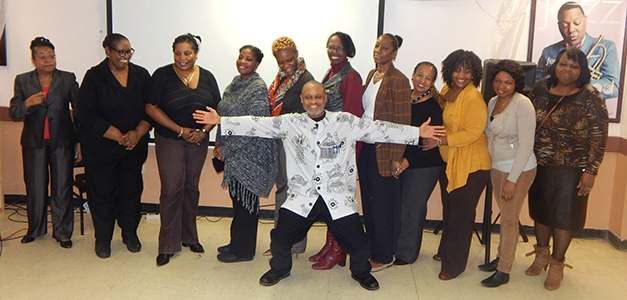
(Caption for the Featured Image:) The front line managers of the Fort Greene Senior Citizens Council – From left to right: Claudette Macey- Executive Director, Fort Greene Council, Inc., Merlyn Bruce-Manager of Christopher Blenman Neighborhood Senior Center (NSC), Sharron Trotman-Manager of Hazel Brooks NSC, Carmel Taylor-Flowers, Manager of Grant Square NSC, Ayana Clarkson-Manager of Remsen NSC, Tyheese Moulterie- Coordinator of Seth Low Senior Club, Grenay Patteson -Manager of Maria Lawton NSC, Julia Shaw- Manager of Willoughby NSC; Glynis Urquhart- Manager of Stuyvesant Heights NSC; Leishanna Lawrence- Interim Manager of Hugh Gilroy NSC; Sharon Barnett-Burrowes – Manager of Grace Agard Harewood NSC; and center front is Mwata Nubian- Operations Manager of Fort Greene Council, Inc.
Officials pushing new bills, policies, awareness for Victims of City’s Rampant Deed Fraud Abuse

City deed rooms – and policies — may match the streets as the sites of some of the nation’s most heinous “bait and switch” crimes of theft

African-American and Latino former and current property owners living in some of the “coolest” areas of Brooklyn, New York, for instance, have been the primary victims of “deed fraud”. They have been maneuvered by white-collar mobsters into parting with their properties, or straight out robbed by the finagling’s of fraudsters – coming in from all around the world – who replace the property owners’ name with their criminal-own.

But community leaders like Councilman Robert Cornegy are saying “enough is enough” of this deed fraud rampage that’s crippling the very foundations of the American Dream. Next week, Our Time Press covers Cornegy’s work on this and other issues.

This week, the City Council Finance Committee held a hearing with the Commissioner of the
Department of Finance, the City Registrar and the Sheriff “to learn more about how real property deed fraud affects New York City property owners and the efforts being made to combat it”.

It was an open hearing where members of the public and government agencies were invited to testify on the issue.

A report issued by the City Council and available on the Internet, offers some detailed background on the rise in “the occurrence of real property scams such as real property deed fraud”.

They also shared the DOF’s view that, “The results of these scams can be devastating to homeowners who may already be struggling under the weight of an impending foreclosure or a death in the family, both financially and emotionally as they realize that the home they thought they owned may now belong to someone else”.

The report cited the rise in New York’s property values as a cause for such criminal acts “which makes schemes to obtain real property even more lucrative for fraudsters and criminals”.

It reveals that most “deed fraud” and property scam incidents are occurring amongst African-Americans and Latinos in the New York City metropolitan area, primarily Brooklyn, Queens and The Bronx. And they “have suffered greater financial losses per scam than their white homeowner counterparts, further stating that “despite owning 80 percent of the homes in New York State, white owners comprised only 39 percent of reported scam victims. By contrast, African-American homeowners comprised 30 percent of mortgage rescue scam victims in New York State (while only representing eight percent of total homeowners) and Latino homeowners comprised 20 percent of scam victims (constituting six percent of total homeowners).1
“According to the data collected by the Lawyers’ Committee, the older the homeowner in New York State, the greater the average loss.”
The report further admits that these scams can be difficult to “investigate and prosecute” particularly when it may be difficult to find the proper owner of the property once the scam has rolled on for years.
While the report on the deed fraud is extensive, clear, detailed and well-supported by footnotes, it makes clear a problem the affected homeowners have known for decades: The powers of the Department of Finance to help them, especially in the past, have been “limited”.
The report notes that the DOF’s two offices “that have authority over deeds and combatting deed fraud are the City Registrar, the recorder and maintainer of a database of all property records including deeds, and the City Sheriff, the entity that “investigates cases of alleged deed fraud and, when appropriate, makes arrests”.
It further states that there’s a catch-22 for the affected property owner. “Pursuant to State statute, every conveyance presented to the City Registrar must be recorded, so long as the written instrument being recorded has the appropriate signatures and is notarized or otherwise appropriately witnessed and that all fees have been paid.
“The New York State Court of Appeals has found that, so long as these requirements are satisfied, the City Registrar has no discretion in whether to record a written instrument – doing so is merely a ‘ministerial duty’. This is true even where the City Registrar may identify that the deed may be fraudulent.”
The Department of Finance’s recent efforts to combat real property deed fraud includes the implementation of a free Notice of Recorded Document Program which “alerts registered property owners when documents are recorded without their knowledge”. It also “will allow them to take steps to limit the harm caused by the recording of a fraudulent document”.
“Deed holders or newly recorded deeds are automatically enrolled in the program, while deed holders who already held recorded deeds at the time of the program’s implementation may elect to register for the program.”
In other measures, the DOF “is sponsoring three pieces of state legislation intended to prevent deed fraud. The first is a bill that would require that all real property conveyances requiring a deed be recorded. The second bill would require that notaries public be fingerprinted. The third bill would allow DOF to remove a deed from the record where the sheriff’s investigation reveals it to be fraudulently filed because, currently, the sheriff can investigate and even make arrests but the City Registrar cannot legally remove a deed from the record”.

Ultimately, it is up to the affected homeowners to speak up and continue to fight for their rights. According to Rozario and Associates (Attorneys at Law), in the accompanying article, they have some justice on their side. The statute of limitations does not run out for forgery of a name on a deed: yesterday, five years ago or 50 years ago. And if you’ve been in foreclosure for six years, the statute of limitations says the case can be dropped.

But it’s good to have an ombudsman to step in, particularly one who grew up in the neighborhood and has witnessed neighbors losing their properties and thus their lives. Such a one is Councilman Robert Cornegy. An interview with Cornegy on the issue of deed fraud and other housing issues appears next week.  (Bernice Elizabeth Green)

Chancellor Fariña: What Business Can Do to Help Educate Children

By Akosua Albritton

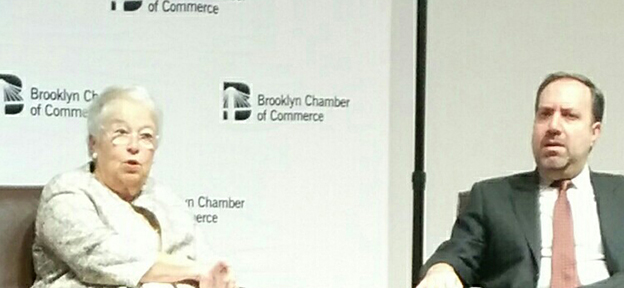
Schools Chancellor Carmen Fariña was invited to breakfast at NYU Tandon School of Engineering on January 28, 2016 to tell local businesses what they can do for the NYC Department of Education (DOE). The invitation came from Brooklyn Chamber of Commerce President Carlo Scissura, therefore, the chancellor had the auditorium full with Brooklyn’s key business executives as well as educators and parents.

NYC Chancellor Carmen Farina

Fariña’s administration as chancellor is marked by observing public school operations throughout the five boroughs. Scissura said in closing his introduction for Fariña: “You don’t meet many executives who have the on-the-ground knowledge as Chancellor Fariña has with her department.”

In short order, the chancellor expressed the following actions Brooklyn businesses can take to be partners with public schools:

Given the volume of industry operating in Brooklyn, the facilities can serve as hubs for more Career Technical Education (CTE) programs and more apprenticeships and internships for public school students at these businesses. Additionally, opening prekindergarten centers within the facilities [would serve families and businesses].

There is a need for the installation of telecommunications within all public schools, although the structure of the schools constructed in the 19th and early 20th centuries are challenging.

The Brooklyn Chamber of Commerce can be a sponsor of the [11th Annual] Children’s Book Festival. The chancellor expressed keen concern for diversity in children’s literature which goes beyond niches to books containing characters of various backgrounds. She said, “Diversity in literacy is essential for moving New York City forward”.

Brooklyn Chamber of Commerce members are encouraged to come into the schools to mentor students and offer employment and internships.

Regardless of the size of the business, the students need to be given [meaningful] work. This goes very far in their education.

To close her appeal, the chancellor commended Brooklynites for “being good about paying it forward” and asked the audience “to make a promise to do something”.

During the “sit-down” with Downtown Brooklyn Partnership President Tucker Reed and Brooklyn Chamber of Commerce’s Carlo Scissura, the state of Universal Prekindergarten education (UPK), dual-language learning and special education were discussed. Fariña said “UPK is the most remarkable thing we did. The establishment of it couldn’t have been done without mayoral control”.

Recognizing parents are the first teachers of their children, the chancellor cautioned parents to be mindful of how they communicate with their children. She observes across income levels and ethnicities that parents talk primarily to their children in a way that produces “yes” or “no” responses, while in schools the teachers converse with their students to develop critical thinking and progressively more sophisticated language skills.
Being a proponent of people knowing more than one language fluently for cultural enrichment, Fariña supports dual-language learning wherein two teachers serve one classroom. One teacher instructs in the native language and the other instructs in English. Having this teaching model creates an inclusive environment where English-speaking and English Language Learners (ELL) can learn together.

In this same vein, inclusion schools join special needs students with mainstream students. Questions from the audience added depth to the already-informative event. Lauretta Joseph, a mother of a special needs young son, is concerned about the Skills and Achievement Credential Certificate (SACC) given to special needs students vis-a-vis a regular diploma. Ms. Joseph anticipates barriers to her son’s future goals and employment should he receive the SACC.

Farina’s response included: “Brooklyn has the highest number of integrated co-teaching classes of all the boroughs” and posited, “This is the solution to achieve a full academic experience for special needs students”.

Prospect Heights Neighborhood Development Corp.’s Gib Veconi asked whether that community would get a dedicated middle school. The chancellor gave a firm, “It will be a dedicated middle school”.

Brock’s Story: When Cellars was Home … in Brooklyn

By Bernice Elizabeth Green

            Brackie “Brock” Rice

There was no place in New York City quite like Greenwich Village in the 50’s and 60’s, not even in Brooklyn.
On any given day you could run into some of the hippest music performers and literary stars in America at some of the coolest places: Boomers, The Village Gate, Five-Five, Vanguard, Oscar’s, and the popular Pink Teacup restaurant, where Brackie “Brock” Rice worked.
“Gregory Hines lived down the street, Bobby Timmons; the jazz piano player lived around the corner; Jimi Hendrix was in and out,” said Rice. “I shared an apartment with two family members for about $100 a month – living room, dining room and kitchen — on Bleecker just around the corner from the Teacup. So every single day was Saturday night.”
Leaving the Village was the furthest thing from Brock Rice’s mind, until around 1970 when romance crept into his life and guided him across The Bridge to Brooklyn. He took an apartment in his sister’s house on Vanderbilt Avenue. It was an easy walk to the Brooklyn Navy Yard where he worked on the TT Brooklyn, one of the last of the ships to be constructed at the waterfront.
Everyday Rice passed an empty building on the southeast corner of Vanderbilt/DeKalb. He soon met marketing executive Tommy Sellers and his wife, a couple determined to purchase 250 DeKalb Avenue to open a “jackets-only” restaurant and bar.
Mr. and Mrs. Sellers opened their spot (a year after the opening of the legendary Two Steps Down, across the street and one-half-block down Dekalb) with Mr. Rice in grassroots public relations mode and their amanuensis, meaning he did, like at Teacup, everything, including welcoming customers, after they were buzzed in. It was a Soul Train world, indeed, with pork chop dinners, light drinks, appetizers, television sets broadcasting sporting events, the fashion-set, the dream catchers and that famous hot jukebox – similar in tone to the warm, moving subjects in paintings by the artists Frank Morrison and Ernie Barnes.
Rice opened the door to a lot of nice, beautiful, colorful people back then, including Muhammad Ali.
The www.clintonhillblog.com posts “what-happened-to-Cellars?” with comments from nine years ago – the year of Tommy Seller’s death due to long-term ill health. Memories of Sellers, the man, are mixed; memories of Cellars, the place, are mostly fond.
Rice remembers everything, but he is not a “tell-all” person; he’s loyal to Tommy, Lucille and their family. And it has a lot to do with, as he says, “being nice.” We believe it is that mixed with a tinge of karma.
One Clinton Hill blog respondent noted in February ‘07, “They used to have a door guy and a sign on the door that said ‘Proper Attire is Required.’ I noticed that as the neighborhood changed over the past decade, the sign and doorman went away.
Actually, Rice stayed around … and close by … for a while, partly as a protector of the legacy, mostly because he loved Brooklyn as much, if not more, as he did The Village. “Cellar’s was the spot; it was about good times.” (Brock’s Story, Part 3 of 3-Parts, comes next month.)

Our Streets, Our Stories …At Boys & Girls High School, New Ventures Getting Next Generations Ready for the Future

Bernice Elizabeth Green

Stories of the journeys of Boys & Girls H.S. in educating, inspiring and empowering young people are often told as a “many-mountains-to-climb” rite of struggle with failure as the operative word.

A recent visit to Boys & Girls H.S. offered a glimpse of how the school is on track in developing and actualizing students’ potentials. And where failure is not an option.

Dr. Michael Wiltshire, Executive Principal Boys & Girls HS; Principal, Medgar Evers College Prep.

The guiding hand of Dr. Michael Wiltshire, executive principal of BGHS since October 2014 and principal of Medgar Evers College Preparatory since 2001, is quite evident, and he gives huge credit to his predecessor Bernard Gassaway.

In an Our Time Press interview scheduled for placement later this season, Dr. Wiltshire discussed pioneering collaborative ventures between BGHS and Medgar Evers College Prep that benefit both schools.

Other innovative programs, projects and resources, as described by Dr. Wiltshire, offer students, particularly at BGHS, solid options for academic fulfillment or career success.

Yet, others provide interactive learning opportunities that promote self-enrichment. In fact, an example was shared by the school librarian on the day of our visit. BGHS’ Our Streets, Our Stories digitizing initiative in cooperation with the New York Public Library is inviting students to bring their family photos and share their histories for archiving this March 2016.

In coming weeks, Our Time Press will feature success stories on this project and many others in the life of Boys & Girls H.S. Some of these articles will be written by student journalists enrolled in BGHS’ own journalism and media program.

The overarching theme of these stories will be how BGHS-initiated programs, supported by community groups, the Department of Education and parents, teachers and school administrators, are all working to keep BGHS moving steadily on course and into the future.

Next week, Our Time Press features community leader Al Vann, a former assemblyman, councilman and Boys High School graduate, in an exclusive interview conducted by writer-reporter Akosua Albritton.