This past February was a memorable Black History Month, confirming the prescience of scholar W.E.B. DuBois when he said “the problem of the 20th century is the problem of the color line”. With the surging candidacy of Donald Trump, in a campaign recognized to be appealing to the deep racism in America, we are seeing the still unacknowledged darkness of that past. Trump’s core of true believers are the heirs of the overseers, drovers, auctioneers and others who were used by the Planter Class to work the slaves to build wealth in land, factories and all sorts of endeavors.
And now these descendants are once again being used, and increasingly squeezed, by an 80-year decreasing tax on the current Planter Class, a political system infected with corporate lobbyists and campaign contributions and now they, as well as others who feel their pain, have to compete and treat as equals nonwhite people from around the world and it’s just too much for them to stand.
In Donald Trump they’ve found a voice that strikes the chords of their fears and when frightened people are directed by a demagogue, history shows they can become a mob very quickly. If Trump, or the also scary Ted Cruz, is the Republican nominee for President, then as much as we like Bernie Sanders and a good fight, knowing America as we do, it’s still big a roll of the dice that enough frightened and angry whites won’t go with the fascist rather than the socialist.
With that in mind, the fight against states restricting voting rights grows ever more important. The Electoral College does not care how the majority of people vote, only the electoral votes count as has been demonstrated four times. John Quincy Adams won in 1824 receiving 38,000 votes less than Andrew Jackson; in 1876, Rutherford B. Hayes receiving 250,000 votes less than Samuel J. Tilden and George Bush in 2000 receiving 540,000 votes less than Al Gore, but still winning the electoral vote 271 to 266.
Whoever the Democratic nominee is, everybody will have to put the stuff of their group aside for this election. The only thing that will matter is getting people registered and voting. If you know people in the “swing states”, give them a call. They’ll be plenty of time to squabble later.
This case study is part of a collection of pages developed by students in the 2012 introductory-level Geology and Human Health course in the Department of Earth Sciences, Montana State University.
Over a few decades, humans have managed to dump tons upon tons of garbage into the ocean. Of the most devastating elements of this pollution is that plastics takes thousands of years to decay. As a result, fish and wildlife are becoming intoxicated. Consequently the toxins from the plastics have entered the food chain, threatening human health. In the most polluted places in the ocean, the mass of plastic exceeds the amount of plankton six times over. This is a large piece of evidence that leaves the problem of polluted oceans undeniable. It is upsetting that more of clean up effort is not taking place.
The Three Plastic Islands
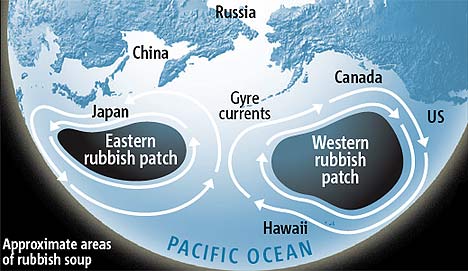
The Great Pacific Garbage Patch, also know as the Pacific Trash Vortex or gyre, is located in the central North Pacific Ocean and is larger than the state of Texas. There are also garbage patches in the Indian and Atlantic ocean. The patches are defined as containing a higher amount of plastic as compared to surrounding oceans. To date, five patches in total have been discovered.
Plastics are transported and converge in the ocean where currents meet. This means that huge plastic islands are made as a result. SES (Sea Education Society) scientists studied plastics in the Atlantic and calculated there are 580,000 pieces of plastic per square kilometer.
Sources of Plastic Toxins Entering the Oceanic Food Chain
As far as plastic entering the ocean, about 20% of the trash comes from ships and platforms that are offshore. The rest sources from litter being blown into the sea, picked up by tides on the beach, or intentional garbage dumping. The worse part is, these plastics don’t biodegrade, so they brake up into tiny pieces that are consumed by fish and sea mammals. Plastic is killing more than 100,000 sea turtles and birds a year from ingestion and entanglement. To learn more visit Project Green Bag.
Plastics getting to Humans Impacting Health
Different plastics spread throughout the ocean. As Styrofoam breaks into smaller parts, polystyrene components in it sink lower in the ocean, so that the pollutant spreads throughout the sea column.
In fact, not only do the toxins in plastic effect the ocean, but acting like sponges, they soak up other toxins from outside sources before entering the ocean. As these chemicals are ingested by animals in the ocean, this is not good for humans. We as humans ingest contaminated fish and mammals.
As far as protecting yourself from contamination, it is probably best not to have a diet that consists mainly of fish, since most is probably contaminated. However, one of the most effective things we could all do as members of this fragile ecosystem is to be responsible for our trash. When we have the opportunity, we should try to avoid buying products packaged in plastic. We should always recycle plastic when we do use it. At the store, request a paper bag instead of plastic, or bring your own. Use a reusable water bottle, and of course don’t litter.
This month, an alarming report said Fukushima radiation had hit American shores. The truth is, it’s only in trace amounts. The real problem is that it’s nobody’s job to check ever again.
Radioactive elements from Japan’s Fukushima disaster were found in the ocean on the U.S. Pacific coast last week. Alarmist fringe sites were quick to herald everything up to an allegedcollapse of the Pacific fishery as the result of this four-year, trans-ocean trek.
But Ken Buesseler, a senior scientist specializing in marine chemistry and geochemistry who has been tracking the radiation since the earthquake, says there isn’t much to worry about. At least for now.
Buesseler, who earned his Ph.D. studying the fallout of the A-Bomb tests from the ’60s, is no stranger to digging through radioactive data.
“I really didn’t expect the U.S. to have a strong response—[at least not] the public,” he explains from his office at the Woods Hole Oceanographic Institute. “Initially, yes. There was a right to be concerned those first few months. But about a year and a half ago, we saw more and more calls of people asking about swimming in Santa Cruz, and should they move their homes to be safe, because they had seen visually the debris show up.”
While the debrisstarted showing up a while ago, the stuff that had the potential to be really sinister, such as radioactive element cesium-137, which was found last week off the coast of British Columbia, is just now arriving. The ocean around Fukushima was originally contaminated with 50 million times the normal amount of cesium-137. Yet when Buesseler arrived at the site with his research team two months after the initial meltdown, he found the ocean had diluted it to just 100,000 times the normal amount. While exposure to high concentrations of cesium-137 can increase cancer risks and even cause burns or death, it’s a number that sounds scarier than it actually is.
“At that point, it was certainly safe to be there,” he says, smiling slightly through a red beard that shows signs of graying. “You could swim in those waters, but you probably don’t want to eat the fish.”
The half-life, or amount of time for half of the radioactive element to decay, for cesium-137 is 30 years.
“That’s a long time,” Buesseler admits. “So you take a contaminated tuna, put it in a can, and it takes 30 years for half of that cesium to decay away per natural processes.”
Luckily, cesium is an electrolyte, and is water-soluble. Thus it moves through living organisms relatively quickly.
“It doesn’t have a target organ that it goes to, it just flushes through like a salt. So the good thing is one of the more serious contaminants for the ocean is lost quickly when it gets into the food chain.”
Unfortunately, it’s not all good news. “The bad news is, the Japanese found, through their own monitoring data, cesium levels weren’t going down in fish. That means they’re getting a source–they’re getting fed more cesium. There are still leaks at the site.”
There are millions and millions of gallons of contaminated water to be dealt with at the Fukushima site, a cleanup project that will take both decades and billions of dollars.
“There are 300 tons coming out a day of [contaminated] water,” Buesseler explains. “Well, that’s still not big compared to what happened four years ago. It’s maintaining levels that are high enough to keep fisheries closed, but I can go there and swim. People can surf in that area.”
And, even though it’s still gushing into the ocean in Japan, by the time that cesium-137 arrives on our own American shores Buesseler says it’s nothing to worry about.
“There are lower amounts of cesium the further you get from the source. Think about dropping dye into a bathtub. Eventually you don’t see it anymore.”
And for those quick to dismiss the importance of checking our oceans for radioactivity, remember this: Everything is radioactive. Everything.
“We live in a radioactive world. Some say we shouldn’t have cesium in the fish, but there’s already cesium in the fish,” he says, laughing. “How much more did Fukushima add? What other isotopes are already in the fish? Don’t worry about the cesium, because there are other things in much higher amounts.”
Other things, like polonium, a radioactive substance so lethal the KGN used it as a poison.
For now, Buesseler is just happy to have the opportunity to learn, even if that opportunity is afforded at such an unfortunate cost as Fukushima. In his line of work, studying radiation, there are very few positive situations that lend themselves to this level of research.
“Isotope variations can track things like Chernobyl and weapon testing,” he says. “We use these horrible disasters to see what the oceans do.”
“Even if we were to stop getting any plastic into the ocean tomorrow . . . then these patches would continue to grow for at least another 500 years,” he said.
“They would just grow and grow and grow because of all the plastic we put in the ocean already that hasn’t even accumulated in these patches yet.”
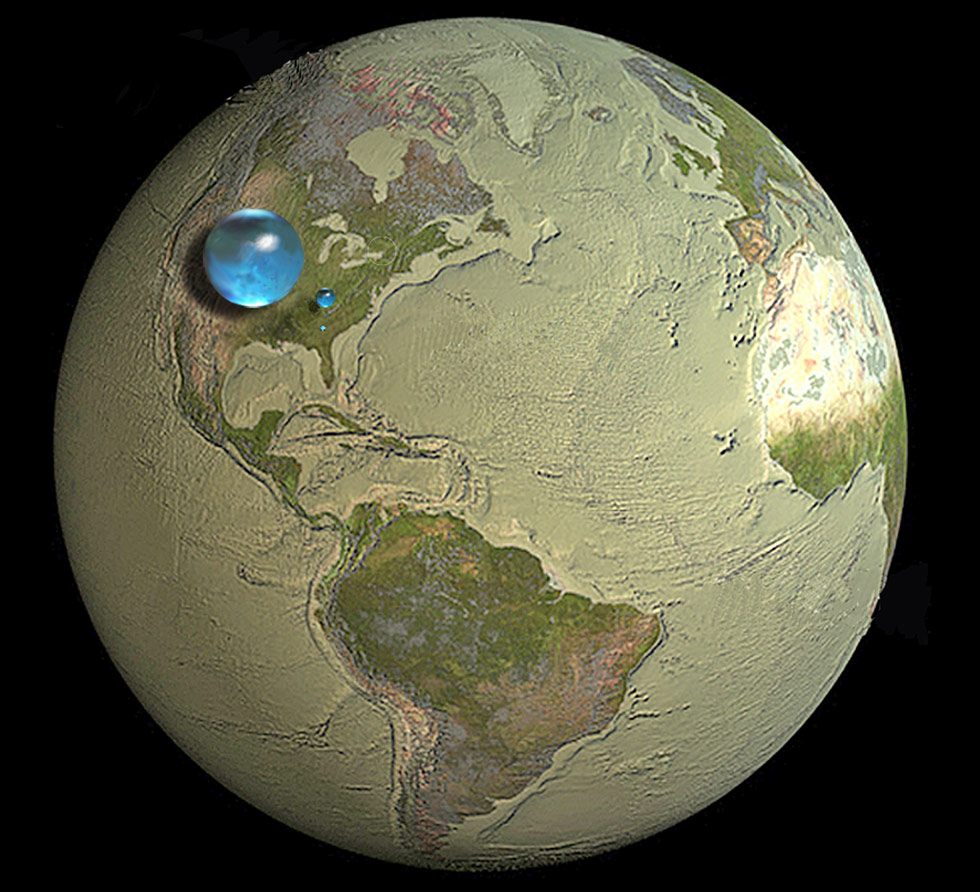
This image show blue spheres representing relative amounts of Earth’s water in comparison to the size of the Earth. Are you surprised that these water spheres look so small? They are only small in relation to the size of the Earth. These images attempt to show three dimensions so each sphere represents “volume”. They show that in comparison to the volume of the globe, the amount of water on the planet is very small. Oceans account for only a “thin film” of water on the surface.
Spheres representing all of Earth’s water, Earth’s liquid freshwater and water in lakes and rivers
The largest sphere represents all of Earth’s water. Its diameter is about 860 miles (the distance from Salt Lake City, Utah to Topeka, Kansas) and has a volume of about 332,500,000 cubic miles (mi3) (1,386,000,000 cubic kilometers (km3)). This sphere includes all of the water in the oceans, ice caps, lakes, rivers, groundwater, atmospheric water and even the water in you, your dog and your tomato plant.
Liquid freshwater
How much of the total water is freshwater, which people and many other life forms need to survive? The blue sphere over Kentucky represents the world’s liquid freshwater (groundwater, lakes, swamp water and rivers). The volume comes to about 2,551,100 mi3 (10,633,450 km3), of which 99 percent is groundwater, much of which is not accessible to humans. The diameter of this sphere is about 169.5 miles (272.8 kilometers).
Water in lakes and rivers
Do you notice the “tiny” bubble over Atlanta, Georgia? That one represents freshwater in all the lakes and rivers on the planet. Most of the water people and life on earth needs every day comes from these surface-water sources. The volume of this sphere is about 22,339 mi3 (93,113 km3). The diameter of this sphere is about 34.9 miles (56.2 kilometers). Yes, Lake Michigan looks way bigger than this sphere, but you have to try to imagine a bubble almost 35 miles high—whereas the average depth of Lake Michigan is less than 300 feet (91 meters).
The data used on this page comes from Igor Shiklomanov’s estimate of global water distribution shown in a table below.