Home Blog Page 855

Bed-Stuy BID, Gateway to Diversity and Prosperity

By Akosua K. Albritton

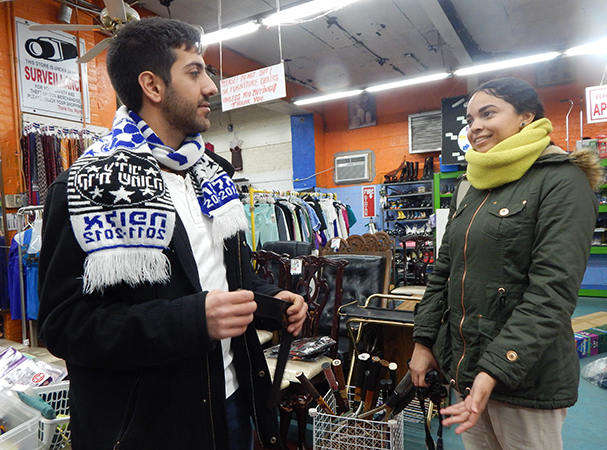
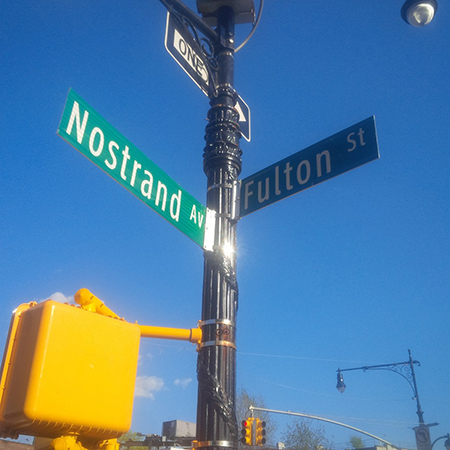
Fulton Street and Nostrand Avenue are two of Brooklyn’s lucrative commercial corridors.  Even a shuttered storefront is a gold mine.  March 2009, Bedford Stuyvesant Restoration Corp. (BSRC) received the green light from the NYC Department of Small Business Services to operate the Bed Stuy Gateway BID (Bed Stuy BID) which currently covers 28 blocks on Fulton Street (between Classon and Lewis Avenues) and Nostrand Avenue (between Halsey Street and Atlantic Avenue).  The inventory of commercial properties can be viewed on the website, www.bedstuybid.org, in the “Vacancy Report” and “BID Photo Gallery” web pages.


Bed Stuy BID evolved into a stand alone entity in 2013.  The Executive Director Michael Lambert explains “the past three years has been about the re-stating of the BID.  The financial management software is migrating from BSRC over to Bed Stuy BID.”


New York City’s BIDs have goals and this one is no exception.  Mr. Lambert counts upgrading the website as one of many goals.  The upgrade “will improve overall website function including the Business Directory and Vacancy Report.”  Another goal is establishing a real estate committee which is comprised of BID property owners for the purpose of getting their input in the shaping and growth of the corridor.  The fruit of this collaboration shall be “attracting quality businesses to the BID and a diversity of business offerings.”


Other goals fall into the category of marketing and engagement.  Marcy Plaza with its Mathematical Mosaic Star and outdoor seating is the perfect spot for public discourse and events.  Merchants will be re-engaged through the Nothing But Networking series starting March 23, 2016.  Bed Stuy BID “will rotate the network venues throughout the the BID to promote to external businesses, to the community, and to build relationships amongst existing BID businesses.”


Significant marketing impact will occur from spring-themed commercials strategically scheduled around Easter and two weeks in May on NY1, Brooklyn 12, MTV2, OWN, Animal Planet, and Centric.  The BID wants to get to a point “of running commercials year-round.”


Hopefully, the power of word-of-mouth marketing is in the mix.  A happy BID merchant is another key marketing component.  This Our Time Press published the article Don’t Sit on the Fence About Your Property, January 21 ,2016 wherein seven business owners in storefronts in 1201 Fulton Street (the northeast corner of Bedford Avenue and Fulton Street) received Civil Court orders to vacate their premises by February 29, 2016.


One can only imagine the impact of seven voices praising Bed Stuy BID for its re-location assistance.  Mr. Lambert stated he “didn’t know they were to be evicted until talking with three of these merchants at the January 11, 2016 Small Business Town Hall Meeting.”  He “referred them to the Brooklyn District Attorney’s Office for investigation into possible deed fraud but didn’t give commercial property referrals.”


On March 8, 2016, Milton Jemmott, when queried about assistance from Bed Stuy BID, said, “No, the BID didn’t offer to re-locate us or tell us about other properties…I’m not sure if I told Michael that I am looking to buy.”


That same week, Sabine Bellevue, owner of Sabine’s Hallway Natural Hair Salon, sent an email message to explain that she independently found and relocated to 450 Nostrand Avenue on the second floor.

POINT – COUNTERPOINT: The Alleged Brownsville Rape

Op-Ed

Alleged Brownsville Rape, My Thoughts on Dismissal of Charges

By Laurie A. Cumbo

Council Member of the 35th District

Chair of the Women’s Issues Committee

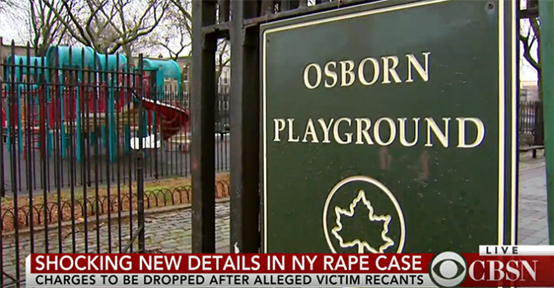
As I was informed of the decision to dismiss all charges in the alleged gang rape that occurred on January 7, 2016 in Brownsville at the Osborn Playground, somehow I did not feel relieved that all was now right with the world.  Black women are protecting our men. Who is protecting our Black women? The #blacklivesmatter movement is being driven by many fierce Black women– protecting their fathers, sons, husbands, and brothers. No one wants to see five Black boys and a father lost in a broken criminal justice system. But at the same time, we must also ask the question, what do we want to see for this eighteen-year-old Black girl?


This case has reached national and international attention. Decisions from cases such as this often set precedent. What is so dangerous about this precedent is that it involved both an intimate partner and stranger rape investigation simultaneously, and it now sets a new standard for what is permissible in both circumstances; and has unearthed the meaning of consent.


In the case of robbery, when someone is approached by five young men that want to take your property, you can either choose to give up your property willingly or you can choose to fight back. Similarly, in the case of rape, five strangers approaching you for sex forces you to make a choice to either fight back or to cooperate. Cooperating in the case of rape is often interpreted as consent while cooperating in the case of robbery is still seen as robbery.


The dismissal of all charges also desensitizes a Black community, and lowers their standards of acceptable behavior.  The alleged incestuous relationship of an eighteen-year-old girl with her father has now been given the green light. Two boys allegedly having sex in a public park with an eighteen-year-old girl while three other boys watched, laughed and videotaped has now been given a green light. Women who are inebriated will have a more difficult time making the case that they were raped. According to the Rape Abuse and Incest National Network (RAINN), the nation’s largest anti-sexual assault organization, “98 percent of rapists will never spend a day in prison.”


Before we rush to celebrate the innocence of these five teenagers and her father then slap each other five on social media, let’s lament that these young men and a father are told that they did nothing wrong that night. They will not be held accountable for their actions nor will they be given any form of assistance, support, education or understanding of the ramifications of their behavior. There are no winners in this situation and the sacredness of community, respect and order has been violated at the highest level.


On Feb. 18, the young woman informed prosecutors that she decided she did not want to move forward with the case and that she “doesn’t do” court. One can only imagine how a woman who has spent her entire life bouncing around the foster care system has come to the conclusion that she “doesn’t do” court.


I wonder what chance at justice an eighteen-year-old girl would have had after being in an incestuous relationship with her father, engaging in some form of sexual act with five young men, predominantly male lawyers representing the young men in this case, and a criminal justice system all led by men.


In a statement released by DA Thompson, he stated, “That night, this young woman’s father and the five young men engaged in conduct that was reprehensible and wrong, but because of the lack of reliable evidence, criminal charges simply cannot be sustained.” This case clearly outlines the need for stronger legislation to protect the interests of women as it pertains to sexual assault.  However, DA Ken Thompson’s statement causes great internal conflict for me because consensual sex is neither reprehensible nor wrong. So the question still remains, was it wrong or was it consensual?


WRONG LESSONS FROM THE BROWNSVILLE FIVE RAPE CASE

Mar. 3, 2016 (Mimesis Law) — Last week, Brooklyn District Attorney Kenneth Thompson stepped into the fray and the spotlight once again to announce that he and his office would be righting yet another wrong. The widely publicized charges against five Brownsville teens accused of brandishing a gun to scare off the father of an 18- year-old woman before gang raping her on a public playground were dismissed.

Thompson spoke to the press about his difficult decision to drop a case with such heinous allegations.

In today’s statement, Mr. Thompson said the woman and her father had “provided multiple inconsistent accounts” to police—that there was no gun and they were in fact engaged in sexual conduct.

The truth that has finally seemed to surface is this. The woman and her biological father were having sex on a playground bench when the five teens approached.  Either by invitation or suggestion, some of these boys then engaged in sexual intercourse with the woman.  If you are at a loss for words, allow the DA to help you out.

“That night, this young woman’s father and the five young men engaged in conduct that was reprehensible and wrong, but because of the lack of reliable evidence, criminal charges simply cannot be sustained,” Mr. Thompson said.

For many people, this was a story that peeled off yet another layer of our ever-diminishing faith in humanity. Although troubling, events like this remind us that there is an important legal distinction between disturbing conduct and criminal conduct. Although Thompson did not allow the questions that were swirling around this prosecution from the very beginning to keep his assistant DA’s from asking for half a million dollars bail at arraignment, he undoubtedly made the right call by walking away from this trash-can fire of a case.

But across the river, in City Hall, one of Brooklyn’s City Councilors has a much different opinion on the matter. Laurie A. Cumbo represents New York City’s 35th District in Brooklyn, including Prospect Heights, Crown Heights and Clinton Hill (where this writer happens to live).

Cumbo penned an op-ed attacking Thompson’s decision to dismiss all charges against the Brownsville Five. She lamented that following the dismissal, “somehow [she] did not feel relieved that all was now right with the world.” This sentiment is understandable in a story that seemingly contains nothing but anti-heroes, victims and a variety of perverse sexual acts.

But Cumbo had no intention of praising the District Attorney’s proper legal decision while simultaneously faulting a decaying culture that is partially responsible for this scene from a Greek tragedy playing out in real life on a Brooklyn playground bench. No, Cumbo went in a very different direction.

Decisions from cases such as this often set precedent. What is so dangerous about this precedent is that it involved both an intimate partner and stranger rape investigation simultaneously, and it now sets a new standard for what is permissible in both circumstances; and has unearthed the meaning of consent.

To be clear, the District Attorney has not claimed that the woman in this case did consent. He has rightly stated that the fact that she has now said she gave consent, whether true or false, makes it impossible for his office to continue the prosecutions.

But Cumbo’s notion that this supremely unique case will somehow set a new precedent for the doctrine of consent is absurd. Her surface examination of this case, as opposed to the hours spent by prosecutors, police and defense attorneys, has led her to the conclusion that, regardless of what the woman has claimed, she could not have consented.

In the case of robbery, when someone is approached by five young men that want to take your property, you can either choose to give up your property willingly or you can choose to fight back. Similarly, in the case of rape, five strangers approaching you for sex forces you to make a choice to either fight back or to cooperate. Cooperating in the case of rape is often interpreted as consent while cooperating in the case of robbery is still seen as robbery.

Consent defenses in rape cases are incredibly complicated and complex. The criminal justice system has shown that it is ill-equipped to properly deal with allegations of sex crimes, often failing to protect the accused and victim alike. However, Cumbo’s attempted legal analogy fails on every level in that it conflates a legal request with assumed coercion. To borrow from every snide commenter on the internet, “That’s not how it works; that’s not how any of this works.”

Cumbo also missed the one silver lining in all of this, the fact that a racist criminal justice system actually decided to dismiss charges against five young black men who, while no angels, are certainly not legally guilty of rape.

The dismissal of all charges also desensitizes a Black community, and lowers their standards of acceptable behavior. The alleged incestuous relationship of an eighteen-year-old girl with her father has now been given the green light. Two boys allegedly having sex in a public park with an eighteen-year-old girl while three other boys watched, laughed and videotaped has now been given a green light.

If cultural lines of morality are drawn by the decisions that come out of our criminal courthouses, then we are already doomed. Our criminal justice system delineates between legal and illegal conduct, not between virtuous and immoral. The only “green light” is the one that tells prosecutors that when the evidence is not there, they should dismiss a case.

But again, Cumbo sees truth where she wants, both in this case and its aftermath.

Women who are inebriated will have a more difficult time making the case that they were raped. According the Rape Abuse and Incest National Network (RAINN), the nation’s largest anti-sexual assault organization, “98 percent of rapists will never spend a day in prison.”

Again, the Brownsville Five case will set no such precedent. The Brooklyn District Attorney’s Office can be accused of many things, but soft-pedaling sex crime prosecutions is not one of them. The complex nature of how intoxication plays into consent is a valid topic for discussion. However, that discussion should be unencumbered by nonsensical statistics.

But Cumbo wants to do much more than discuss these issues. She wants to change the law.

This case clearly outlines the need for stronger legislation to protect the interests of women as it pertains to sexual assault.

Exactly what legislation would Cumbo propose? Should we start treating rape like DWI/DUI, and once a person’s BAC hits .08%, she can neither drive nor consent? Perhaps a law that states that regardless of the facts and circumstances, consent cannot be legally given to engage in sexual acts when five or more males are present.

Generic demands for generic legislation do nothing to address valid concerns regarding the prosecution of sex crimes. The further we move away from determining consent on a case-by-case basis, the more we leave the door open for injustice.

At the end of her op-ed, Cumbo turns her attention to Thompson himself, and decides to go for the jugular.

In a statement released by DA Thompson, he stated, “That night, this young woman’s father and the five young men engaged in conduct that was reprehensible and wrong.” […] However, DA Ken Thompson’s statement causes great internal conflict for me because consensual sex is neither reprehensible nor wrong. So the question still remains, was it wrong or was it consensual?

Even with the incessant criminalization of almost every facet of human life, there are still some things out there that are both wrong and legal. Reasonable people would agree that teenagers having group sex in a public playground with a complete stranger is wrong. However, if consent is given, it is also legal. Cumbo, in trying to hit Thompson with a rhetorical ‘gotcha’ question, exposed her failure to recognize a criminal justice system that needs to strengthen protections for the accused, not weaken them.

Debauchery can and will occur in a free society. All the teenagers involved in the Brownsville Five case have been failed by family and society, but addressing these failures should only involve the criminal justice system when a crime has been committed.

Unfortunately, Councilwoman Cumbo sees nothing but failure in this rare case where the system worked somewhat properly. And the valuable lesson she seems to have missed is that our criminal courts are there to adjudicate legality, not morality.
 

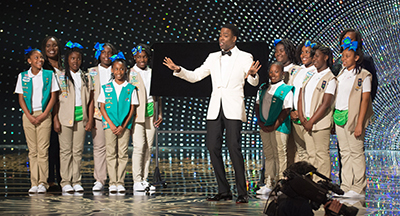
Thanks to Chris Rock, Girl Scouts Raise Dough with Cookie Sales at  Academy Awards

February 28, 2016 - Host Chris Rock and girl scouts at The 88th Oscars® at the Dolby® Theatre in Hollywood, CA on Sunday, February 28, 2016...88th Annual Academy Awards, Show, Los Angeles, America - 28 Feb 2016. (Credit Image: © Rex Shutterstock via ZUMA Press)
-medium wp-image-17744″ src=”http://ourtimeathome.com/wp-content/uploads/2016/03/Pg1_ChrisRockGirlScoutsWeb-300×162.jpg” alt=”February 28, 2016 – Host Chris Rock and girl scouts at The 88th Oscars® at the Dolby® Theatre in Hollywood, CA on Sunday, February 28, 2016…88th Annual Academy Awards, Show, Los Angeles, America – 28 Feb 2016. (Credit Image: © Rex Shutterstock via ZUMA Press)” width=”300″ height=”162″ /> February 28, 2016 – Host Chris Rock and girl scouts at The 88th Oscars® at the Dolby® Theatre in Hollywood, CA on Sunday, February 28, 2016…88th Annual Academy Awards, Show, Los Angeles, America – (Credit Image: © Rex Shutterstock via ZUMA Press)

Host Chris Rock presents the amount of money (a joke) collected during the show by the Girl Scouts, including Rock’s daughters Zahra and Lola, onstage at the 88th Annual Academy Awards at the Dolby Theatre on February 28, 2016 in Hollywood, California.
Rock, as the event’s host, made use of the opportunity to help his daughters sell Girl Scout cookies to celebrity attendees. In total, the girls sold more than 300 boxes of cookies for approximately $2,500 during the event. But by the time Girl Scout Week, this week, is over, the goal of $65,243 — meant as an onstage joke, may probably be met. At the event, millionaire celebrities were grabbing for boxes.


What’s serious is the girls did raise dough, and Rock was responding to a request from his daughters to help them with their sales.

At the stage, Chris Rock shared that his Oscar-hosting duties have caused him to miss the opportunity to help his daughters with the Girl Scout cookie season. “I’ve been away from my two daughters at a very important time in their life. I have missed most of Girl Scout cookie season,” he said. Chris Rock also told the audience how his younger daughter Zahra complained about coming in second on her troop’s cookie sales and asked for help.

“I want you to reach into your millionaire pockets and buy some of my daughters’ Girl Scout cookies,” Chris Rock added, sending a local Girl Scout troop all over the Dolby Theatre. Not a few celebrities were soon spotted buying and eating the cookies, including Kate Winslet, Tina Fey, Mindy Kaling, John Legend, Matt Damon and Christian Bale.

When Chris Rock called for the troop to get up on the stage 45 minutes later, the on-screen tally had shown the number $65,243, representing the amount of money the girls have raised.  On their official Twitter account, @girlscouts tweeted their gratitude to Chris Rock for giving them the rare opportunity.
According to Advertising Age, the Girl Scouts said that Chris Rock personally reached out to a troop leader two weeks ago and the organization stepped in from there. “Working with the Academy was a team effort. We helped out in any way we could,” they said.

The Director of Communications for Girl Scouts of the USA Stewart Goodbody elaborated the process that happened behind their emergence in the prestigious award event. It all began with Chris Rock. “He has personal ties to Girl Scouts, and he speaks really highly of the organization. And he felt it would be a great idea to do something fun and lighthearted and shine the light on something positive in this year’s Oscars telecast. And we think he knocked it out the park,” Goodbody said, as quoted by Adweek.

According to San Jose Mercury News, the troop turned to the girls’ troop council to decide how the money will be used. Some have criticized the move, but the Girl Scouts were grateful for the opportunity and the celebrity audience seemed to enjoy the experience.

Chris Rock’s initiative to help his daughters sell Girl Scout cookies turned into a major moment for the troop when they managed to raise $65,243 from only about 300 boxes of cookies. Celebrities showed their support by purchasing the cookies after being encouraged to help by host Chris Rock.


Junior Architect Uses her Skill to Protect Her Neighborhood


By Akosua K. Albritton

Young architect Zulmilena Then.

While not an astrophysicist, Zulmilena Then has chosen a different path.  She chooses architecture as her profession and civic engagement.  The New York City chapter of the American Institute of Architects (AIA New York) counts over 5,000 licensed architects, allied professionals, students and public members in its membership.  AIA New York does not keep track of gender, race or ethnicity statistics; however, the Directory of African-American Architects does.  As of March 5, 2016, it counts about 264 licensed African-American architects in New York State, of which 77% are located within the five boroughs.


Within that small pool of professionals, there are 48 licensed women.  42 are located in New York City.  True, Ms. Then is not an astrophysicist but she certainly is a rare breed, particularly when she decides to take the licensing examination.  Then remembers the first time she looked at buildings aesthetically:


I remember when I was 15 years old living with my family in the Dominican Republic. My aunt visited from the States…she took us to visit the Colonial Zone. This was my first time visiting and it felt like I was in a completely different world. I was awed by… the narrow cobblestone streets filled with wonderful colonial-style architecture. I was completely fascinated because I was walking through the past while being in the present. It was such a surreal experience. This was the day that helped me learn about the importance of historic preservation.


Her stumping grounds are Cypress Hills and East New York. Today, Then holds a bachelor’s degree in architecture from Pratt Institute and works at Michael Ivanhoe McCaw Architects, P.C., located at 365 Stuyvesant Avenue in the Stuyvesant Heights Historic Landmark District.  Mr. McCaw is one of the 264 African-American licensed architects in New York State.  Then explains she is “currently the only female in the office”.  This firm is the architect for Cypress Hills Local Development Corporation’s US Department of Housing and Urban Development/NYC Department of Housing Preservation and Development Asset Control Area Program.


So this neighborhood preservationist works for a business that is doing good in her neighborhood.  Better still, Zulmilena Then is using her talents to save her community. In 2015, she and colleagues Ena K. McPherson, Farrah LaFontant, James Ward, Rickie James, Hector Lozada, Claudia Williams and Damian Mercado formed Preserving East New York to protect the architectural gems spotting and clustering in East New York.


There are several historic [structures] that are interspersed throughout East New York. Many are eligible for Historic Landmark Designation. Also, a potential Historic Landmark District—East New York Historic District–is there. The Landmarks Preservation Commission (LPC) surveyed the area for a potential Historic District in 1977 but the proposal never came to fruition. We have asked LPC to revisit their survey in hopes of having the 1977 proposal fulfilled.


Some examples of the notable buildings within the area include the 75th Police Precinct Police Station House at 484 Liberty Avenue, Grace Baptist Church at 233 New Jersey Avenue, Holy Trinity Russian Orthodox Church at 400 Glenmore Avenue, and Tyrian Masonic Lodge at 68 Pennsylvania Avenue.


Time is of the essence to organize the community and activate LPC because the East New York Rezoning Proposal was recently approved.  This plan involves demolishing wide areas.  The members of Preserving East New York disapprove of it. The organization gives the following assessment of the proposal:


The East New York Rezoning Proposal will have a major impact within the communities of East New York and Cypress Hills. It will lead to the lasting transformation of these two communities. Our neighborhoods, as we know them, will disappear because the lack of historic preservation within this plan has left our historic [structures] under a severe risk of demolition. As the first of 15 neighborhoods to be rezoned and as the one that will be used as a model for the other neighborhoods, it is important that the city recognizes the need to address the preservation of all our historic resources in order to protect our communities. All of our neighborhoods deserve to keep a part of history.


Bridge Street AWME Church 250th Anniversary Service


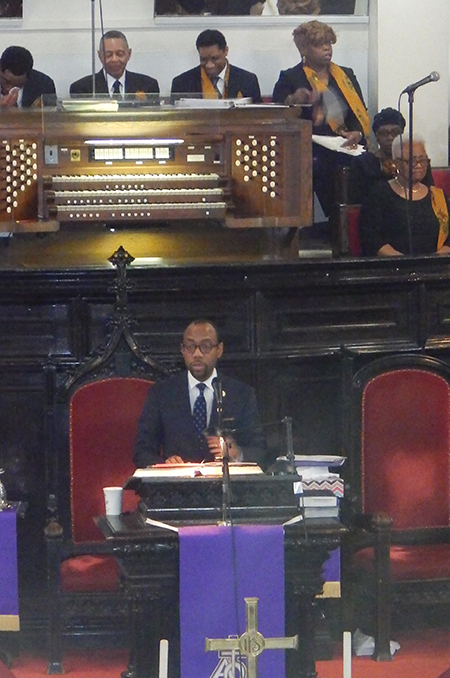
Last week’s celebration of Bridge Street Church’s 250th anniversary featured and address by one of the nation’s great speakers, The Rev. Dr. Cornell Brooks, a civil rights activist, attorney, minister, and leader of the NAACP as chief executive officer and the organization’s 18th president.


Dr. Brooks follows a long line of distinguished history-makers who have spoken at the church over the years.  They include:  U.S. Secretary of Commerce Ron Brown, Governor Mario M. Cuomo, Mayor David N. Dinkins, and the writer/composer James Weldon Johnson, author of the words for the African American anthem. “Lift Every Voice and Sing;” orator/human rights leader Frederick Douglass, and humanitarian, freedom rights warrior Harriet Tubman — whose passing is observed annually on March 10.


On Sunday, February 28, Dr. Brook’s remarks to the “august and distinguished congregation,” included an amazing “appreciation” to guests, visitors and the membership.  He started off with a nod to Rev. David B. and Valerie Cousin for their leadership, service, commitment and ministry. He then expressed appreciation to everyone present including, “all the preachers, stewards, trustees, choirs, the bishop – Presiding Elder Melvin Eugene Wilson, the NAACP board of directors, Dr. Hazel Dukes, president of the NYS conference, Karen Boykins-Towns, former NAACP Brooklyn chapter president, and L. Joy Williams, who currently holds that honor.  


His list also included the precinct commander, all the members of the Judiciary, Senators, the Comptroller and the Brooklyn District Attorney.  He didn’t omit the elected officials, including the city council and representatives of the Mayor’s office, “who have graced us with their presence and their comm

The Rev. Dr. Cornell William Brooks, National President & CEO, NAACP

itment to engaging in public service beyond the last Sunday preceding the first Tuesday in November.” 


His humor was delightful.  His grace, honorable. His message, mighty.


Dr. Brooks’ presentation also was impressive for its example of how a trained mind works from an exacting memory: no notes.  He never missed a beat even as he was asked to announce cars that were double parked and about to be ticketed. As The Rev. David B. Cousin, Bridge Street’s pastor, handed the guest speaker a slip of paper during his address, Dr. Brooks said, “Now speaking parenthetically about the affluence and prosperity of this great congregation, the pastor just passed me a note, there is a silver, note that, Mercedes – notice I said I was speaking prophetically.”  Dr. Brooks then read aloud the license plate number, and immediately continued with his keynote with: “We will intervene with the Lord as you try to move your car to avoid a ticket.” The congregation erupted in laughter.  (Bernice Elizabeth Green)


The Rev. Dr. Cornell Brooks

President and CEO, NAACP

Keynote Speaker

Bridge Street AWME Church

250th Anniversary Service

Sunday, February 28, 2016

Borough of Brooklyn in New York City

*  *  *

“Not Merely Historic, But History-Making” (Excerpts)

On this memory-imbued afternoon, we find ourselves in this sacred space at this sacred time, not by happenstance, not by accident, not as a consequence of a crap shoot of chronology.


We find ourselves at this point on the Gregorian calendar, not as a consequence of the mere ticking of a clock.  We find ourselves in this place at this crossroads of ministry in this extraordinary mecca of commerce and culture called New York City.  We find ourselves in these pews in front of this Holy desk under the anointing of the Holy Spirit at a moment in which a congregation called Bridge Street African Methodist Episcopal Church is celebrating its 250th year of ministry.  We find ourselves in a moment in history where we are yet celebrating African American History Month.  We find ourselves in a moment in time when we are yet celebrating the 107th birthday of the NAACP.  We find ourselves at the intersection of history.


We African Methodists.  We Baptists.  We Catholics.  We Gentiles and Jews.  We, from every area of the county, whatever your hue or heritage, race or religion, if you are here, you are in a special place.

There are rivers of history that come together at this moment like the Tigress and Euphrates in the fertile-crescent or the so called cradles of civilization.  These rivers of history wash over our souls, wash over our memories and remind us where we have come from, and yet where we are.


We’ve come to take this place yearning to hear from our God, yearning to hear the whisper of God’s voice down the winding corridor of time, to speak to our hearts.  We have been celebrating, yes celebrating 250 years of history and wondering: What does God have to say now? What does God have to say to my needs, to my hurts, to my worries, my fears, my trepidations?  What does God have to say after 250 years? There’s yet some child who’s yet asking the question: “What does God have to say to me this afternoon?”


There’s some senior who says I’ve been through a few things; I’ve walked a long way.  There’s some mother or father, some husband or wife who’s yet grappling with grief and wondering what does God have to say to me?  There’s some parent or grandparent or prodigal son or prodigal daughter who’s asking even amidst this august celebration of history, “What does God have to say?” and I want to simply say to you as preachers have said over the many generations this church has been in existence:  God yet speaks.


… The scholar Isabel Wilkerson, in the eloquently incisive book called “The Warmth of Other Sons,” described a journey of six million African Americans from foreign countries, oppressive countries, countries in which they were mistreated and enslaved like the Israelites in Egypt; nations known as Jim Crow South Carolina; Jim Crow Georgia; Jim Crow Alabama.


And not only that, there were those who came from Islands: Jamaica, the Bahamas, and they came to a place they understood to be a Canaan land:  New York City, Brooklyn.  They arrived, not always by Delta Airlines, not always by First Class, some of them came by Delta Airlines of the working class, translating and transliterated, that would be Greyhound Bus lines.  They came by rail and by car to New York City.  They came to Brooklyn.  They came here with the memory of slavery.  They came here with the memory of oppression.  They came here understanding what it was like to do without, to not have, to go wanting, to be hungry, to be homeless, to be without clothing, and to be without sufficient provision.  They came to this church seeking help, seeking hope, seeking power, seeking prayers, seeking salvation, seeking God’s love.  This is described and was described as the Great Migration.  But history tells us that this church was here before they got here.  You, like the ancient Israelites, have an ancient history relative to American history.


(In) Deuteronomy, which is simply the recounting, the retelling, the reiteration, if you will, of the Law, we have Moses delivering up a series of sermons.  In this 26th Chapter, versus 1-9, the people are told to declare where they are…


Thereafter, they are told to declare where they came from.  And if by chance someone wants to glean some kind of message they’d like to remember ‘round about Tuesday or Wednesday of this week, you can just say the preacher stopped by and he taught under the topic, “Not Merely Historic, but History Making.”


..  How many of you when you look back over your life understand what it is to be homeless; what it is to be in trouble; what it is to be worried; what it is to go through; what it is to think you might go under?


How many of you understand this Sunday morning that everybody who comes to Bridge Street was not around here on a flowery bed of ease?  How many of you know that some of us here did not come as a consequence of the subway? We’ve not ridden down a paved road, we’ve come from hard places; we’ve come from trials, difficulty and turmoil.  How many of you know that Bridge Street was not built from people of weak character who hadn’t experienced difficulty, who hadn’t experienced trouble, who hadn’t experienced travail?


How many of you know that this church was built by people who walked with the lord, who walked in muddy places?  They walked in the rain.  They walked in ditches and over mountains through dark and dangerous valleys.  They walked, and they walked, and they walked.

And they came to this place.


(Excerpts from the final parts of Dr. Brooks sermon will be presented next week. 

The full text can be found at www.ourtimeathome.com)