Home Blog Page 848

Op-Ed: Justice, Not Revenge

By Ken Thompson, Brooklyn District Attorney

As Brooklyn’s district attorney, I must enforce the laws to protect the safety of our community. I discharge this duty in the pursuit of justice and not revenge and I do so with an unyielding commitment to fairness—whether that means freeing innocent people from prison who were wrongfully convicted, helping people resolve their old and outstanding warrants without the fear of being arrested, refusing to saddle our youth with criminal records for possessing small amounts of marijuana or deciding the right sentence for a rookie police officer who mistakenly killed an innocent man.

I understand the anger and confusion expressed by those who opposed my recommended sentence following the conviction of former rookie police officer Peter Liang for his accidental shooting of Akai Gurley. Nevertheless, I stand by my decision. While a private citizen is free to conflate justice and vengeance, I cannot and will not do so.

On November, 20, 2014, Mr. Liang, on patrol in the Louis H. Pink Houses in East New York, Brooklyn, ignored his firearms training and recklessly fired a shot in a darkened stairwell that ricocheted off a wall and struck Akai Gurley. Mr. Liang then failed to render aid as Mr. Gurley lay dying.

My office vigorously prosecuted this case because the evidence established Mr. Liang’s criminal conduct. Justice demanded that he be held accountable for his actions. A Brooklyn jury of Mr. Liang’s peers agreed and returned a guilty verdict against him.

Our pursuit of justice did not end there. We had an obligation to recommend a sentence that recognized the gravity of the crime and its tragic consequences, and that took into account whether the public’s safety would be ensured by the defendant’s incarceration. The truth is that a number of factors played a role in this tragedy, including the paring of two rookie cops and the broken lights in that stairwell.

Justice encompasses punishment, but justice is not only punishment and, certainly, not only incarceration. Justice is also the fair application of our laws. In this case, fairness dictated our sentencing request of house arrest, 5-years of probation and substantial community service for Mr. Liang, now a convicted felon who must live the rest of his life with the fact that Akai Gurley, who was unarmed and the father of a three year old daughter, died because of his reckless conduct.

Akai Gurley’s tragic death has contributed to the nation’s urgent conversation about fairness of our criminal justice system, especially towards people of color, and I embrace this long overdue conversation.

Our country is finally seriously considering critical and measured reforms to all aspects of our criminal justice system. And we must continue to explore opportunities to repair and strengthen police-community relations, examine how and whether everyone who comes into the system belongs in it and how people are ultimately treated within the system. If the criminal justice reforms we seek are to bring about real and lasting positive change, we must always aim to balance our duty to keep the public safe with the community’s right to fair treatment under the law.

I am committed to improving the criminal justice system to ensure that all who come in contact with it are treated equally and fairly. I support systematic change, but must also evaluate each case on its individual merits. Every day, I will strive to do what is fair, what is right and what is just—because that is what I must do as district attorney.
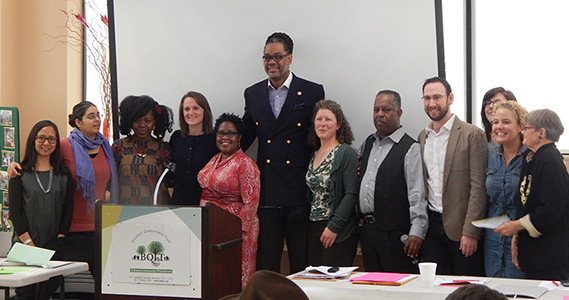
Bed-Stuy Residents Dorothy and Demetrice Mills’s Give $50,000 to Brooklyn Queens Land Trust

Dorothy and Demetrice Mills’ presentation of a $50,000 check to the Brooklyn Queens Land Trust surprised the organization’s president Meg
Fellerath (far right), treasurer Irene Van Slyke, the Board of Directors, staff, supporters and community gardeners at BQLT’s annual meeting,
last Saturday. City Councilman Robert Cornegy, seen standing tall, below, in group photo, came by earlier and was applauded for his donations
to the group, as well. (Photo: Mark Stewart)

Demetrice and Dorothy Mills are the epitome of all that’s right about Bedford-Stuyvesant — and the world, for that matter.

And it is fitting that Brooklyn’s observance of April Earth Month & Volunteer Month and the Annual meeting of the Brooklyn Queens Land Trust (BQLT) would be the proper time and the appropriate place, Center for Nursing & Rehabilitation at 520 Prospect Place in Brooklyn, for the couple’s surprise special announcement last Saturday, April 9, 2016.
The couple – he, a former corporate executive, and she, a former educator — donated a personal check in the amount of $50,000 to BQLT, an organization that is close to their hearts, which they helped to grow from seeds planted many years ago.

He once said, “A president has to be a leader, cheerleader, and motivator for board members, setting the direction for the future of the organization.” He didn’t mention that coming along with the job is being a good role model – which is what he and Dorothy are. The dynamic duo of Dorothy and Demetrice Mills have set a standard for the rest of their Bedford Stuyvesant community. With this gesture, hopefully, others will be inspired to give back in a way that invests in the future of our gardens, our children and our neighborhoods.

All of the achievements, credentials, awards and accolades amassed over the years do not measure up to the love the Mills have for the land. He comes from “a family of farmers” who own “A fair amount of farmland in the South.” She comes from a family of real estate investors in urban New York.

It factored into his volunteer work for gardening groups, and his founding of the Classon Ful-Gate Block Association Community Garden.

Under his presidency, BQLT community gardens enjoyed a great expansion to 32 community gardens conveyed by the Trust for Public Land (TPL) and stretching from Park Slope to Bedford Stuyvesant, Fort Greene/Clinton Hill to Flatbush/East New York, from Bushwick in Brooklyn to Cambria Heights, Jamaica, and East Elmhurst in Queens. The BQLT partnered with TPL to save the gardens from the auction block in 1999.

“Many gardeners had taken care of their gardens for many years, in some cases, for decades,” he once wrote, “and they organized to save their gardens. The founding gardeners and the garden members are our real heroes.”

Demetrice Mills, a Past President, Brooklyn Queens Land Trust, has been a BQLT member since 2006 where he has served as treasurer and secretary. He was president of the Board (2010 – 2014). And, from 2007 to 2015, served as co-Chair of BQLT’s Operations Committee. He is now the Chair of BQLT’s Operations Committee.

In addition, he is a Board Member of the NYC Soil & Water Conservation District, a member of New York City Mayor’s Office of Environmental Remediation – NYC Clean Soil Bank, a member of Cornell University Cooperative Extension Healthy Soil Advisory Committee, a Board Member of the Land Trust Alliance New York Advisory Committee and a Board Member of the American Community Garden Association.

Demetrice Mills has dedicated even more of his time to the community by volunteering with a number of community groups, and educating and inspiring people of all ages to become involved in their communities. In addition to his role as a founder of the Classon Ful-Gate Block Association Community Garden, Mr. Mills is a member of the Bedford-Stuyvesant Community Block Association, a past President of the Classon Ful-Gate Block Association, a member of Community Board 3, member of BedStuy Alive, Treasurer of the 79th Precinct Community Council, and a 2007 Graduate of the New York City Police Department Citizen’s Academy. He is a volunteer member of Bedford Academy High School PTA and he and his Dorothy co-chair the 79th Precinct Council’s College Scholarship Campaign Committee, an annual campaign to help local high school graduating seniors obtain a college degree.

The BQLT relies on grants and money they raise from collecting member dues and special events like bake and plant sales. They are the recipients of grants from politicians and urban gardening programs such as Green Thumb. “It’s really the volunteers in each community garden that keep it thriving,” Mr. Mills once said. “And offering a helping hand is an easy way to start. Just walk into your local garden and let them know that you are interested in volunteering. From picking up garbage to raking the soil to repairing damage from last year’s tornado, every little bit helps.”

And the Mills’ $50,000 will go a long way, too.

Demetrice and Dorothy have been together for some 44 years, and married, 34. They have four children and two grandchildren.

OUR TIME at Home … Gray Matters: Elaine Greene’s Journey

By Bernice Elizabeth Green


Elaine Greene is tired of “real estate thieves stealing properties” and she wants the community to join her “fight back” campaign.


Taking Care of Business: Elaine Greene (left), owner of the Bed-Stuy based church uniform store, Greene & Greene, with her employee, Mrs. Argena Sheffield. Photo credit: Bernice Elizabeth Green.

At the Monday, April 4 Community Board 3 public meeting, Ms. Greene invited everyone present to sign petitions on behalf of Rita Gray, her former landlord who “lost” one of Central Brooklyn’s prime corner properties, a huge structure on the northwest corner of Bedford & Fulton, across from the El-Taqwa Mosque.


The story of a possible property scam was first reported in Our Time Press last fall. Successive stories have appeared over the course of the winter. Ms. Gray’s tenants hired a lawyer to stop evictions by the new owner, and Ms. Gray took it to the Kings County DA’s Office.  Until a few weeks ago, Ms. Greene held on to hope that Ms. Gray would pull through it all, and with the help of her devoted tenants, win back her building.  Ms. Gray and the tenants were fighting an uphill battle allegedly against the odds of statute-of-limitations laws, among other matters and unfortunately they were forced to vacate the building by February 29.


But it’s a story that is top-of-mind in neighborhood consciousness, and it’s not going away.  Ms. Greene’s petitions are getting around, and her voice is being heard by members of one of New York State’s biggest armed forces – the women in white, men in white gloves: the ushers who march down the aisles of churches city and statewide every Sunday. Ms. Greene is one of the largest retailers of uniforms and regalia for church ushers (Church Ushers Association of Brooklyn and L.I., United Ushers Benevolent League, Eastern Baptist Ushers Association and so on), plus the Orders of Eastern Star and Masonic Temples in Central Brooklyn. Her Med Couture, Med Couture Gold and Peaches products include full-length slip gloves, stockings, shoes for all ages.


Her tiny business is now relocated from 1258 Bedford along an arm of the corner property to a small space on 482 Tompkins Avenue, where women and men stop in weekdays 5:30-7:30pm, or Saturdays all day starting at 9:00am.  Her customers purchase, engage in talk and testimony, and more often than not, round everything off locking hands in prayer.  At least that is what we observed on Tuesday.


So why would an active small businesswoman who holds onto a full-time job at Interfaith Hospital (37 years), and has a full-time life which includes ushering at her home church at Brown Memorial in Clinton Hill, want to add a huge mission to her overloaded plate? It has a lot to do with Ms. Gray, an elder and an immigrant being taken advantage of.


Behind Closed Doors, A Double Standard revealed: The true face of gentrification is in the shadows cast by other worlds.  That bitter truth was revealed inadvertently on Tuesday by this man who hid from Ms. Greene’s camera. She and other business owners were evicted from the ground floor while other businesses remain in stealth on the second.

“And enough is enough,” she told us.


“It’s a criminal act, and they have been doing this for years and years and years and getting away with it. Ms. Gray is elderly, an immigrant.  Justice was not in her favor. The decision to let the complainant, Robert Thomas, have the building was not based on the facts.”


Ms. Greene, too, is disheartened by this ‘passive generation’.”


“There’s no sense of struggle and fight.”  But she has started a movement to send a message to greedy developers. “We’re not giving up.”


Ms. Greene actually went back to the building on Saturday evening.  She had been told that the tenants who occupied the second floor were still there.


While the ground floor – minus the six or so small, diversely owned businesses–was gated and closed, the second floor was lit.  She could tell that people were going about their business upstairs; there also was a message for FedEx taped outside the building.  She noticed something else: an open box attached to the building with bundled loose wires appears to signal a safety hazard condition.


Ms. Greene rang the bell, and a man came down.  When Ms. Greene inquired that she thought all residents were asked to vacate the building, he replied by hiding behind the door, “We have different leases.”


Ms. Greene cited another double standard: “Funny, how the man who owns the building now never gave Ms. Gray a dime for it. So what was the sale price if you say you had the option to buy it?  There was no sale price ever mentioned in the court.  There was no closing, no kind of negotiation considered.
“And these kinds of scams going on with our seniors is linked to homelessness in this country.  It should be probed not just here in Brooklyn, but in California, all over. Those people on the second floor were there before February 29th and they are still there.”


Ms. Greene said she and the other tenants appeared at a town hall meeting sponsored by Robert Cornegy in January at Restoration.   She was inspired to do research and learn more about the situation.


Mr. Thomas, through court records, says he acquired the property through an agreement with one of Rita Gray’s family members.  But Ms. Greene’s research reveals that Thomas has a history of securing properties through a similar fashion. “And they are mostly owned by people of color, the elderly.  It adds up to millions of dollars stolen, not to mention the tax dollars people who scam the community get away with not paying.”

Ms. Greene will provide to Our Time Press updates on her journey throughout the year.


“A Caring Hand” Expands Grief Services to Bilingual Families

By Whitney McIntosh

Each year in New York City, over 4,000 children experience the death of a parent or sibling.  The majority of those grieving children do not receive the counseling and support that they may need and deserve. Parents may not be aware that resources exist, and others may face a cultural stigma about seeking emotional support. That is why A Caring Hand exists.


Concerned Care Givers and Receivers
are elated over new “Caring Hand” service. (Photo: Mitchell)

A Caring Hand’s sole goal over the last 8 years has been to devote as much time and resources as possible to helping families and children through times of unimaginable grief no matter what the source: accidents, crime, illness, natural causes or self-harm. In group or individual sessions, services cater to each individual family’s situation. Even with the generous donations from supporters and foundations, A Caring Hand has been limited in providing support and guidance to families throughout the city during one of the worst and confusing times in their lives. For example, until now, no such services existed in New York for bilingual families.


In late March, A Caring Hand launched the city’s first bilingual family grief program. At a press event on March 1st, A Caring Hand announced that thanks to the generous support of the New York Life Foundation and A Little Hope, Inc., the organization was moving forward to be the first and only nonprofit in the city providing grief counseling for children age 5-17 and their Spanish-speaking parents and caregivers.


In a sunlit and mahogany-rimmed room of the City University of New York’s Harlem campus, longtime supporters and staff of A Caring Hand beamed with pride as they detailed the new program and how overjoyed they were to finally include bilingual families into their sessions. This has resulted in record enrollment with the addition of a group of Spanish-speaking mothers.


Dr. Robin F. Goodman, executive director (far left), and Manhattan Borough President Gale Brewer (far right), were speakers at a recent milestone event, attended by, left to right, care activists Sylvia Wong Lewis, Byron Lewis and Ms. Witherspoon. (Photo: Mitchell)

Speakers included A Caring Hand founder Susan Esposito-Lombardo, Dr. Robin Goodman, Executive Director and Manhattan Borough President Gale Brewer.


“It’s one thing to be known at school as the kid who’s good at baseball or math, but another to be known as the kid whose dad died. Grieving children often hate feeling different. And they don’t know where to turn to sort through a jumble of new feelings that can include sadness, guilt and anger,” said Dr. Goodman.


One of the main features of the services at A Caring Hand is the 11-week group sessions where families come together. After pizza (one of the universal New York City kid-pleasers) the children [age 5-17] meet in groups, the youngest, middle and teens separately, while their parents and caregivers have their own group.  “The kids meet others who are going through exactly the same thing, and it’s an enormous relief for them to know they are not alone and have a place to share memories and sort out emotions. They gain new coping skills and even have fun. In the adult group, members express their concerns, gain support and learn to be a confident parent,” Dr. Goodman said.


A Caring Hand intake clinician Tamara Velasquez, whom Spanish-speaking callers first speak to, enthusiastically welcomed the attendees in Spanish and English. She proceeded to impress upon the crowd and any concerned families the importance of simply taking the first step and picking up the phone, finding hope at the other end of the line.


Borough President Brewer expressed her support and encouragement, focusing on the impact that the bilingual capabilities of the program will have on the city as a whole, where services can be lacking. Now that ACH has increased capabilities to support bilingual children and families it will make all the difference to close some of those gaps.


Susan Esposito-Lombardo, who started the A Caring Hand memory of her father Billy Esposito, who died on 9/11, was one of the most affecting of all the day’s speakers. Esposito-Lombardo recalled her father and his kindhearted behavior towards all. In her touching remarks, she shared some of her own story, knowing what it is like when your life changes in an instant, worrying about her mom who, in turn, worried about her and her brother. Esposito-Lombardo notes how the foundation is expanding in new and beneficial ways that would make her father proud, being there for as many families as possible from all corners of the city with a growing, caring community for its most vulnerable residents, its children.


Families who are interested in A Caring Hand should call 1-212-229-CARE (2273) or e-mail info@acaringhand.org, and visit the website at www.acaringhand.org.  Sessions are conducted in Midtown Manhattan and Harlem.


Being Economically Viable in Today’s Economy: “Being the company of one.”

By Akosua K. Albritton

In 1993, Michael Douglas starred in Falling Down a movie with strong social commentary.  One short scene involved an African-American man dressed in slacks, white shirt with rolled sleeves, top two buttons opened, and loosened neck tie.  He carried a placard in his hands and cried out to the gathering crowd about how he lost his job because “I am not economically viable.”  He wasn’t sure what it was that made him “not viable” in that economy.  It is now 2016.  There are millions of Americans who make themselves not viable for the present economy by not adjusting to changes in market demands, needed skills, and not thinking like a company of one.


On April 6, 2016, the Brooklyn Chamber of Commerce and Liquid Talent held the 2016 Future of Work Summit, Exploring What the Next Generation of Work Looks Like in Brooklyn at Brooklyn Law School.  What was discussed is how a significant minority of Brooklynites have been earning income for many years.  It is the reality of the W-2 (employee) vis a vis the 1099 (independent contractor) tax status.  For many people, it is the merging of these two statuses to design one’s particular lifestyle.


Isaac Oates, CEO, Justworks

The summit examined the changing attitudes about work, craft, growth, productivity, and self-esteem for the business manager and worker.  Isaac Oates Founder and CEO of Justworks in his keynote address posited “Rather than achieving the work-life balance, workers [or craftspeople] seek work-life harmony.  This harmony comes when workers have a sense of project ownership.”


Because more people choose a challenging project with good compensation over a full time permanent job, Oates contends “people seek learning opportunities; want to enjoy benefits and perks; and need flexibility in when and where they work.”


Liquid Talent Co-Founder, Alex Abelin.

The “Moving Towards a Project-Based Economy: Is 1099 the Future?” breakout session was moderated by Liquid Talent Co-Founder Alex Abelin.  He queried Caitlin Pearce, Freelancers Union’s Member Engagement Director; Chad Sanders, Dev Bootcamp’s New Products Director; and Chris Sojka, Madwell’s Co-Founder and Creative Director about the realities of the independent contractor’s lifestyle; i. e, being the company of one.


Caitlan Pearce, Freelancers Union’s Member Engagement Director.

Caitlin Pearce perked many ears when she stated “34% of the country identifies as 1099ers.”  This means millions of American households have staked a claim in their own talent and ingenuity rather than the standard 9 to 5 job.  Pierce said “There are a lot of benefits to being a freelancer…You have choices in jobs and skills.”  The counterbalance is “a freelancer must be great at doing taxes, getting clients, and using one’s skills set.”


Nonpayment is the quintessential issue.  Chris Sojka plainly said, “Getting stiffed is common.”  Pearce revealed 70% of her membership has dealt with nonpayment or partial payment.  In fact, businesses are willing to go through suing.”  Freelancers Union educates its membership on contract negotiations to reduce these incidents.


If a person surfs the web and other media, one may come away with the idea that the future of work as an agile independent contractor is open to only coders, web designers, writers, graphic artists, and webmasters.  Caterers, custodians, transcribers, database managers, customer service representatives, and the construction trades are in this world too.  Pearce contends “We need to be mindful about the whole subcontractor sphere.”  Unfortunately, the caterer and janitor are held in lower regard than the chemist and coder.  The Freelancers Union is righting the situation of treating these subcontractors as a subclass.  In fact,” safe work environments, discrimination, inequality, and business support are continuing pressing issues for this organization.”


The future and present require people skilled in current technologies—be it culinary arts, business services, or construction trade–and willing to learn process modifications or totally new processes.  The skills set and willingness to learn something new is what keeps anyone viable.


Chad Sanders , Co-Founder, Dev Bootcamp

Dev Bootcamp’s Chad Sanders explained “Most of our students are career changers forfeiting current skills to come over to Dev Bootcamp to gain leverage by learning code.  Dev Bootcamp is a 19-week program that combines technical skills training with learning how to stay adaptive in the market.”  This adaptiveness ought to be long term, having a 20 year trajectory.  Madwell’s Chris Sojka encourages everyone to expect “you can learn something new. Fluidly moving through other disciplines and evolving within their own career and within the organization.”  Sanders posited “The nature of the economy requires having colleges that orient students to this thinking.”


In the interest of revealing the panel’s depth of commitment to the new work place, the moderator Alex Abelin asked whether any of the panelists accept their employees freelancing elsewhere.  Sojka said “I encourage my employees to freelance.  This results in getting fulfilled and expanding the skills set and deepening experience.”  Sanders remarked “I know of businesses that warn against freelance.”  He encouraged freelancers to “have an agency to support contractors in project sourcing, payroll, accounting, and insurances.”


Tami Reiss, CEO, Cyrus Innovation

The Group Panel Discussion, “The Way We’ll Work: The Future of Work Panel” was moderated by Tami Reiss, Cyrus Innovation’s CEO and panel members David Ehrenberg, Brooklyn Navy Yard’s President & CEO; Katie Hunt-Morr, Neutralized’s CEO; Arthur Woods, Imperative’s Co-Founder; and Toby Moskovits, Heritage Equity Partners’ Founder and CEO.


The questions and responses etched a new American workplace characterized by collaboration, partnering, and trust that grows loyalty.  The 40-hour week is replaced by focusing on meeting deadlines.  David Ehrenberg who had taken an extended maternity leave said, “The bottom line is as long as the work is getting done there is work hour and location flexibility.  Similarly, Arthur Woods promoted “job tailoring” examples of which include working from home and coming in earlier or later which give “creative agency to make decisions that are right for you.”


Kate Hunt-Morr contended “Getting Americans to be mindful of time zone differences is necessary to transact business [given one’s business partners may be in different parts of the globe].”  Hunt-Morr asked “How to bring purpose-driven work [ethic] to lower income households in Brooklyn and in other nations.”


The future of work in Brooklyn is looking up.  Not only do business managers want team-thinking and collaboration within their organizations, they desire better communication and touch points with other local businesses.  Toby Moskovits “believes the various work spaces in Brooklyn that lead to bumping into other businesses is one reason businesses are coming to Brooklyn.”