Home Blog Page 816

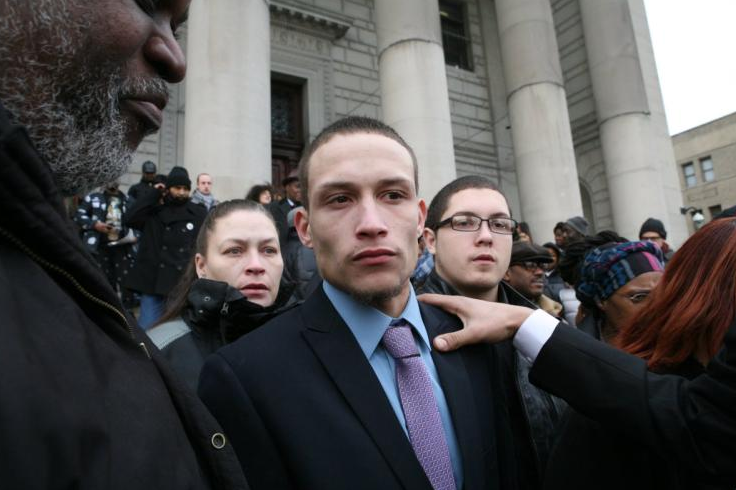
Ramsey Orta: (Opinion) by Alton H. Maddox, Jr.

Parker’s “The Birth of a Nation” ©

By Alton H. Maddox, Jr., “Attorney-at-War”

On “60 Minutes” last Sunday night, there was a discussion with Nate Parker, who plays the role of Nat Turner in “The Birth of a Nation”.  The premier may happen this week.  I have always had an interest in Nat Turner.  My research has shown that his “insurrection” prompted the Virginia General Assembly to come within four votes of liberating all “slaves” in Virginia.

Malcolm X said:  “Of all the disciplines history is best qualified to reward our research, Nat Turner should be given his ‘propers’.”  I know of no venue in New York City that has given proper deference to this “freedom fighter”.  This is shameful in a city where blacks constitute the largest and oldest ethnic group.

Courthouses have always been of great fascination to me.  Beyond my second trial in New York, I had vowed to never try a case until I controlled the courthouse.  I kept my promise. Initially, I had to desegregate the courthouses in New York City.  I have an audiotape of attorney Phroska McAllister praising me for being a “Rosa Parks”. This happened a decade after Brown v. Bd. of Ed.

I asked all black lawyers to appear at the arraignment of the “Central Park 7”.  No black lawyer accepted the invitation pro bono.  Clara Jones, Harold and Eloise Dicks and Roy Canton et al had asked me to represent one of the defendants, Michael Briscoe pro bono against a political duopoly, a special interest group and a pressure group with no war chest.  I not only showed up, my client walked.

Twenty-seven years later, we should take another stab at it to save Ramsey Orta.  Pressure should first be applied to the National Bar Association(202- 842-3900, Fax: 202-315-3051), followed by the Metropolitan Bar Association (212-964-1645) and black law enforcement associations and organizations.  It is no time for black organizations and associations to remain silent.


Brooklyn Movement Center Holds 2016 Annual Meeting

REVISED

By Akosua K. Albritton

Brooklyn Movement Center (Brooklyn MC) held its 5th annual meeting on October 1, 2016 in Stuyvesant Mansion at 375 Stuyvesant Avenue. Attendees included board members, their core members, solidarity members and the curious. Notable guests included Stefani Zinerman of CM Robert Cornegy’s office, NYS Assembly member-elect Tremaine Wright and The Brooklyn Reader Publisher Zawadi Morris.

Lead organizer Anthonine Pierre made the opening greetings and primed the body for thought-provoking discussions by posing the questions: 1) How does Brooklyn MC activists make themselves sustainable beyond their first five years of existence? 2) What does it look like to do Black Lives advocacy? And 3) What is the role of Black elected officials in this work? Community organizer-turned-City Council member Jumaane Williams gave an engaging keynote speech that responded to the third question.

Dressed in a pullover sweater and slacks, Williams spoke frankly about race relations, power structures and the power that’s generated by community-driven social justice campaigns. He quipped, “Central Brooklyn really means Black Brooklyn”. Williams explained, “There is a structure now where some people benefit and others don’t. Black Lives advocacy is difficult due to the people being addressed”. Williams went on to say, “The difficulty in organizing around Black issues is that many people don’t want to deal with the conditions of Black people. It is okay to organize around women’s issues but Black has a difficult path. Then there is the fact that leadership in some organizations don’t have Black leadership. Take Flatbush Development Corp. and Tenants and Neighbors as examples”.

Williams asserted that “public safety can’t be left up to the police”. It should also include housing, education and employment. Further, he contended that “Stop, Question and Frisk could be a useful tool; however, it is overabused due to bias-based policing”. The bias is in the preponderant stopping of men of color and the tactic is used to meet quotas rather than observing questionable activity by anyone and then implementing all the steps in Stop, Question and Frisk.

After three icebreaking questions were bandied, the meeting moved to describing Brooklyn MC’s work groups which are Police Accountability, Food Justice, Environmental Justice, Street Harassment and Brooklyn DEEP.

Peter Velez explained the Police Accountability Work Group focused on Central Brooklyn. Velez said that “Social Media and cell phones give people a longer view of the abuse waged on Black and Brown bodies”. Current initiatives are the Right to Know Act, business cards for police officers and Consent to Search. This work group coalesces with Communities for Police Reform, which is a citywide coalition.

Sabine Bernard and Ogonnaya Dotson-Newman presented the Street Harassment Work Group. Street Harassment works on measures to reduce verbal and physical assaults on women, queer folks and gender nonconforming individuals. The No Disrespect Project focuses on the harassment and objectification of women by men while in public spaces.

Sala Hewitt discussed the aim of the Food Justice Work Group which deals with “providing access to affordable and quality food choices to the local area”. The work group has been engaged in incubating and incorporating the Central Brooklyn Food Cooperative. The food cooperative currently operates from the Brooklyn Movement Center.

Veralyn Williams described Brooklyn MC’s Brooklyn DEEP podcast. Ms. Williams said, “Brooklyn DEEP is a platform for people to be the owners and tellers of their own stories”. Williams envisioned Brooklyn DEEP becoming “the APP for Central Brooklyn”. In recognition of Veralyn Williams’ departure from Brooklyn MC, Executive Director Mark Winston Griffith surprised her with a flower bouquet.

Griffith transitioned to discussing the Environmental Justice Work Group which is the newest area of work. This work group has two projects: Central Brooklyn Solar and BASE. Central Brooklyn Solar is an effort to increase the installation of solar panels throughout Central Brooklyn. Brooklyn MC received a $5,000 seed grant from NYSERDA to organize Central Brooklyn Solar.

BASE is the acronym for Brooklyn Alliance for Sustainable Energy. This project is in keeping with Consolidated Edison’s mandate to bring down energy consumption. The BASE coalition seeks to have a new substation constructed in Brooklyn in order that increasing energy demands are fulfilled.

The annual meeting closed with a practical discussion on sustaining the organization in terms of people and finances. Griffith explained the membership needed to increase in number and where everyone is paying dues. Further, members require training to do effective outreach about the group’s causes and to bring more people into the fold. To increase funding, the board of directors and members are put to task to execute more effective fundraising.

This annual meeting was a strategic planning session that gave attendees the means to address such issues as balancing the power between the public and the police, the right of women to be in public spaces, siting clean energy in communities of color and making available affordable, nutrient-dense food. With effective and consistent public outreach, the Brooklyn Movement Center may positively impact lives through collective work and responsibility.

Interview with NYC Corrections Commissioner Joseph Ponte

Exclusive to Our Time Press

Interview with Joseph Ponte, Commissioner New York City Corrections

Part One of Two

New York City Corrections Commissioner Joseph Ponte is a small town guy in the big city, who is changing the culture at the problem-plagued Rikers Island complex that’s been the topic of reports of mismanagement of both prisoners and correction officers. The Commissioner visited the offices of Our Time Press last Thursday, September 29 to address a wide-range of topics and issues.

Making the impossible, possible

One of the commissioner’s most immediate and impactful reforms was the elimination of punitive segregation for 16- and 17-year-olds, something people have been requesting for years. He had not been in the job for a year and he got it done. He then went on to 18-year-olds and he has effectively eliminated it for 19- to 21-year-olds. The reforms are having an immediate impact on communities

We asked Ponte how does that happen? How does the impossible became possible”?

The commissioner said he knew it would work because he had seen it work in Maine, with its progressive juvenile system, that over a 15-year period has eliminated punitive segregation. “They have found ways to manage young people without using” punitive segregation as a tool, he said. “The work they had done in Maine on the juvenile side was very impressive. It’s probably the top two or three in the country as far as managing juvenile offenders. It also cost them about 200,000 plus a year for every juvenile in custody.”

Ponte says “these are not throwaway people,” and should not be locked away from the community forever. 

Corrections Officer Training

As a first step, the commissioner said that the screening requirements for the officers have been raised to the NYPD level, a process that required hiring and training the staff who were investigating the applicants.

“It used to be if you tried to get a job at NYPD and got rejected, you could come and apply and come to work for DOC. Now we apply the same standards.” Beyond the application are the new expectations of the officer. “If you look at the job postings, they don’t add up to all of the things we ask officers to do today.” Things like training in mental health and managing mentally ill inmates. “None of us signed up to work in a mental health hospital, but 40% of our inmates have a level of mental illness. And like I said, it’s not in the officer’s job description working with the mentally ill.

Additionally there was no training done on how to manage adolescents, 16, 17, and 18-year-old, “which is much different than how you manage adults.”

The biggest challenge has been to shift the staff “from a model that really was punitive, so when inmates misbehaved, we locked them up. Misbehave again, we locked you up longer. So as we ended that model, we needed the officer to be more engaged with the inmate.”

In the past, officers didn’t see themselves as that kind of role model and “it really requires a shift in culture.” By the end of the next calendar year, they expect to turn over almost half of the officers and Ponte see that as a good opportunity to effect the culture change that’s needed.

“We don’t change our inmates or the people committed to our facilities without changing our staff,” says Ponte.

Juvenile Offenders

Coming to the State, Ponte was surprised that New York classifies 16 and 17-year-olds as adults. “In the rest of the world, they’d be juveniles and they wouldn’t even come into the adult system,” he says noting that New York joins with North Carolina as the only two states that classifies 16-year-olds as adults. “And one of 10 that treats 17-year-olds as adults.”

At Rikers, even though teenagers are sentenced as adults they are treated as juveniles inside the facility and separated from the adult population, and can attend high school on the island. Even so, the commissioner says that by being in the adult system, they don’t have the range of options that a juvenile system can offer. “The department can’t say, “This kid doesn’t need to be incarcerated, we should divert him into a program.”

Ponte said that with the support he’s received from the Mayor and the Council, he has been given the resources to decrease the inmate ratio to 1 officer to 15 inmates, where it used to be 1 to 33. While at the same time dividing up the population into adult, juvenile, mentally ill, violent offenders –those areas restricted to no more than six inmates per officer “and at times you’ll have one officer per inmate. So you may have as many officers as inmates in these areas just to be able to manage them without locking them up. The options would be lock them up in segregation, and we don’t do that. So we just increase the staff to provide the safety and make sure the programming still runs.”

This is labor intensive but if it were a juvenile facility the staffing levels would be much higher, said Ponte. “It’s one thing to say that it costs a lot of money, and it does. It’s the other thing that their outcomes are much better,” and that has to be the ultimate goal. “With this staffing model, our outcomes are much better. Locking kids up into segregation was a bad idea 10 years ago, it was a bad idea here and we stopped that in December of 2014.”

The inmates can be there for several days or several months and it is the longer stays that have remedial and trade training certificate programs available to them and the department has recently gotten funding to have a re-entry component for adolescents so that when they are released, they don’t just get a MetroCard back to the neighborhood. The family situation is looked at. Is he going back to school? Is there mental illness? Ponte says it’s a matter of “trying to set that community piece up for him or her so when they get back out there,” they can deal with the peer pressure and if steps are not taken, “we’re going to lose you real quick. So having some structure to the release makes a lot of sense.”

Model Facility Shows Results

On the island there are two model facilities that have been made into crucibles where the best practices and the lessons learned from a “painful” self-evaluation of the department have been put into practice. “We spent several months doing a very deep dive into the organization, talking to staff” said Ponte. It was an organizational health survey and we rated probably at the bottom of the barrel. You couldn’t have probably gotten any lower.”

In these facilities, the George R Vierno Center (GRVC) and the Anna M. Kross Center (AMKC), the 14-point Anti Violence Reform Agenda was initiated which was a holistic approach to incarceration, with the understanding that each element was dependent on the other. “The 14-point plan really encompassed everything, from the quality of staff to the training of staff to the safety of staff to the programming of inmates.”

The Commissioner emphasized the importance of programming in the institution. Before he came, “most of our inmates got zero to no programming. I mean they could go to rec, they could go to law library, that’s not programming.”

In these model facilities “it’s up to five hours of additional programs and that’s not counting rec and law library, which they’re all entitled to. That’s additional programming. It could be educational, it could be antiviolence, it could be anything of that nature.”

The results achieved by these facilities in reducing violence is very impressive. From Sept. 14, 2015 to Aug. 31, 2016, comparing expected incidents based on historical records with actual events, they show violence is down over 70%. “That’s after going through the entire process, from cleaning the place up, doing the infrastructure changes, making sure all the locks and doors work and then retraining the officer, re-classifying the inmates, ensuring the officer has ownership of his or her housing areas, and then adding the programming piece.”

Rikers has a population where half, about 4,000, turnover in seven days and for the rest, the average stay is about 56 days. “But there is a substantial group that did more serious crimes, about 170 days on average. That’s, when we can offer programs that are beneficial. A lot of these guys in these areas show more serious criminal behavior, but they’re also well-behaved when we offer the programming piece to them.”

Programs like the OSHA certification course are very popular as are safe food handling. “I’m telling you, they’re signing up for this and we’re getting 60%, 70% participation in programs, which for me I’ve never seen in jails and prisons. Part of it is they’ve never had anything. We literally could offer nothing.

Violence

“Violence is really driven by a small percentage of the inmates. Most inmates like everybody else, they did something wrong, they’re going to come in and do their time and they want to go home. It’s maybe 10% that are really most problematic,” and those would be the 16 – 25-year-olds.

The commissioner is a strong proponent of alternative models for incarceration saying “While they are violent felons, there are issues, either addiction or mental health, that are cheaper to do” outside of the incarceration system.

For us now, it’s really developing the programs and getting them to the highest level, doing the evaluations on those that are effective and impact and recidivism, those that aren’t. So it’s really fine-tuning the stuff that we have. We have a lot of stuff rolling out at the same time. And trying to then, at some point, maybe a year from now, we start to look at evaluating what’s worked, what doesn’t work, what’s better, what’s not.

Some of the stuff has never been done. So we created a secure unit, which is where the inmates are out of the cell about 10 hours a day, and restricted in small numbers. But they go to program and they go to rec. They have some interaction in small groups but there’s no punitive seg for that age group.

No one in the country’s even trying that, they are reducing their reliance but no one’s saying I’m going to eliminate it. Not only are we saying it, we’ve already eliminated it for 18-year-olds,” considered adults in many parts of the country, “and we will eliminate it for 19 to 21-year-olds real soon. When you ask if there is somebody else out there that we can copy from, not in these kinds of program and operational areas because no one’s even trying, they’re not even talking about it.

Asked how long to roll out these practices across the Island complex, Ponte said it would take at least a year and probably two.


Incarcerated Women

“Most female crimes are usually committed along with the male participant, most times. Problem is as we incarcerate more women, we’re incarcerating families. Many times, the woman is the leader in the family, so you incarcerate them, don’t give the support, and you’re creating generations of problems for the city.”

Rikers has about 600 women and punitive segregation has already been eliminated for them and programming put in “but it’s just not enough. We need to get in front of that. Most of our female offenders are not violent. They’ve committed crimes, ideally, but typically it’s with a male. You know, almost always it’s with a male.”

Commissioner Ponte says, “we need to get smarter” about incarcerating women and the long term damage that entails. “They are the true breadwinners and (the one’s) holding (the) structure together.”

___

If Commissioner Ponte’s policies roll out successfully, then the small town guy from Maine would have done this big city a great favor. Part Two will be presented next week.

The Commissioner fielded questions from Our Time Press co-publishers David Mark Greaves and Bernice Elizabeth Green with community leader Dr. Kim Best, former President, 79th Precinct Council, on Thursday, September 29, 2016 in Brooklyn, New York.
Legal Aid Society lands $5.74 million on behalf of a mentally ill man who died at Rikers Island

SETTLEMENTS

Legal Aid Society lands $5.74 million on behalf of a mentally ill man who died at Rikers Island

This week the Legal Aid Society Prisoners’ Rights Project and Emery Celli Brinckerhoff & Abady announced a settlement in the case of Bradley Ballard, a seriously mentally ill and diabetic man whose horrific death at Rikers Island in 2013 was ruled a homicide. The settlement of $5,750,000 is the largest ever entered into by New York City for a death in custody. His death was due to the abuse and cruelty of Department of Correction staff and medical providers. Mr. Ballard arrived at Rikers on a parole violation for failing to change a report of address. His needs were mishandled by the city’s health care contractor at the time, Corizon Health, Inc. The abuse took a macabre turn when Department of Correction staff illegally shut him in his cell as a rogue punishment for perceived rudeness, leaving him to decompensate without medication or treatment for his schizophrenia and diabetes. For seven days, until Mr. Ballard died on September 11, 2013, correction and medical staff walked by the locked cell without offering assistance, turned off the water to his cell and ignored his obvious and fatally deteriorating state until it was too late. Mr. Ballard’s mother, Beverly Ann Griffin, was represented in this lawsuit by Jonathan S. Abady, Debra L. Greenberger and Hayley Horowitz of ECBA and Jonathan Chasan and Mary Lynne Werlwas of the Legal Aid Society.


New Council Bills

This week the New York City Council’s Committee on Housing and Buildings, chaired by Council member Jumaane D. Williams, Deputy Leader, held a hearing to discuss two bills: one that would require street numbers to be placed on every side of a building that contains an entrance, and the other that would require the Department of Environmental Protection (DEP) to be notified whenever excavation or drilling to a depth greater than 50 feet is proposed. The committee heard testimony from elected officials, members of the real estate industry and interested members of the public.


Funding for Small Businesses

U.S. Senators Charles E. Schumer and Kirsten Gillibrand last week announced $150,000 in federal funding for Harlem Biospace, Veteran Incubator and Coalition for Queens. The federal investment was allocated through the U.S. Small Business Administration’s Growth Accelerator Fund, through which each recipient receives $50,000 for growing their businesses. These investments provide entrepreneurs with support from committed and experienced mentors with backgrounds in entrepreneurship, sales, technology and marketing.

The purpose of the SBA Growth Accelerator competition is to draw attention and funding to parts of the country where there are gaps in the entrepreneurial ecosystem. Each recipient of funds will be required to report metrics including jobs created, funds raised, start-ups launched and corporate sponsors obtained among other pieces of information.


Environment

Attorney General Eric T. Schneiderman issued the following statement on arguments before the United States Court of Appeals for the District of Columbia Circuit on the federal Environmental Protection Agency’s “Clean Power Plan”, a rule requiring fossil-fueled power plants to cut their emissions of greenhouse gases pursuant to the Clean Air Act.

“Today, my office is leading a coalition of 25 states, cities and counties in defense of the Clean Power Plan, regulations that will, for the first time ever, limit climate change pollution from our nation’s largest source, fossil-fueled power plants. In our states, we have demonstrated the opponents’ ‘doom and gloom’ predictions are wrong – our states have shown that power plant pollution can be cut dramatically while holding the line on utility bills, maintaining grid reliability, and adding billions of dollars and thousands of jobs to our economies. I look forward to the court upholding the Clean Power Plan and ensuring that we will continue to take essential actions in fighting the unprecedented health, environmental and economic impacts of climate change.”

Opinion: Scott hooting video footage too little and too late

OPINION

Releasing all video in best interest of justice

Published Wednesday, September 28, 2016 7:01 am

by Julianne Malveaux, NNPA

Keith Lamont Scott was killed by a police officer on Sept. 20 in Charlotte. The officer, dressed in civilian clothing, said that Mr. Scott had a gun and that he did not follow verbal orders to put his hands up.

While there is videotape that documents the interaction between Scott and Officer Brentley Vinson, Charlotte-Mecklenburg Police Chief Kerr Putney had declined to release the tapes because there was “no compelling reason” to do so. By Saturday, public protest along with a disturbing tape released by Scott’s wife, provided a compelling reason. Still, Chief Putney released just two short snippets of the shooting and indicated that more videotape was being withheld.

The compelling reason for the Charlotte police to release all of the videotape is because there is a significant difference between what they say happened and what the Scott family says. The police say that Scott had a gun; the family says he was in his car reading a book and waiting for one of his sons to come home from school.

Having reviewed the tapes, the family says it has more questions than answers. Allowing others to see the tape will likely raise more questions, but it will also close the trust gap. Failing to release the full video suggests that the Charlotte police have something to hide.

Releasing tape snippets seems like appeasement, like the drip, drip, drip of the police trying to make a case shooting Scott to death. The North Carolina NAACP, the ACLU, and many others have called for release of the entire, unedited videos, but the police chief has dug his heels in. Does he have something in common with Rahm Emmanuel, the Chicago mayor who claimed there was nothing to hide on the Laquan McDonald tapes? They were released more than a year after his murder, and they contradicted the police version of his killing.

We didn’t have the luxury of tape during enslavement, yet we know that horrors were visited on black people. Slave owner journals, along with some of the implements of torture that have been discovered (and may be displayed in our new museum) document the horrors, but imagine having tape of it.

We don’t have tape of lynching, although there are pictures of those lynched, though they are conspicuously absent in many history books. We don’t have tapes of Rosewood or of the evisceration of Black Wall Street. Indeed, the carnage that economically envious Whites visited on a successful African American community is so shameful that white Tulsans have attempted to erase the record of their cowardly acts – the newspaper articles that recounted White cowardice went missing decades ago.

We don’t have tape of the police brutality that caused so many black deaths in the early and mid 20th century. We know the brutality existed, and we know police officers were never charged “back in the day” for killing or torturing black people. The fact that we didn’t have tape then contributes to the urgency that we get tape now. I don’t know what the tape shows, but I know that I don’t want to leave it to my imagination, and I don’t want a minute here, two minutes there, when we know cameras should have been running for much longer.

When another black man is shot and killed and the police version is that he had a gun, the public deserves to see if the tape backs that version up.

If there is a video record of a police interaction with an African American, it ought to be released, and it ought not to be edited. Failure to do so fuels the anger that spilled over onto Charlotte streets on the evenings of September 20 and 21. Once the family saw the tapes and shared their concerns, people were back on the streets on Sept. 22, but they were peaceful, and the atmosphere was much less tense than it had been.

There is a marked contrast between the behavior of the police establishment in Tulsa and that in Charlotte. In Tulsa, videotape was released just a couple of days after Officer Betty Shelby shot Terence Crutcher. Not a week had passed before the officer was charged with first-degree manslaughter, based on what prosecutors saw on the tapes. People in Tulsa have been outraged, but peaceful.   People in Charlotte feel outraged, but also hurt and betrayed.

It is interesting that Rakeyia Scott keeps telling the police that her husband has no weapon, even as the police keep insisting that he drop the gun. Is this a set up? An Amadou Diallo moment (when a wallet was mistaken for a gun)? Something else. There is a compelling reason to release all, not just snippets, of the tape of Keith Scott’s killing. It is an opportunity to build trust and to show that the Charlotte-Mecklenburg police have nothing to hide from those they are sworn to “serve and protect.”

Julianne Malveaux is an author and economist.