By Lyndon Taylor Outrage and disbelief reverberated through Restoration Plaza this week as community members, clergy, elected officials, and local stakeholders gathered to voice unified opposition to the sudden decision by NYC Schools Chancellor Melinda Aviles-Ramos to remove Superintendent Brendan Mims from his post in District 16.
The hastily convened meeting was led by Assemblymember Stefani L. Zinerman, Deputy Majority Whip and representative for New York State Assembly District 56 in Brooklyn. Zinerman, a vocal supporter of Superintendent Mims, reaffirmed her unwavering confidence in his leadership, citing his student-centered approach and the academic and cultural progress made in the district under his guidance.
“Mims has brought intentional, student-focused leadership to District 16,” Zinerman stated. “He’s laid a strong academic and cultural foundation for our children. This decision is not only a blow to our district, but a disservice to the students and families who have benefited from his dedication.”
Speaker after speaker at the community meeting echoed similar sentiments, offering glowing praise for Mims’ work and demanding answers from the Schools Chancellor and the Department of Education.
“The biggest issue here is transparency,” said Kofi Osei Williams, Executive Director of Asase Yaa Cultural Arts Foundation. “If there was a problem with Superintendent Mims, the principals, parents, and community partners should have been informed. We deserve clarity. We need answers.”
Parents in the district have also voiced their frustration and confusion over the decision. “I’ve known Mims since he took office, and he’s been phenomenal,” said Charmaine Crosby, a longtime parent in the district. “He’s done so much behind the scenes for us parents—things that don’t make headlines but make a difference. Just a month ago, we were here celebrating him, and now we’re fighting to keep him.”
Rev. Afiya Dawson, Senior Minister at The House of Lord Church and a former teacher and guidance counselor in the district, emphasized Mims’ rare caliber as an educational leader. “Brendan Mims is excellent—not just good. He’s a talent who’s made an undeniable impact on this community,” Dawson declared. “Why replace excellence?”
Superintendent Mims, a respected educator and founding principal of M.S. 358 Magnet School for STEAM Exploration and Experiential Learning in Queens, has garnered widespread acclaim for his vision and results-driven leadership in District 16.
As questions mount and support swells for Mims, community leaders say they are not backing down. “This isn’t over,” Assemblymember Zinerman assured the crowd. “We will stand together to ensure our district’s voice is heard.”
At the heart of the outcry is a community fighting not just for a superintendent, but for transparency, respect, professionalism and a future shaped by leaders who put children first.
By Mary Alice Miller The Boys & Girls High School auditorium was nearly full to witness Borough President Antonio Reynoso’s State of the Borough Address. Brooklyn’s diversity was present: young and not-so-young, professionals and community activists, union members and business owners, homeowners and renters, and state and city elected officials. Reynoso gave a special shout-out to community board members.
Suleila Clarke sang the National Anthem. The Nelson Mandela Drum Line and Borough Hall’s own DJ Specialist entertained the enthusiastic crowd. Reynoso greeted the crowd with his wife, Iliana Gomez, and adorable young sons, Alejandro and Adres.
Reynoso spoke of his parents, who immigrated from the Dominican Republic. “I was just a Brown boy from the Southside of Williamsburg. I grew up in Section 8 housing, eating family dinners paid for by food stamps and playing basketball with my friends over at Rodney Park. My family was poor, but we were happy,” said Reynoso. He said he “succeeded because this city bet on him, his parents, and his future.”
Reynoso attributed his success to hard work, luck, and the government: Section 8 housing, food stamps, school scholarships, welfare, and WIC. “It’s all the resources New York and this country used to take a bet on me,” said Reynoso. “Because what it really comes down to is opportunity. The thing about a borough, a neighborhood, a block – it’s not just a geographic location. It’s a gateway to a suite of resources – to schools, to jobs, to trains, buses, healthcare facilities, parks, libraries – all of the things that shape our daily lives and our future possibilities.”
In his first year, Reynoso invested the entirety of his capital funding – a total of 45 million dollars – into Brooklyn’s three public hospitals for maternal healthcare improvements. Reynoso’s office established a new partnership with Brooklyn College to establish New York State’s first credit-bearing Advanced Certificate program in Perinatal Mental Health. Brooklyn College is piloting two of the program’s courses this spring and will host their first full cohort this fall.
“Last year, we invested over 15 million dollars into our K-12 public schools and more than 5 million dollars into CUNY,” Reynoso said. “We even teamed up with Council Member Chi Osse to bring computer lab upgrades to every single K-12 public school in Superintendent Mims’ district in Bed-Stuy. All 19 schools received the money they needed to get new computers, tablets, laptops, and more. And while we can’t say much right now – District 16 won’t be the only school district in Brooklyn seeing this type of targeted tech investment.” Reynoso spoke of the history and potential of New York Harbor as the world’s largest, best-known port. He applauded the state/city investment of tens of millions of dollars to strengthen Brooklyn Marine Terminal and “make it the 21st-century working waterfront of our dreams.”
“They’re starting to talk housing when they should be talking about one thing and one thing only: Red Hook is Brooklyn’s last working waterfront,” said Reynoso. “And this infrastructure, it’s a public good – generations of New Yorkers relied on our manufacturing districts for well-paying, high-quality jobs that provide a path to the middle class. We can’t afford to lose it – not to housing. Because there is no scarcity of opportunities to build housing across the borough, but there is a scarcity of manufacturing.”
Reynoso thanked nonprofits that helped when the City reopened NYCHA’s Section 8 waitlist to help neighbors with their applications; who teamed up for a SCRIE and DRIE enrollment and renewal support clinic, helping older adults and people with disabilities freeze their rents; and helped hundreds of Brooklynites learn about deed theft, access free one-on-one consultations, and receive support with living wills, power of attorney, and healthcare proxies.
This year, the Brooklyn Borough President’s office received the most community board applications since he took office. A year ago, Reynoso testified before the City Charter Revision Commission and asked for the city to create a Community Board Central Office, an independent agency tasked with supporting our 59 community boards. The Community Board Central Office would be charged with providing boards with land use and planning expertise, communications and technology support, space needs, HR assistance, and even help with FOILs.
“Community boards have an important job to do – and we need to make sure they have what they need to do it and do it right,” Reynoso said. Reynoso announced his Nonprofit Acquisition Fund two years ago, committing to prioritizing capital funding to nonprofits looking to buy permanent homes. This year, two nonprofits successfully received funding to do just that: Mixteca – an immigrant women-led nonprofit in Sunset Park – and the Arab American Association of New York – a nonprofit in Bay Ridge that provides all kinds of support to our Arab and immigrant neighbors.
“We are Brooklyn. We got us – even if no one else does,” said Reynoso as he closed the event. “Don’t forget to spread love, it’s the Brooklyn way.”
By Nayaba Arinde Editor-in-Chief “Life in this city is already too expensive— now Trump’s tariffs are driving prices even higher,” evaluated Public Advocate Jumaane Williams. “New Yorkers are struggling to afford the basics.”
Indeed, the public is leaning into the threat of President Donald Trump’s tumultuous tariff trickle-down, which is traumatizing city residents in real time. And then there is the Trump tariff turmoil effect that has the stock market numbers free-falling and seesawing like an indecisive politico arbitrarily weighing up options on a daily basis. As the president plays ping pong with his trade tumble with China, Mexico, Canada, and the world with retaliatory 100%-plus tariffs put on US goods–auto workers and car buyers, electronic goods buyers, clothing stores, tea and toys, and even US farmers, are decrying the effects of the economic checkers game.
“Tariffs hurt low-income families,” possible City Hall candidate Christina Serrano told Our Time Press. The daughter of one-time Knick Greg ‘Jocko’ Jackson (a Brownsville icon, especially with the Brownsville Recreation Center) is a community advocate who worked for Councilmembers Alicka Ampry-Samuels, Chi Osse, and Chris Banks and is running for the City Council seat in the 41st District (which includes Brownsville, Bed Stuy, Crown Heights, Ocean Hill, and East Flatbush).
“We know tariffs are taxes placed on goods we import from other countries. But let’s be clear: when tariffs go up, it’s our families, especially in working-class and low-income communities, who feel it first and worst.”
The economic flexing decisions coming from the White House have created a U.S.-China trade war. Certain observers are charging that Trump keeps changing his mind and the tariff rules, making working—and middle-class folk struggle daily while millionaires, billionaires, and oligarchs count big gains. The fluctuating action has China retaliating against Trump’s 104% tariff on Chinese goods, resulting in China slamming U.S. goods going into China with an 84% tariff.
As the tariff trauma hits on different levels, Public Advocate Williams said, “We need to focus on real solutions that help working people put food on the table and stay in their homes.” Serrano added, “Tariffs make everyday items like food, clothes, and household goods more expensive. For families already living paycheck to paycheck, higher prices at the grocery store or the corner shop hit hard.”
Meanwhile, joint front-running mayoral candidate Assemblyman Zohan Kwame Mandami told Our Time Press, “We’ve been in the race for a little more than 5 months. From the very beginning, it’s been the same message: to fight for a city that we can actually afford because what we’re seeing is that in the wealthiest city in the wealthiest country in the history of the world, working-class workers are being priced out of the city that they built.”
From witty to biting, the political season will throw up some classic remarks. Grassroots activists, authentic advocates, political chancers, and genuine changemakers are getting in gear. This is as the electorate and the general proletariat are navigating the DC-created headwinds with cuts affecting everything from medical insurance to social security, education, and law enforcement. All candidates are striving to convince potential and dedicated voters that they–and they alone—will be representing misrepresented people. This week, some pundits have Mayor Eric Adams’s re-election bid in the rearview mirror, with an Andrew Cuomo versus Mamdani two-man race as the June primary race match-up.
“One in four New Yorkers is in poverty, 500,000 children go to bed hungry every night, and these are statistics that are a stain on our city, and they are the result of political choices that have been made for far too long,” Queens Assemblyman Mamdani told the paper. “You’ve seen this mayoral administration that has taken almost every opportunity to exacerbate a cost-of-living crisis that we will instead combat from the very 1st day that I’m in office.”
Sounds lofty. How so? “We will do so by freezing the rent, by making the slowest buses in the country fast and free, and by delivering universal childcare,” predicted the Ugandan-born, New York-raised candidate with a massive Campaign Finance Board matching funds boosted war chest. His personal experience gives him a particular understanding of immigration and what’s coming down from the White House.
“It is terrifying to see what this White House is putting New Yorkers through because it has put New Yorkers firmly within their crosshairs, detained New Yorkers, disappeared New Yorkers – detained them in ICE facilities as far away as Louisiana without charge, other than engaging in the First Amendment–one of the bedrock principles of this country.
So what does he tell migrants and immigrants who are afraid? “I understand their fear because what we are seeing is a federal government that is looking to deport them at almost every opportunity and a mayoral administration that has refused to show the courage necessary in fighting back against that–instead offering collaboration, or in the words that have characterized Andrew Cuomo’s campaign thus far – ‘cowardice.’ It’s important that we show conviction at this moment, we show clarity.”
He spoke as the news cycle had now Independent candidate Mayor Adams swinging for the fences. Released from the effects of the alleged President Donald Trump quid pro quo federal legal charges, he has a new lease on political life. This past week, Adams addressed the fatal helicopter crash in the Hudson and traveled to the Dominican Republic after the tragic nightclub collapse, which affected New York’s large Dominican community.
As the City Council and mayoral candidate Speaker Adrienne Adams sought to sue the mayor for allowing ICE agents to set up an office on Rikers Island, Mamdani slammed Adams’ other big immigration issue.
“It is New York City law to uphold the pieces of legislation we passed over many decades that have come to be known as our Sanctuary City policies,” Zamdani told the paper. Policies that have kept New Yorkers safe. These policies have been defended by Republicans and Democrats alike, but now, they have been at the heart of Eric Adams’s fear-mongering over the course of his term. It is the law to ensure that New York City does not allow ICE agents into schools, hospitals, city property, the properties of city contractors, Rikers, and yet we’re seeing the rollback of many of these same principles, and that is unacceptable.”
As the mayor, Mamdani determined, “I would establish 100% compliance with Sanctuary City law and would work towards providing legal representation for many of the New Yorkers who are currently in the process of being deported because what we know is that to keep families together providing legal representation increases your chance of success 11-fold. It’s time that we finally fight for New Yorkers and keep them in their homes.”
By Fern Gillespie Brooklyn is steeped in Jazz history. During the 1930s and 1940s, Jazz icons drummer Max Roach (1924-2007) and pianist Randy Weston (1926 – 2018) were childhood friends who grew up in Brooklyn. They were classmates at Boys High School in Bed-Stuy, and both were considered music prodigies. Weston would often reminisce about hanging out at Roach’s house as a youth and meeting Jazz icons like Dizzy Gillespie and Charlie Parker.
To celebrate Jazz Appreciation Month, Our Time Press reached out to two Black Brooklyn organizations that have a mission of presenting, preserving, and promoting Jazz. “You look at Max Roach and Randy Weston and all of these great musicians who were also residents of Brooklyn who are in the Central Brooklyn Jazz Consortium Hall of Fame,” Clarence Mosley, Jr., chairperson of Central Brooklyn Jazz Consortium, told Our Time Press. “They really brought out the culture. You look at Max Roach and when his records were talking about “Freedom Now” and Randy Weston incorporating the African tradition in his music. These musicians are cultural icons.”
In 2011, Jitu Weusi, then chairman and co-founder of Central Brooklyn Jazz Consortium, persuaded Mosley to lead the cultural nonprofit. Mosley was a banker who grew up in Brownsville and had performed as a jazz pianist through college.
For Mosley, his banking business skills have been an asset to the organization. “We have partnered with Investors Bank to provide a seminar on financial literacy for musicians to help them better manage their finances and look for opportunities to save money for retirement,” said Mosley. “We also partnered with some older adult clubs, specifically the Fort Green Council. We started doing what we called the “Noon Time Jazz Series.” It’s a free service where we engage musicians to perform at the various older adult clubs.”
This April, the “Noon Time Jazz Series” is being held at older adult clubs in Brooklyn. Current performances feature saxophonist Bill Saxon, singer Camille Gainer, drummer Brandon Sanders, saxophonist Reggie Woods, saxophonist and singer Camille Thurman and bassist Kenny Davis with Eddie Allen
“We’re also doing programs to help the young kids learn about music,” said Charles Dougherty, Executive Director, Central Brooklyn Jazz Consortium (CBJC)and an educator and musician who has performed with Stevie Wonder, Monte Alexander, and Melba Moore. “We fund after-school programs for the kids to learn instruments in their primary years.”
Upcoming CBJC events include the Cultures United Jazz Festival beginning on May 18. On May 20, CBJC will hold its 25th Anniversary Gala. This milestone gala honors the founders of CBJC: Alma Carroll, Torrie McCartney, and Viola Plummer and longtime supporter Annette Robinson. In addition, Jitu Weusi, CBJC co-founder and founder of The East, will be inducted into the Brooklyn Jazz Hall of Fame.
“There is a saying that says ‘Jazz is what liberates you the most,’” said Mosley. “If you listen to any form of music from the African Diaspora, Jazz is a very important part of that. You can hear the blues, gospel and all of that coming through the music. It’s a continuum of our culture.”
At Sistas’ Place, Jazz Month and Poetry Month merge with an April month long celebration of Sun Ra (1914-1993), the iconic Jazz icon and poet. The Jazz concert series “Satellites of the Sun: The Music of Sun Ra,” features the music of Sun Ra and the people he chose to be part of his Sun Ra Arkestra over the decades. The Sun Ra alum performing are The Dick Griffin Quartet, Robert Rutledge & George Gray Quintet, Alex Harding & Anthony Nelson Quintet and Ahmed Abdullah’s Diaspora.
Jazz trumpeter Ahmed Abdullah, the music director at Sistas’ Place and concert producer, is the author of the memoir “A Strange Celestial Road: My Time in the Sun Ra Arkestra.” “It’s my 50th anniversary of working with Sun Ra. My first gig with Sun Ra was at The East. I worked with him for a span of 22 years,” Abdullah told Our Time Press.
The cosmic style of Sun Ra made him a cultural pioneer of Afro-Futurism. “I think it’s a fitting label because he was talking about creating music for the 21st century — the music of the future,” he said. “Now it’s the 21st century. His music is totally appropriate for the time we’re living in.”
When Sun Ra was born in Birmingham, Alabama in 1914, it was during the era of Ragtime. “He played every genre of the music. He played Ragtime, Swing, Be-Bop, Jazz and Fusion,” said Abdullah, who teaches Brooklyn youth about Sun Ra and serves as an adjunct professor at The New School, where he teaches a course on the music and philosophy of Sun Ra. “Sun Ra was really about the Black community. Having spent the first 32 years of his life in Birmingham, he was about trying to move our people forward. It was in his being.”
To Abdullah, jazz was the music that was given to this country to civilize this country. “It is the music of the spirit and liberation,” he said. “To raise the level of awareness and consciousness of the people in America to a higher level.” For information on Sistas’ Place, contact www.sistasplace.org/ Contact Central Brooklyn Jazz Consortium at www.centralbrooklynjazz.org/
by Yvette Moore Brooklyn had its first “Black Maternal Health Awareness Walk,” April 11, with participants walking downtown from Borough Hall to Abolitionist Place and City Point at Albee Square to kick off a weeklong focus on the issue.
The event gathered a powerful collective of medical experts, community service providers, advocates, birthing practitioners and women and men who had experienced the often-subpar care behind the troubling statistics on Black maternal health.
Walk organizers said more than 1-in-5 Black mothers hospitalized for childbirth report experiencing poor treatment based on their race, ethnicity, cultural background, or language. The Black maternal mortality (50.3/100,000 live births) is more than three times the rate for White women (14.5), and significantly higher than Hispanic women (12.4) and Asian women (10.7), according to Maternal Mortality data released by the Center for Disease Control, from the National Vital Statistics System.
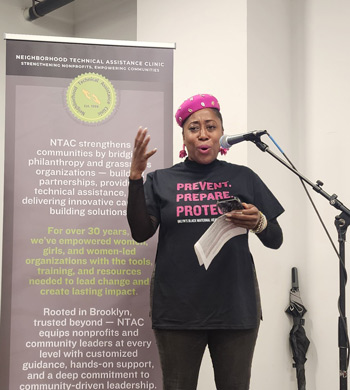
“We are walking in honor of the thousands of Black women who have endured, survived and continue to fight against maternal health disparities every single day,” said The Rev. Dr. Valerie Oliver-Durrah, founder and CEO of Neighborhood Technical Assistance Clinic and co-organizer of the event with Brooke Remel Oliver-Durrah, her daughter. “This is more than a walk. It is a witness. It’s a movement. This is history in motion.”
Rev. Oliver-Durrah said support from community partners including Brooklyn Collaborative, Downtown Brooklyn Partnerships, City Point were critical in organizing the event.
The Walk began inside Borough Hall with morning presentations on the state of Black maternal health care and ended with an afternoon “resource activation zone” where community-based maternal care providers and advocates shared resources with participants inside City Point.
Afternoon speakers included Dr. Denise Howard, Chief of Obstetrics and Gynecology at New York-Presbyterian Methodist Hospital, and Jose Perez, who lost his fiancé Christine Fields shortly after she gave birth because of botched medical care at Woodhull Hospital.
The morning information session opened in celebration with stilt walkers, a violin soloist and a prayer by The Rev. Karen Smith Daughtry of the House of the Lord Pentecostal Church for the “maternal health care deserts” too often experienced by Black women.
While the morning presenters spoke as professionals in their respective areas, many also shared their own experiences of receiving inadequate maternal health care. New York State Assemblywoman Rodneyse Bichotte Hermelyn of Brooklyn’s 42nd District was one of these. In 2016 she experienced a problem while carrying twins and went to Columbia University Hospital for care. She was turned away for insurance reasons, and because they didn’t want to be liable. Later, she was rushed to another facility.
“We are walking in honor of the thousands of Black women who have endured, survived and continue to fight against maternal health disparities every single day. This is more than a walk. It is a witness. It’s a movement. This is history in motion.” -The Rev. Dr. Valerie Oliver-Durrah founder and CEO of Neighborhood Technical Assistance Clinic
“Unfortunately, my son Jonah didn’t make it,” she said. “For a long time, I lived with this pain. I didn’t go to therapy. But I thought about an opportunity to help other people, other mothers. And that my voice needed to be loud. I didn’t want my late son to have died in vain. So, we wrote a bill that took four years to write, the Jonah Bichotte Cowan law, which mandates hospitals to take care of women, any woman, undergoing pre-term risks. You can’t turn them away. And it was hard passing that bill. In 2020 it finally passed.” Assemblywoman Hermelyn said United States has the third highest maternal mortality rate of high-income nations.
We’re in the middle of International Black Women’s History Month and Black Maternal Health Awareness Week with women and their associates leading call-to-action initiatives. Our Time Press applauds in this issue the work of Dr. Valerie Oliver-Durrah Brooke Durrah (above) and community partners in building a Brooklyn milestone: the first-ever Brooklyn Black Maternal Health Awareness Walk with its mission to Prevent, Prepare, Protect and, ultimately, empower and inspire the forgotten, ignored or overlooked. The Durrah women, mother and daughter, are co-organizers and producers of the event.
“When Black women say, ‘I’m in pain,’ they have to listen,” she said. Camille A. Emeagwali, Senior Vice President of Programs & Strategic Learning for New York Women’s Foundation, was another morning speaker who had experienced a high-risk pregnancy. She focused on the importance of listening to Black women and supporting their responses to the Black maternal health care crisis.
“Since the inception of the New York Women’s Foundation 38 years ago we have prioritized funding for reproductive justice and health equity, especially for Black women, whose problems and challenges are often ignored and the solutions for those problems and challenges are often under invested in,” Ms. Emeagwali said. “We need to recognize that being a Black pregnant woman should not be a health crisis.”
She noted the recent closure of local medical facilities providing culturally competent sexual and reproductive health to people of Bedford Stuyvesant, Brownsville, Crown Heights, East New York, Flatbush, and Fort Greene-areas that are already underserved.
“Nearly 3 out of 4 pregnancy-related deaths are preventable,” she said. “We can no longer ignore that many of the health disparities stem from structural racism, such as residential segregation, community disinvestment, income inequality, lack of healthy food access and affordability.
“We can no longer ignore that racial inequities in maternal health often persist regardless of education or income. This points to systemic issues beyond social-economic status.” Black women experience implicit bias and discrimination, barriers to receiving preventative prenatal and post partem care, overuse of cesarean deliveries, and providers who fail to address serious complications in their pregnancies, she said.
“We must fund Black women who are advocating, organizing, holding the hand of a pregnant women providing support.” -Camille A. Emeagwali Senior Vice President of Programs & Strategic Learning New York Women’s Foundation
Ms. Emeagwali challenged the audience to imagine radically different health care experiences for pregnant Black women, including routinely having access to quality health care before, during and after deliveries. She pointed to the need for Black pregnant women to have access to doulas and midwives and for health care providers to trust Black women, listen to them, and collect data centered on the experience of Black people to combat systemic racism. “And we must fund Black women who are advocating, organizing, holding the hand of a pregnant women providing support,” she said.
Ms. Emeagwali said less than 2 percent of all U.S. funding goes to women and girl charities, including those focused on maternal health and reproduce justice.
Dr. Thomasina Ellison Clarke, an OB-GYN at Maimonides Medical Center and mother of two talked about the implicit bias in Black maternal health care. She heralded the role midwives could play in turning that around.
“Historically, Black women have faced systemic barriers that have impacted their health outcomes,” she said. “From the days of slavery to segregation, and even in today’s health system, Black mothers have often been denied the care and respect they are entitled to. “So, here’s a good chance to shout out Black midwives! Despite systemic barriers, Black midwives have been critical in supporting Black women throughout history.
“They have offered culturally competent, patient-centered care, advocated for their patients, and ensured safe deliveries. As hidden figures and unsung heroes, it is central to acknowledge their contributions and continue to support their work by duplicating their best practices.”
Black women confronted with complications are 3 to 4 times more likely to die from pregnancy-related issues than White women, Dr. Clarke said. Yet Black mothers often report feeling unheard and dismissed by health care providers when they tell them what they are experiencing.
“When Black women say, ‘I’m in pain,’ they have to listen.” -Assemblywoman Rodneyse Bichotte Hermelyn Brooklyn’s 42nd District
“This lack of respect and understanding can lead to inadequate care and poor health outcomes,” she said. Dr. Clarke said acknowledging disparities is not enough, but rather, implicit bias must be addressed through education and ongoing training and cultural exposure. Tackling these disparities will require new and ongoing policy initiatives on both the state and federal levels, she said. Health care providers and mothers themselves must have a seat at the table as these policy initiatives are developed and reviewed, she said.
Community support is vital for improving Black maternal health outcomes, she said, including peer support, doula services, and the much needed culturally competent, patient-centered care are essential resources to Black mothers in marginalized communities. Dr. Clarke urged participants to reach out to their local politicians and express their concerns about Black maternal health care.
“Then you take the knowledge you have acquired through what you have seen and heard to the poll and vote. This is your voice and call to action,” she said. Ngozi Moses, founding Executive Director of Brooklyn Perinatal Network, focused on equity in Black maternal health care. Since 1988 when the network started from a community task force to address high infant mortality, its purpose has been to prevent and reduce infant/maternal illness and death by providing needed information and services through its collaborative of community partners. But over the years, Ms. Moses has consistently experienced the under-funding of community-based organizations providing such vital services.
Ms. Moses, a petite woman under 5 feet, took the microphone off the raised podium to speak about about equity in maternal health care. “Many of us confuse equity and inequality. So, I want to do a simple demonstration to show when you think of equity and equality, what you need to be thinking of. “If all of us were to speak from this mic,” she said, pointing to the raised mic stand on the podium, “some of us would reach it, and some, like me, would not. For me to reach that mike, I’d need a soapbox to stand on.
“That soapbox is what we need in our community. We need committed investment where there is disinvestment.” Community-based organizations are the bloodline of the community and are key to good maternal health care for Black women because they have, “boots on the ground to help families who need help,” Ms. Moses said.
“But inequity is a big problem because the money and payment for the value of our service is never recognized by those who have the power to change the paradigm and value our services and pay us more,” she said. “We don’t get the credit, and we don’t want the credit. We want the funding.”
Kimberly Seals Allers, a journalist, public speaker, and techy introduced a new way to use technology to improve maternal care outcomes for Black women with her Irth App. Irth is Birth, minus the B, representing the word bias, or Birth Without Bias, as Ms. Allers said. Irth is a platform much like Yelp, which people use to find good restaurants and other services.
“How many of y’all are going to 2-star restaurants and hotels on purpose? No, you are not,” she said. “Irth is the first app designed for Black and Brown women and birthing people to find and leave reviews of OB-GYNs, birthing hospitals, and pediatricians. We are all about publicly sharing where we’re getting good care and where we are not. We can create safety for each other while driving more accountability and transparency.”
Ms. Allers said the app uses the reviews to build a database measuring health care providers and institutions from a patient’s perspective. “On the backend, we turn these reviews into data. Yes, we need our own data. We cannot rely on these systems to give us data. And we can’t just rely on clinical measures. Just because we didn’t die or nearly die doesn’t mean we had the experience that we deserve. That’s a very low bar,” Ms. Allers said.
The Irth App launched on the Apple and Google Play stores in 2020. The app also allows family members, midwives, and doulas to search and leave reviews of their OB-GYN, birthing hospitals, postpartum care and pediatricians, up to the baby’s first year. Ms. Allers’ company can also use its data to guide medical facilities through a quality improvement process rooted in Black and Brown patient experience and voices. The company is currently working with Brookdale Hospital.
At City Point, Walk co-organizer Brooke Remel Oliver-Durrah summed up the day and a charge from the event’s rally cry, “To Prepare, to Prevent, and to Protect.” “Those are simple and powerful words,” she said. “To prevent the injustice of unnecessary bias and loss, to prepare our communities with knowledge and resources for equitable care, and to protect mothers, Black babies, Black futures.”
Ms. Oliver-Durrah pointed out the significance of Brooklyn’s first Black Women’s Maternal Health Awareness Walk ending at City Point, just across the street from Abolitionist Place. The historic stretch of Duffield was once home to Harriett Tubman and believed to have sheltered those escaping slavery as part of the Underground Railroad.
“We stand on sacred ground where Black people fought for their freedom just as we are now fighting for our health justice, for equity care, and for the protection of Black life at every stage,” she said.
Yvette Moore is the author of Freedom Songs and its sequel Just Sketching, both are available on Amazon.com
Telling Their Stories
Call to Action: Ngozi Moses, Founding Executive Director of Brooklyn Perinatal Inc.“I just had a baby five months ago. I know what it’s like to be scared in the delivery room. I know what it’s like to have complications. I’m able to share a snippet of my story. But unfortunately, so many women are not able to. We know the statistics. This Walk is about moving from awareness to action.” Crystal Cranmoore,WABC-TV Reporter and morning program moderator, Maternal Health Awareness Walk“My great grandmother used to say to me, ‘When women give birth, they have one foot in the grave and one on the earth.’ I didn’t understand what she meant until I went through that process. Kimberly Council, Brooklyn Deputy Borough President