Sometime in early 2000, I received a call from the National Action Network inviting me to speak at its regular Saturday morning meeting about the Black Women’s Leadership Caucus, Inc. (“BWLC”) and its campaign to honor Harriet Tubman with a national holiday. Although I had demonstrated with the Rev. Sharpton on several occasions, even traveled to Washington, D.C., but at that time I was neither a member of nor had I ever attended a meeting at the National Action Network – I am now a member. To my surprise, Rev. Sharpton introduced me noting that I would be speaking on his radio broadcast. I was overwhelmed – I spoke for about 10 minutes and the media blitz began. Herb Boyd wrote an article for the Amsterdam News, Cicely Tyson mentioned our campaign during her interview on BET and WHUR Radio (run by Howard University) gave us a “shout out”, as did Marko Nobles — Debbie Allen agreed to serve as BWLC’s spokesperson for the Tubman Holiday campaign.
Although BWLC was unsuccessful in its Tubman Holiday campaign, on August 27, 2003, then-Governor Pataki signed legislation for the Harriet Tubman Day of Commemoration honoring Tubman every March 10 in New York State. Other states honoring Tubman on March 10 include Delaware, Maryland, Georgia and Texas.
BWLC invites the public to join in its wreath-laying celebration every March 10 at 10 am at the Harriet Tubman Memorial, located at 122nd Street/Harriet Tubman Square at Frederick Douglass Boulevard in the Village of Harlem, New York.
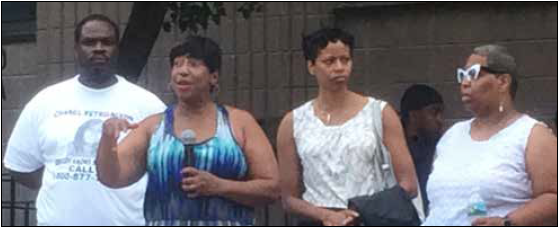
Antigun violence advocates and community members united in a Peace and Prayer Ceremony to highlight the unexpected murders of two young women in Bedford-Stuyvesant last night.
The emergency rally brought out more than a hundred attendees to the Stuyvesant Gardens Houses on Gates Avenue to celebrate the lives of Chynna Battle, 21, and Shaqwanda “Q” Staley, 29, who were gunned down last Thursday when gunmen opened fire in the crowded courtyard.
The double murder has caused many in the community to question the antiviolence prevention tactics of the area, particularly among the youth population.
Mozelle Brown,56, Battle’s mother, believes the death of her child was not in vain but an educational opportunity for her community–calling her daughter a “martyr” in the fight against gun violence.
“They are symbolic in bringing attention to what is going on around here. He [the Lord] chose those two [Battle and Staley], those two! Those two young ladies were the special ones, they were the ones who paved the way for this to happen. It’s grabbing our attention now and it should have been grabbed a long time ago,” said Brown.
Brown went on to call upon the community to unite and work together in order to prevent future gun deaths and to be vocal about any suspicious activity in the neighborhood.
Democratic District Leader Geoffrey Davis was quick to point out the need for more youth programming in the area to stop the tide of violence and noted the need for the proposed recreational center as part of the controversial Bedford-Union Armory Redevelopment plan.
“It’s just us mourning again and again and again and we need resources in our community to stop this. Our young people need jobs, our young people need a place to go. We’ve got to turn this into action and I’m trying to do that with the recreational center at the Bedford-Union Armory,” said Davis.
This theme was taken further by community member and preacher Valerie Ferguson, 51, who demanded that people start speaking up about any suspicious activity in the community.
“This is where I live at, this is where I raised my kids at, this is where I’m raising my grandchildren at, this is where I go to church at, this is where I cook out at, this is where I hold my brothers and sisters at, and you are not going to destroy my neighborhood!” said Ferguson.
Some other attendees alluded to the lack of local crime prevention efforts by residents, starting a slogan of “See something, say something”, to motivate neighborhood residents to speak out against any crime or suspicious activity in the area to the New York Police Department.
According to Battle’s cousin, who was one of the approximately 20 people in the courtyard on the night of the incident, there were police officers already at the scene of the killings. It is reported they were responding to a different situation when the shooting took place.
Battle and Staley were hanging out in the courtyard behind 760 Gates Avenue near the corner of Stuyvesant Avenue at about 9:30 p.m. on July 13 when gunfire broke out, striking Battle in the head and Staley in the back. Both victims were rushed to area hospitals where both were later pronounced dead.
The two young women were longtime neighborhood residents. Battle grew up in the neighborhood and lived in a nearby building where she was raising her three-year-old daughter Amelia. Staley grew up about a mile away near the corner of Hancock Street and Howard Avenue, and although she had recently left the neighborhood to attend college, she remained a beloved figure who frequently came back to visit. Both burials are scheduled for later this week.
“This right here is the tipping point. I’m tired of being sick and tired. I can’t fathom the idea of one of my daughters being executed and that right there was what that was for no reason. Those women had a right to live,” said Bruce Green, 50, President of the Brooklyn Anti-Violence Coalition.
According to Green, many groups supported the rally effort, including NYPD’s Neighborhood Coordinating Officer team for the area, the Stop the Violence organization, local residents and community and faith leaders.
A preservationist and an environmental justice attorney, contend there is a great probability that asbestos is in the armory. They strive to officially discover the existence of the substance before construction crews arrive at the site.
Dr. Juan Blanco Ruiz, the architect and preservationist, read the Phase I Environmental Site Assessment (i.e., Brownfield Report) prepared by Sam Schwartz Engineering and Integral Consulting in March 2016 to find the scope of the assessment subjects did not include asbestos, lead-based paint, radon, lead in drinking water, mold and ten other services. Given the armory was built in 1906 when these substances were commonly used or the conditions existed, Dr. Blanco Ruiz has few good words for the project.
“The Drill Hall’s roof is 1.2 acres in area. The cost of asbestos remediation would be monumental. It would cost as much as $50 million to replace the roof and it is not what they (BFC Partners) budgeted,” explains Dr. Ruiz. He discovered the presence of asbestos in the building “upon reading a professional journal published in 1906 which announced the completion of the armory”. In that article, they placed special pride in the use of new “fireproof mineral roofing cement”. Upon Googling the name of this material, I was taken directly to the Web page to apply for compensation for victims of Mesothelioma of Asbestos.com. He followed up his reading by visiting the building, inspecting the roof and taking at least four pictures of the Riding Hall’s ceiling.
Dissatisfied with the brownfield study, Dr. Blanco Ruiz questions the integrity of the project and project team when he said, “I believe it to be criminal negligence to set up a recreation and health center with asbestos present, and I don’t take kindly to putting people in harm’s way”.
His other criticism of the reconstruction is that 386 housing units (rental and condominium) are proposed but there are no plans to provide underground parking.
Where Blanco Ruiz is positive in the existence of asbestos, Joel Kupferman, Executive Director of the Environmental Law and Justice Project (ELJP), is the attorney “who harbors a very strong suspicion that it is the case that asbestos exists in the Bedford-Union Armory”. His suspicion is fueled by the age of the structure and that builders knew very little about the health compromise associated with asbestos exposure. ELJP is preparing legal papers to gain access into the armory in order to test for the substance in advance of construction crews arriving to the site.
“New York State and the City of New York have poor records of investigating the presence of asbestos prior to construction activity and ordering cease work on construction jobs where it is indeed found. Disclosure of this critical information to the public—particularly community residents and businesses in the vicinity—is paramount before any activity takes place and not afterwards,” explains Kupferman.
The concern for testing before construction commences has to do with what this lawyer has observed. “When asbestos is found while construction is in progress it may result in the work crew acknowledging its existence and inform us, but the tendency is to not stop the work.”
Another issue is enforcing violations. Kupferman opines, “The City (Buildings Department) will issue the fine to the builder but it doesn’t work hard to collect the fines”.
BFC Partners was contacted July 17, 2017 via telephone and e-mail to obtain their knowledge of the presence of asbestos and holes in the armory’s shed roof of the Riding Hall and CB9 community residents’ contention that BFC Partners has no plans to do asbestos remediation, although developers are required to correct such environmental hazards.
BFC Partners spokesman Sam Spokony issued the following statements:
Regarding your question about leaks in the roof, “The Bedford-Union Armory is in desperate need of renovation and any leaks in its roof are the result of a clear lack of maintenance. Our proposal for the armory includes addressing any necessary repairs and providing a new recreational and community center that will offer free and low-cost programming to Crown Heights residents”.
Regarding the question on asbestos and remediating it: “Prior to commencing construction, BFC will follow strict protocol mandated by environmental regulations and code, including investigations undertaken by a licensed third-party testing agency to determine whether any asbestos-containing material is present. As BFC has already stated publicly, if any asbestos-containing materials were found to be present, we would address it by following strict regulations enforced by the city’s Department of Environmental Protection and Department of Buildings.”
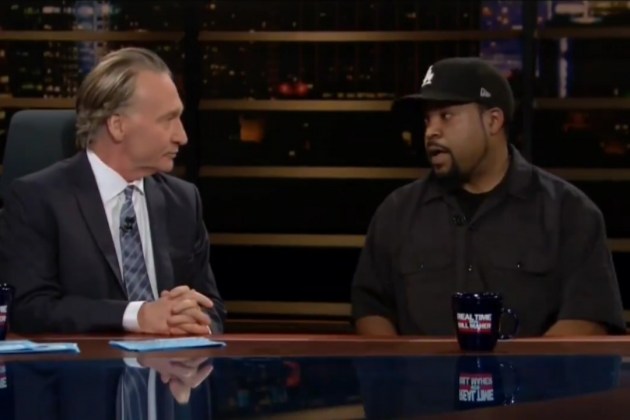
Bill Maher, Ice Cube and this alleged Repurposing & Repossession
of “nigga”
Bill Maher and Ice Cube
What if I took a gun, stuck a rose stem first into the barrel and called it a vase?
And then, every time me or my friends walked around with this gun with a rose stuck inside we called it a vase, but if we ever saw you with a gun we’d get upset and accuse you of having a gun? Wouldn’t that just be the silliest thing? I mean, just because you stick a rose into a gun, it doesn’t make the gun a vase. The gun is still a gun, capable of hurting or killing people, regardless of what you say it is or how you say you use it. And oh, how hypocritical would it be for me to carry my gun that I call a vase everywhere I go, but become irate and angry when I see you carrying yours.
Last week, Bill Maher drew some negative attention when he responded to Republican Senator Ben Sasse’s comment about having Maher come and work in the fields of Nebraska by saying,
“Senator, I’m a House Nigger.”
Almost immediately, Twitter and Facebook was filled with comments about Maher’s words. He’s insensitive. He’s racist. His show should be cancelled immediately. The word nigger and its remixed spelling nigga have always been and will always be a hot-button topic. Its origin is purely racist and evil, a word spewed from the mouths of overseers in the Antebellum South when referring to their chattel, their human property, the Black slave. It followed the degradation of the Black race out of slavery, and into Jim Crow, when people used the word to remind you who you were, and to reinforce that you were nothing more. Eventually, Blacks began using the word with and about other Blacks. As the new tongue called slang began to take hold of the youth in inner cities, so too did this word. Comedians used it to incite laughter. The guys on the block used it to describe one another. Somehow, someway, this word was welcomed into Black urban vernacular.
I used it.
I used it in almost every sentence I spoke between the ages of 16 and 33. I used it, because as a child, I heard my uncles use it. I used it because everyone did – my neighbors, my family, strangers in the community, Richard Pryor, Eddie Murphy, everybody. It was how I described my friend, “he’s my nigga”. It was how I described my enemy, “that nigga”. It was how I relayed my feelings on anything, like “nigga please”.
When elders would say that I shouldn’t use such a horrible word, I never could relate because I didn’t see the horror in it. I’d debate that we took the power away from the word by changing the spelling. Nigger was evil. But nigga was okay to use. Just as long as Whites didn’t use it, because when they use it they are being racist. But me, I’m using it as a “term of endearment”.
I knew a woman who is White but was born and raised in Jamaica. She came to America as a kid, and as a young woman she worked in the music business. All her friends were Black. Her husband was Puerto Rican. Most of her business associates were Black. But as I said, she is a White woman. When I was first introduced to her, we hit it off immediately. She was cool. We spoke about all kinds of things. One day we were with a bunch of friends and one of our mutual friends, who didn’t know that we were cool, made mention to her that they didn’t know that she and I were friends. Her reply to that person was, “Oh yeah. Marlon is my nigger.”
Now, it is very possible that she meant Marlon is my nigga. But that’s NOT how it felt.
Her saying that bothered me. When we were alone I asked her about it, and she actually got upset with me. She said that all her Black friends are okay with her using the word because of how she was raised. She said I was being too sensitive about it. I smiled it off, but she and I were never as cool as we were before she used that word in describing me. I don’t care how many of her Black friends let her use it with them, it bothered me that she felt so familiar that she could use it in such a flippant manner. I never used or even looked at the word the same after.
Like my former friend, Bill Maher works in entertainment. He has Black friends, and has been linked to a number of Black women, most notably Karrine Stephens, who is affectionately known as “Superhead”. He has used the word on camera before. In 2001, Maher argued on his show, Politically Incorrect, that anyone should be able to use the word. So, I’m not totally surprised or shocked by his use of the word, and moreso, I’m not convinced that he is contrite for using it. He has already stated that he believes he should be able to use the word. The question is why? Why does he feel that he should be able to use the word? In his own words from that 2001 show, “Blacks say that Whites cannot use this word. I disagree… The word has changed. It has been co-opted as a term of endearment.” His point was that because Blacks use the word in television and music, the word should be seen as less hurtful and is part of the popular vernacular.
The problem is that Blacks use of the word is rooted in our own cognitive dissonance. When the word began to appear in urban vernacular we were a people trying to deal with the Post-Traumatic Stress Disorder of slavery, while trying to identify as free and equal, all the while still working to patch up the holes in our social, spiritual and emotional selves which were the results of generations of oppression and subordinance. Even now, we suffer from many of the same maladies. Using the term nigga on each other was a sick way of trying to delineate how the White world at large addressed us, our way of taking the word and finding comedy in its use against us. For the Chinese, the word “chink” is derogatory. It equals nigger with regards to the way it feels when it is used on a Chinese citizen. But Chinese men and women do not use that word when describing each other the way that Blacks use nigger. The Chinese have never felt a need to co-opt that word, because it’s foreign to them. Chink is not a Cantonese word, or a Mandarin word, so the Chinese have never felt a need to use it to add to their vernacular. The reasoning behind Blacks use of the word nigger is an indictment of the fact that Blacks still recognize the subordinance related to being Black and living in America.
So, when Ice Cube, during a taping of Real Time with Bill Maher, says in response to Maher’s statement that, “That’s our word, and you can’t have it back,” I have to disagree. Yes, it is obvious that we have accepted the word, and we have used it with such fluidity that it appears wherever you see examples of Black entertainment. But it isn’t our word. It’s an English word created to describe Black people in a derogatory light. Now, as with most words you can take it and do with it what you want, just like my example of using a gun like a vase, but don’t be misled. That gun is not a vase, because the moment it is used in its natural intent, someone gets hurt. Just like the word nigger. Blacks can reappropriate and reconstruct it, and then build ideals on why it is acceptable to do such a thing, but the moment that the word is used by its originators in its natural intent, someone gets hurt. The only way to move passed the pain and frustrations of that word is to never ever use it with one another.
The word nigger continues to hold its power because we have created a secondary taboo about it, where certain people can say it like water flowing from a faucet, while still others are totally outlawed to even mumble it. The controversy will continue for as long as Blacks maintain this confusing ambiguity about the meaning and use of the word. It isn’t acceptable.
In the same way that words like Kike, Spic and Chink aren’t acceptable, neither is nigger.
It isn’t acceptable when other races say it to Blacks, and it isn’t acceptable when Blacks use it on other Blacks.
That’s what Ice Cube should’ve said.
(Community Journalist Marlon Rice, author, social media consultant and events marketing specialist, created the popular Nights at the Round Table panel discussion series, and the www.thadeuce.com website. Rice recently joined DBG Media’s Our Time Press as a columnist and events facilitator. Rice’s “The Thinker’s Notebook” is dedicated to the memory of his late beloved mentor, Mama Aminisha Black, whose column, “The Parent’s Notebook,” appeared for many years in this paper.)
The other day I was doing some petitioning along Franklin Avenue in Crown Heights. Petitioning isn’t just a necessary part of the democratic process, but it’s also an opportunity to interface with your community. If you can wade through all of the no’s and I’m not interested’s, and if you can bounce back from being blatantly ignored, you may find yourself having interesting conversations with people from your neighborhood that you do not know.
Such was the case the other day.
I approached a young white couple as they strolled along Franklin Avenue, near Eastern Parkway. My prerequisite question for anyone I approach while petitioning is the same.
“Are you a registered Democrat?”
The couple looked at one another with excited interest, as if my question reminded them of an inside joke. The man explained to me that no, neither of them were registered Democrats in New York. In fact, they weren’t registered to vote at all in the United States. They were from Vancouver, British Columbia in Canada and although they’ve lived here for about 2 years, they’ve never gotten around to figuring out how to register to be a part of the voting process. I told him that if he is a permanent resident, though he cannot vote in the presidential election, there may be some local elections that he could in fact vote on. I told him that they should check the requirements for registering to vote in local elections. The couple appreciated the information, both of them smiling and taking turns thanking me. That’s when the woman spoke. She asked me a question that would inspire the article you’re reading right now. Here is her question, as verbatim as I can remember it.
“Although we have only lived here for two years, we have seen a big change in the neighborhood during that time. There are more whites moving in, people from all over the world coming into Bed-Stuy to live. We know that Brooklyn has always had its own culture, and we know the same is true for Bed-Stuy. We also know that Black culture in this community was prominent at one point. We love the Brooklyn that we decided to move to, and we don’t want to be a part of eradicating everything that this neighborhood was before we arrived. So, tell me. What can we do so that we are not part of the problem?”
Aside from being totally shocked at the question, I found myself dealing with a feeling of pride for being asked about this. Proud of her for being astute enough to notice the nuances of gentrification, and brave enough to speak about them in earnest. And proud of my community for continually providing evidence to new faces to remind them about what once was. Old Brooklyn will not go quietly into the night.
The word “gentrification” has been tossed around ad nauseam for the past 15 years. The base definition is the process of renovating and developing undervalued properties and communities to align those communities to middle-class or upper middle-class residents. To give a base example, if there is an abandoned building on your block, and you buy the building and turn it into a luxury apartment building, then you’ve gentrified your block. One of the problems that those who have been in these communities “pre-gentrification” have with gentrification is the wanton displacement of both residents and businesses due to the increases in market rent bought on by the development and strategic marketing of these neighborhoods as “new” and “trendy”, in an attempt to lure in new business models and more affluent residents. Again, to give an example, now that you’ve built your luxury apartment and are charging luxury prices, you want your tenants to have the same amenities in this new neighborhood that they would have in the neighborhood they used to live in. So, you raise the rent on Papi’s bodega until he cannot compete and is forced to close. You then rent the same space to Starbuck’s. They can afford the rent you’re asking for. This affects the entire neighborhood though, because Papi used to sell coffee for 75 cents. Starbuck’s sells the same size coffee for $3. Between the higher rents and the higher cost for goods, you’ve just made your neighborhood more expensive to live in.
Certainly, one can see how the process of gentrification can change the entire scope of a community, leaving those who were here prior to the changes worried about being able to afford to live in a community they’ve lived in their whole life. The young woman’s question, however, wasn’t from the perspective of a developer or a mortgage broker. She is a renter, a tenant who wishes to not seem problematic to other tenants that may feel resentful about what she represents. Your prototypical gentrifier is not a home or business owner, they are tenants who’ve decided to move into your neighborhood because they can afford the rents and like the fact that the train station is three blocks away. They go to work and they come home. They appreciate the new taverns and bars in the community because it gives them the freedom of a social life without having to trek to the city. They are more like you and I than they are unalike. New neighbors in the community may change the landscape of the community but it doesn’t change the concept of being neighbors.
My answer to my new Canadian friends was simply this: Love your neighbor. You have moved into a community that is new to you, but it is not a new community. There are families that have lived here for generations, as well as those who just moved here last month. Our children attend the same schools. We shop at the same supermarkets and use the same train stations to get to work. This community isn’t just yours because you live here now, and it isn’t just mines because I was here first. It’s ours. And since we share this amazing community, we must learn how to love one another. We must seek one another out and show recognition that we are neighbors. We must listen to one another and be empathetic to our individual and collective plights. We must share resources and knowledge. Most importantly, we must find common ground. We may celebrate different holidays, play different sports or even celebrate different cultures, but our community will be stronger if we share in those differences together rather than to allow surface issues such as race and class to separate us. If you do not want to be viewed as a problem in your community then you should start with loving your neighbor as you love yourself.
We talked for about 15 minutes and then the couple wished me well in my task to collect signatures. The guy and I exchanged numbers and promised to keep in touch. I think I’ll text him this weekend to find out his opinion about this article.