Home Blog Page 65

Historian Dominique Jean-Louis:

Tracing Black Families Back to Slavery in Brooklyn

Fern Gillespie
Slavery in New York City began 400 years ago in 1626 when 11 enslaved African men were brought here by the Dutch West India Company. By 1786, Brooklyn had 2,669 white residents and 1,317 Black people enslaved. Although New York State’s abolition law was passed in 1799, human bondage remained until 1827. The exhibit “Trace/s: Family History Research and the Legacy of Slavery in Brooklyn,” on view through August 30, is curated by Dominique Jean-Louis, Chief Historian of The Center for Brooklyn History (formerly the Brooklyn Historical Society) at Brooklyn Public Library.

It explores the current descendants of Black Brooklynites who were enslaved and the wealthy white slaveholders who built Brooklyn. Our Time Press spoke with Jean-Louis about the exhibition and the impact of slavery in Brooklyn.

OTP: The “Trace/s” exhibit focuses on Black Brooklynites whose ancestors were enslaved in Brooklyn. What do you want the public to understand about the historic impact of slavery in Brooklyn?
DJL:
There are three big takeaways from the exhibition. One being there was slavery in Brooklyn, which I think a lot of people don’t know. It’s not as though we have monuments announcing that there was slavery in Brooklyn or that it’s taught in the schools. I wanted to bring that awareness to people. Takeaway two was that so much of the Brooklyn that we’ve recognized is a result of 200 years of slavery.

That slavery was incredibly prevalent in Brooklyn. A lot of our street names and subway stops that we maybe don’t give a second thought to–Bergen and Lefferts and Vanderbilt. All of these places that you encounter just moving around the borough. These are from a legacy of slave owning specifically from those old Dutch families.

When you look at Brooklyn’s growth– the ports, waterfronts and the land– all of it is super tied to slavery. And so with this exhibition, we really wanted to demonstrate how the borough we recognize today was really shaped by these 200 years of enslavement. And then the third take away and the other piece of the exhibition is really highlighting how important family history is for doing the research about Brooklyn’s history of slavery.

Also just making it meaningful that so many Brooklynites have this kind of a legacy in their ancestry, whether that’s being descended from enslaved people or maybe even being descended from slave owners. On display are two large scale oil portraits.

OTP: Mildred Jones, a retired Bed Stuy teacher, is the great-great-granddaughter of a man who was enslaved in Flatbush. How did she get involved the Trace/s exhibition?
DJL:
When we decided to do an exhibition on slavery in Brooklyn, we thought how interesting and useful it would be to connect a family story. So, we started working with the Afro American Historical and Genealogical Society and reached out to Stacey Bell at the local New York chapter, and asked if they encountered folks that trace their ancestry back to slavery in Brooklyn. The legacy of enslavement is a very present thing for Mildred Jones.

She has heirlooms from her family that belonged to her enslaved ancestors. Mildred’s brother Gus had been a genealogical member before he passed. He had uncovered his ancestor, Samuel Anderson, who was enslaved in Brooklyn and was the subject of an 1898 newspaper article. We have his firsthand account of what he remembers of slavery.

The story was so compelling. It was really sad that Gus had passed away before we started the work on this exhibition. His sister, Mildred, stepped up and was willing to do the portrait. We also did an oral history with her as the portrait was being painted.

So we got not only her image to put in the exhibition, but her whole family story. It’s not just being descended from enslaved people, but about that family’s journey through a changing Bed Stuy, a changing Brooklyn. She talks about her childhood in Bed Stuy and her work as an educator really fleshes out the story of generations since slavery.

OTP: Why did you decide to have a major portrait painted of Mildred Jones?
DJL:
In our collection, we have quite a number of oil portrait paintings of slave owners in Brooklyn. That’s one of the things that this exhibition really underscores: who has access to generational wealth and privilege in Brooklyn. When we connected with Mildred, we were able to identify a portrait from our collection of John Lott, from the family who had enslaved her ancestor. John Lott has a large scale portrait.

It’s almost life-size. So, we wanted to paint one of Mildred Jones at the same scale to address the disparity in who has access to this kind of representation and who doesn’t. These are two stories and two shared histories. John Lott’s portrait has been preserved and conserved by this institution for more than a century.

His portrait also hangs at Borough Hall and in Albany. If you think of an oil portrait, a face like his is what comes to mind. A well-dressed older white man. Mildred’s portrait by artist Rusty Zimmerman is with her AKA pearls and her more contemporary apartment with Afrocentric statues she’s acquired from West Africa.

It says a lot about determining who built Brooklyn, whose stories that we should be looking to for the history of the borough. Having it painted in the same medium and in the same scale was important to visually level the playing field between these two family’s stories before we get deeper into the documents, bill of sale and other materials from the collection.

OTP: When you were researching for the exhibition, what were some of the outstanding situations and experiences of enslaved Brooklynites that you discovered?
DJL:
I think people to the extent know that slavery took place in northern states like New York. They know domestic slavery. Like maybe you had a household servant, enslaved person. The thing about Brooklyn is that Brooklyn is New York City’s breadbasket. That the slavery that took place here in Brooklyn was plantation slavery.

You had larger farms where crops were being grown to be sold at market to turn a profit. This wasn’t just enslaved people belonging to one household and upkeeping the household. These are plantations. We were lucky enough to have a painting in our collection. It shows one of these plantations. The farm of a man named Cornelius Van Brunt in what today would have been Gowanus.

The painting shows Black laborers on the farm. We’re kind of introducing people to visually, and also with the archives that we have on display, that it was hard agricultural work that these enslaved people were doing here in Brooklyn on the ground where we stand. And of course, it’s very hard to imagine our kind of like concrete high-rise in Brooklyn as rolling hills of farmland. But that’s precisely what it was. Also, the important role that slavery played in building Brooklyn as a striving urban center.


“Trace/s: Family History Research and the Legacy of Slavery in Brooklyn” is at the Center for Brooklyn History at the Brooklyn Public Library through August 30. Dominique Jean-Louis hosts a weekly tour every Friday at 3:00 pm. On August 21, there will be a special genealogy research program. For information on the exhibit visit www.bklynlibrary.org/exhibitions/traces
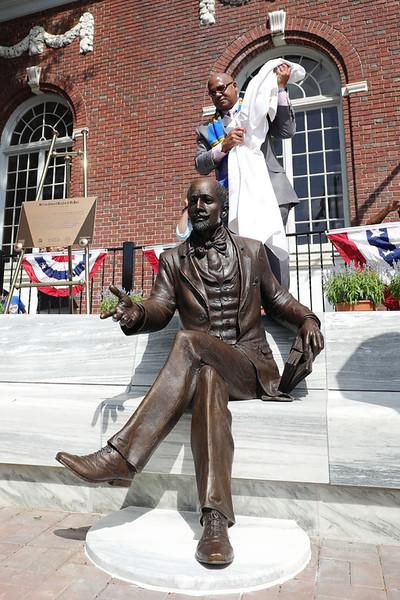
“Monument to Love” in Great Barrington

A bronze sculpture in honor of the great legacy of Dr. W.E.B. DuBois and created by the famous artist/sculptor Richard Blake, was unveiled Saturday, July 19, 2025, in Great Barrington, Mass, the site of the scholar’s birth (in 1868).


Hundreds attended the event, overseen by The Sculpture Project co-chairs Ari Zorn and Julie Mitchell, which took place outside the town’s Mason Library where the life-like artwork sits on a stone bench.


DuBois’ great grandson Jeffrey Alan Peck called Blake’s masterpiece an homage to peace.
Dr. Imari Paris Jeffries, President & CEO of Embrace Boston, said of the town’s memorial to the founding member of the NAACP and creator and first editor of the human right’s organization’s historic Crisis Magazine, a “monument to love.”


Dr. David Levering Lewis, the historian and Dr. DuBois’ two-time Pulitzer Prize winning biographer, reflected on the social activist’s past, revealing that scholars of 80 years ago considered the Great Barrington native, a “national treasure.”


As is the character of the event’s hometown, the two-hour event was an amalgam of multicultural preferences. The official monument dedication program not only listed the Top Legacy Sponsors & Donors (called Legacy contributors), it gave weight to those individual supporters (Souls), who contributed $10 to $240, and all those who were listed, according to donation amounts, as Justice, Freedom, Democracy and Equity donors.

Gratitude was extended to Great Barrington in-kind donations from the community market to the churches to the librarians and to the SoCo Creamery where a popular ice cream flavor was renamed DuBoisenberry.


Gwendolyn Hampton Van Sant, CEO and founder of Multicultural Bridges, is an expert in cultural diversity. She also is a board member of the W.E.B. DuBois Sculpture Project. She led the audience in a remembrance tribute to those special persons, now deceased who, like DuBois, did the work of forging a path to make it easier for those who came after to navigate. Van Sant incorporated an emotional Ancestral Calling into the program.


In addition to Mr. Peck, scholars Lewis and Jeffries and Ms. Van Zant, the speakers included Former Massachusetts Governor Deval Patrick, and State Representative Leigh Davis -3rd Berkshire District.

The Sculpture Project event co-chairs Ari Zorn and Julie Michaels delivered the welcome for the project which they brought to fruition and culmination over several years, which included selecting Mr. Blake to sculpt the monument.

It is hoped that monies will continue to be raised to help with the development of a museum in Accra, Ghana, where DuBois, passed in 1963, a day before the Dr. Martin Luther King Jr’s March on Washington.


The program included rousing musical presentations with selections and stylization presented in a way that commented on the times, as much as the speeches did: Wanda Houston performing “Life Every Voice and Sing. Gina Coleman & the Misty Blues band, performing “This Little Light of Mine” and “Hold On”; Randall Martin’s Sweet Life Project featuring Carla Page on Steve Wonder’s “Higher Ground”, Burt Bachrach’s “What the World Needs Now,” and Marvin Gaye’s “What’s Going On” – all the latter seeming like a commentary on the immediacy of DuBois message.


It was evident that event producers were aware of the music Du Bois loved during his lifetime, and current music espousing his lifelong messages that he would love if he were alive today.
The speeches drew the parallel with current events.


Mr. Peck quoted from his great-grandfather’s “The Future of the American Negro,” published in 1953. He emphasized the need for today’s generations to uplift his great-grandfather and be inspired by his (example) in times like these.


The event did remember the children, as DuBose remembered them in his “Credo” read by Luna Zander. “I believe in the training of children … for Life lit by some large vision of beauty and goodness and truth.”


After the performance by the Berkshires’ “Youth Alive Step & Dance Team”, the anticipated pride in performance took a back seat to their collective awe in seeing Richard Blake’s sculpture work up close. The youngsters took turns sitting on the marble bench next to the sculpture and grasping DuBois’ open palm.


Peck said, “It’s fitting (my grandfather) sits here (at the entrance to the town’s library) and welcomes townsfolk to a place of knowledge, a home of books, and a sanctuary of truth.”
Bernice Elizabeth Green, with Joanna D. Williams and Chelsea Jo Williams

All photos on this page are by photojournalist Stephanie Zollshan for the Berkshire Eagle.

A Community Vibe The Annual Hancock Block Party

0

By Pojanee Fleury
When summertime hits Brooklyn, the streets buzz with excitement, and few events truly embody that vibe quite like the annual block party on Hancock Street, between Stuyvesant Avenue and Lewis Avenue! For the past 18 years, this annual tradition has transformed the bustling Bed-Stuy block into a lively hub of celebration, bringing together neighbors, families, and friends for a day of joy and connection.


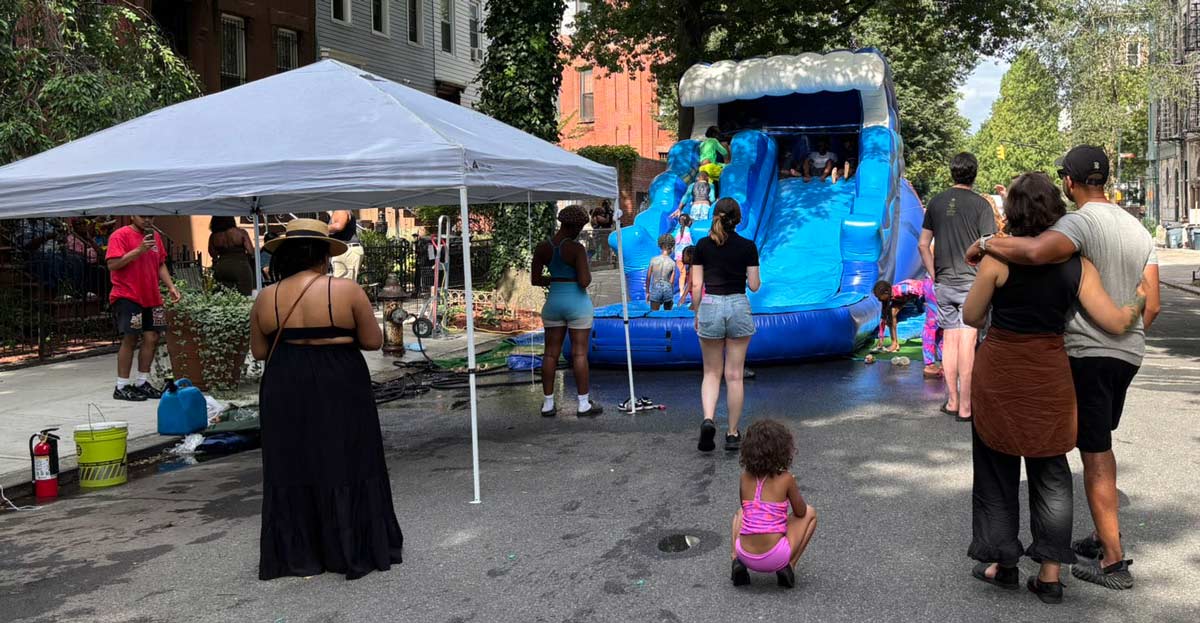
This year, the festivities were in full swing with music by DJ Doug Brown, residents serving delicious food, and children playing games and enjoying a giant inflatable water slide! The joyful vibe was contagious, and everyone joined in dancing and laughing together, all organized by the 500 Hancock Block Association.


These experiences leave a lasting impression on block residents as well as their extended family and friends who also came out to join in on the festivities, building a larger community that extends far beyond the block. Events like these don’t just bring people together for a single day; they are instrumental in creating and maintaining supportive networks that make communities safer, families stronger, and children uplifted. These gatherings remind everyone of the power of unity and shared purpose, creating bonds that can last a lifetime.


A Tradition Worth Celebrating
The annual Hancock Street Block Party has become more than just a fun-filled day; it’s a tradition that fosters a deep sense of belonging and pride in the historic Bed-Stuy community. A 500 Hancock Block Association representative explained, “It’s our biggest event of the year,” indicating that this is an active Block Association bringing residents together throughout the year. “We have block cleanups and plant flowers,” she continued, “we do beautification [projects] on the block flowers, and we’ve entered contests like Brooklyn’s Most Beautiful Block.”


When asked why it is important to have the block year every year the rep replied, “it keeps everyone connected and especially through harder times its really important for people to know who the neighbors are, but even simple things like alternate side parking or if someone is double parked next to you, you know who’s car that is and…you have their number.” This statement highlights the importance of building a strong sense of community within a block. Through events like block parties, activities, and meetings, residents are able to get to know each other and establish these important relationships.


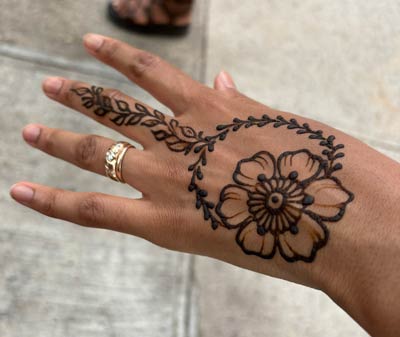
The block party included salsa lessons by a Cuban American resident, free Henna by Henna Motifs, relay races between the adults and children, and, of course, the amazing inflatable water slide was a big hit! The joy on the children’s faces highlighted the importance of block associations coming together to create positive experiences on their block and in their community. These children were not only having fun but were also building happy memories with their neighbors, learning the value of teamwork and togetherness. These moments develop stronger connections to their block and foster a true sense of unity and pride in their community.


The Hancock Block Party stands as a testament to the power of community. Through shared experiences, laughter, and collaboration, residents not only celebrated a day of fun but also strengthened the bonds that unite them. When neighbors come together, they create a stronger, safer, and more vibrant neighborhood that benefits everyone.

A Celebration of Beauty & Community: 400 Bainbridge St Block Party Recap

0

The “Flower Block” on Bainbridge Street, between Howard and Saratoga Avenues, hosted its annual summer fun day on Saturday, July 19, 2025. The event celebrated the vibrant beauty of its plant life while bringing block residents together for a day filled with laughter and connection.

It is a cherished neighborhood tradition that not only celebrates the radiant elegance of its meticulously maintained flowers and greenery, which line the block in a stunning display of color and life, but also the strong sense of community and togetherness that permeates the block.


Residents came together to enjoy a day filled with laughter, connection, and community spirit. The event featured activities for all ages, including games for kids and a potluck feast showcasing homemade dishes from neighbors. The street came alive with exciting energy as neighbors, friends, and visitors came together to enjoy the festive atmosphere!


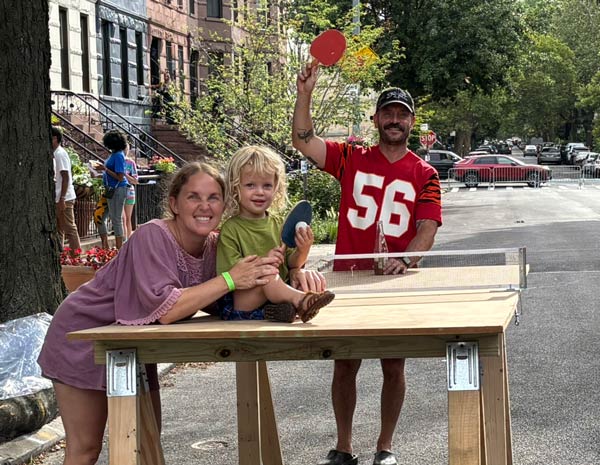
Children laughed and played games in the car-free street, while adults gathered to chat over delicious food and drinks. But the event wasn’t just about having fun—it was about truly building community.

Jane Wright, Co-President of the 400 Bainbridge Street Block Association, shared that when tenants rent on the block, she extends an invitation to join the Block Association. “I want everyone on the block to see themselves as residents and a part of this community, not just a temporary tenant,” she explains.

Wright, a resident of the block for more than 30 years, also shares that the street closure allows residents to take the time to actually see and connect with each other, which is something that is often overlooked in big, busy cities. These connections not only create a sense of belonging and unity but also foster a supportive environment for all individuals within the community.


A Group Effort
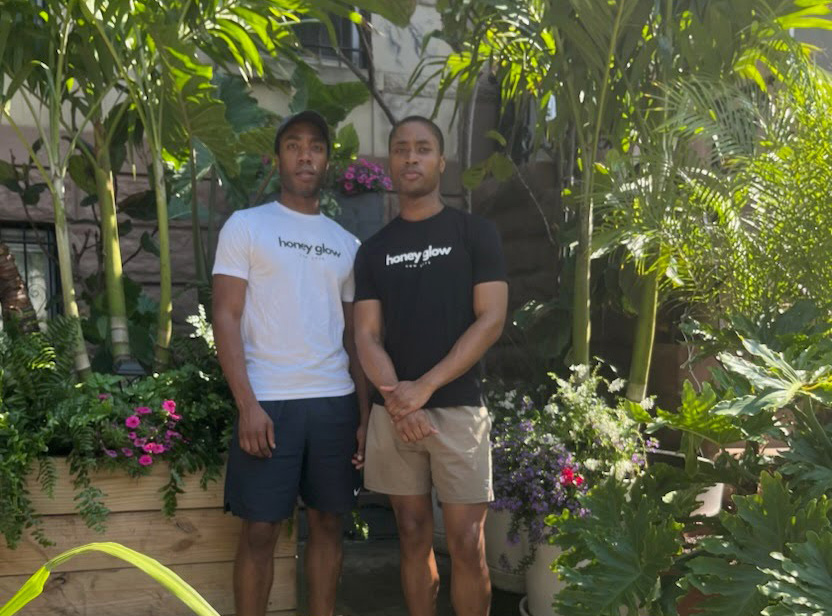
Among the dedicated residents who helped make the event truly special were 400 Bainbridge Street Block Association Co-Presidents Rusty (26) and River Fields (23). As active community leaders and founders of the multi-7-figure beauty and wellness brand Honey Glow, Rusty and River brought their passion, energy, and care to the celebration. They personally pitched in to help set up festivities, creating a warm and festive atmosphere for everyone to enjoy. Their commitment to the neighborhood goes far beyond the block party.

They’ve played a vital role in beautifying Bainbridge, transforming Bainbridge’s once refuse-filled tree pits and sidewalks into lush, green spaces—earning the block its well-deserved nickname: “The Flower Block.”


The famed block has received three Love Your Block Grants as well as a Citizens Committee grant, all supporting the block’s blooming beauty. Their green-thumbed dedication has been recognized, and they have been awarded the title of Greenest Block in Brooklyn four times in the Annual Greenest Block in Brooklyn contest. Bainbridge Street is more than just a place where flowers grow – it is a community that comes together to create something beautiful.


Why Block Parties Matter
Events like the 400 Bainbridge St Block Party are more than just days of fun—they are the heartbeat of a thriving neighborhood. They create spaces for connection, break down barriers, and strengthen the ties that keep communities resilient. Moments like these, where strangers become acquaintances and acquaintances become friends, are vital reminders of the power of community spirit.


Jane also reflected on the tradition of their block parties, noting that the Block Association has been organizing these events on Bainbridge Street since the early 2000s. While she admitted that they may not have always hosted the most lavish block parties, Jane emphasized their commitment to closing the block each year. This tradition ensures there is always a day when residents can come together, and, most importantly, provides a safe space for the children to enjoy their block surrounded by neighbors and friends.


From residents like Saleema who make food for the block association’s events to Shelly and Ross who volunteer to shovel snow for neighbors who are unable to do so, and more- everyone contributes in their own way to create a sense of community. The block association and the commitment of residents serve as a powerful example of what can be achieved when people come together with a common purpose. Here’s to future gatherings on Bainbridge Street because when neighbors unite, every block becomes a home and Our Time Press will be there!

Liberia: Beyond Joseph Boakai Speaking Beautiful English

By Jeffery Kazembe Batts
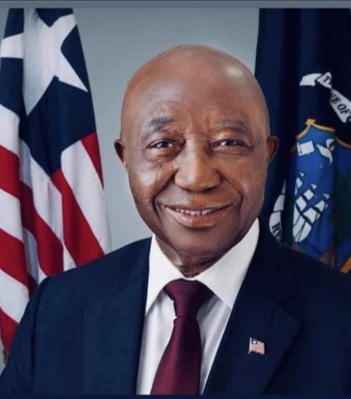
While meeting with five African heads of state recently, President Trump responded to comments made by Liberian President Joseph Boakal by inquiring, “Such beautiful English. Where did you learn to speak so beautifully? Were you educated? Where in Liberia? That’s very interesting”. The question and comment displayed a remarkable level of ignorance or contempt on the part of the 47th American president.

After being founded in 1816 by white Americans to deal with the “problem” of a growing number of free Blacks, starting in the 1820s, the American Colonization Society (ACS) embarked to help free-born African Americans and similarly enslaved African people who attained freedom, to establish settlements on the west coast of the African continent. English has been the official language of the area.


Beyond displaying a lack of knowledge about Liberia, during the first six months of his second term, Trump has initiated policies that harm Africa as a whole. He has cancelled American participation in the Paris Climate Accord. He has cut vital funding for the World Health Organization. Liberia, a small coastal nation, and others depend on these international organizations as partners in their development plans.

We must remember on January 12th 2018, in an Oval Office meeting at the White House during his first term, President Trump is quoted as barking, “Why are we having all these people from shithole countries coming here?” referring to Africa and Haiti. Despite his apparent hostility to Black nations, Liberia’s entanglement with the United States is profound.


The ACS facilitated the creation of the Americo-Liberian ruling elite minority. These colonizing Black people did not interact with but ruled over the indigenous Black Kpelle, Bassa, and Kru ethnic communities.

Using strong support from the fifth American president, James Monroe, Liberia declared its independence from the ACS on July 26, 1847. Like Haiti, the U.S. did not formally recognize this independence until the American Civil War. Besides the hostility from the indigenous peoples, British colonial interests in the West and French colonial interests in the East thwarted Liberia’s geographic expansion.


The following is a brief history of the Liberian presidency. In 1848, Joseph Jenkins Roberts was elected by the Americo-Liberian minority and became the first Liberian president. In 1920 Charles D. B. King was elected president and re-elected in 1927 in a widely considered scandalous election. In 1925, after little support from the American government in the request for loans, President King signed a 99-year lease of 1,000,000 acres of Liberian land to the Firestone Rubber Company.

The land is the same area that Marcus Garvey’s Universal Negro Improvement Association was negotiating to purchase. He was forced to resign in 1930 after a League of Nations inquiry that found slavery and forced labor to be rampant in the country. Liberia’s longest-serving president was William Tubman, who served from 1944 until dying in 1971. He is credited with working to integrate the indigenous population into civic society, promoting African independence, and overseeing modernization efforts. His Vice President, William Tolbert, succeeded him.


On April 12, 1979, Tolbert was killed during a coup led by Master Sergeant Samuel K. Doe, an ethnic Krahn, who became the first non Americo-Liberian to be head of state. Although welcomed in Washington, DC, by President Reagan, Doe led a murderous regime that publicly executed many political rivals. As Malcolm X had famously said about another assassination, “Chickens came home to roost.” Doe himself was overthrown and murdered in September 1990 during the first Liberian Civil War.

Instability, war, and foreign intervention dominated the land for years. With a combination of military force and political maneuvering, Charles Taylor became president in 1997 with three-quarters of the vote. After losing popular support and an onslaught of diplomatic shenanigans, including from the USA, President Taylor resigned and left the country in August 2003. He went into exile in Nigeria, handing authority to Moses Blah.

In 2005, Ellen Johnson Sirleaf, who finished second to Charles Taylor in 1997, was elected. She is the first woman in Africa to be elected president. In 2011, the former Harvard University student and Citibank executive was awarded the Nobel Peace Prize and re-elected. 2018 George Weah, a former FIFA World Player of the Year, was elected president. Losing his re-election bid, he was succeeded by current Liberian President Joseph Boakai.


Under Trump the U.S. has suspended most foreign aid by closing the U.S. Agency for International Development (USAID). According to the Center for Global Development, American support accounts for 2.5% of Liberia’s gross national income, which is the highest percentage in the world.

The suspended aid has negatively impacted the former American de facto colony by curtailing the construction of schools and health clinics, training for teachers & doctors, meals, and support to farmers. With the current Trump policies taking hold, $290 million in aid previously earmarked has not been allocated. Pondering the aid cuts Deputy Finance Minister Dehpue Y Zuo is pessimistic saying “We have to take a dramatic switch to see where we will be cutting funding for other areas.”


Liberia was one of the first recipients of USAID in 1961. Many Liberians celebrate the historic and cultural relationship to America, especially Black Americans. Nonetheless, Liberian people are included in the devastating impact of Donald Trump’s words and actions as he manifests an anti-Black agenda on the domestic and international stage.

Nonetheless, opportunities exist for African Americans to step in and strive to fill the gap in resources needed to help build Liberia and the surrounding nations. After all, the current POTUS has prioritized bringing in white South Africans who are not facing genocide, while at the same time rounding up Black people for incarceration and deportation, and belittling African heads of state when they visit the White House.