Home Blog Page 58

Attorney General James Sues Company Behind Zelle for Enabling Widespread Fraud

0

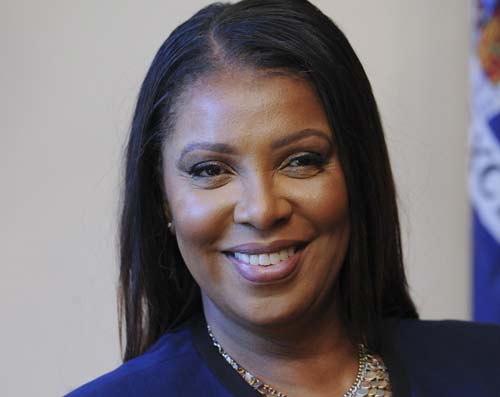
NEW YORK – New York Attorney General Letitia James today sued Early Warning Services, LLC (EWS), a company owned and controlled by a group of the largest banks in the United States that was tasked with developing and operating the electronic payment platform Zelle, for failing to protect its users from massive amounts of fraud.

An investigation by the Office of the Attorney General (OAG) revealed that EWS designed Zelle without critical safety features, allowing scammers to easily target users and steal over $1 billion between 2017 and 2023.

EWS knew from the beginning that key features of the Zelle network made it uniquely susceptible to fraud, and yet it failed to adopt basic safeguards to address these glaring flaws or enforce any meaningful anti-fraud rules on its partner banks.

Attorney General James filed this lawsuit after the Consumer Financial Protection Bureau (CFPB) abandoned a similar lawsuit, filed in December 2024, following the change in the federal administration.

With this lawsuit, Attorney General James is seeking restitution and damages for affected New Yorkers, as well as a court order mandating Zelle maintain anti-fraud measures necessary to protect its users.


“No one should be left to fend for themselves after falling victim to a scam,” said Attorney General James. “I look forward to getting justice for the New Yorkers who suffered because of Zelle’s security failures.”


EWS is a financial technology company owned and controlled by a group of the country’s largest banks, including JPMorgan Chase, Bank of America, Capital One, and Wells Fargo. Those banks tasked EWS with hastily launching an electronic payment platform to compete with payment apps like Venmo, PayPal, and CashApp, which were not controlled by banks.

In their rush to launch, EWS prioritized attracting new users through a simple registration process and quick transfers that left consumers vulnerable to scammers.


Zelle’s advertisements misleadingly promised safe and secure money transfers. In reality, Zelle failed to adopt basic anti-fraud safeguards.


Beginning in 2017, the year Zelle launched, anyone with a U.S. bank account could enroll in Zelle and send or receive near-instant money transfers through linked email addresses or U.S.-based mobile phone numbers.

Scammers could sign up through a quick registration process that lacked important verification steps, allowing them to utilize misleading email addresses such as those associated with trusted businesses or government entities.

Zelle’s emphasis on immediate and irreversible transfers means that by the time consumers realize they have been targeted by fraudsters, their money is often already gone.


As a result, Zelle quickly became a hub for fraudulent activity. The most common scams involved fraudsters gaining access to users’ accounts and making unauthorized transfers, and scammers convincing users to send funds under false pretenses, for example by offering non-existent goods or services or by impersonating a trusted institution like a bank or government office.


In one example of a common scam using Zelle, a New York user received a call from an individual impersonating a Con Edison employee advising that the consumer was delinquent on his energy bills and that his “electricity was going to be shut off that day” unless he paid Con Edison via Zelle.

The fraudster identified “Coned Billing” as the name associated with the account. The consumer transferred $1,476.89 to a Zelle account named “Coned Billing,” but after realizing the call was a scam, was told by their bank, JPMorgan Chase, that the bank “can’t get [him] that money back.”


The OAG’s investigation revealed that EWS and its partner banks knew for years that fraud was spreading on Zelle and failed to take meaningful action to stop it. When participating banks received complaints from Zelle users about fraud, EWS allowed banks to report that fraud to EWS long after it occurred, which enabled bad actors to scam additional consumers.

In fact, when Zelle launched, EWS did not require participating banks to report scams like the “Coned Billing” scheme in which fraudsters convinced users to send funds under false pretenses.

Even when EWS did receive reports of fraud, it failed to promptly remove the fraudsters from the Zelle network or require banks to reimburse consumers for certain scams. EWS developed basic safeguards to address these issues as early as 2019, but failed to adopt them.

EWS failed to meaningfully enforce even the limited, inadequate anti-fraud rules that it did have in place against participating banks despite knowing of widespread violations of those rules.


EWS aggressively marketed Zelle to New Yorkers, promising safety and security. However, EWS’s failures enabled fraudsters to run rampant on the Zelle network, leading to millions of dollars in losses for New Yorkers.


Attorney General James alleges that EWS violated New York law by creating a payment platform highly susceptible to fraud and doing little to stop it for years while falsely marketing it as a safe and secure service.

With this lawsuit, Attorney General James is seeking restitution and damages for all affected New Yorkers and court orders mandating EWS maintain necessary anti-fraud safeguards and take other steps to protect their customers from fraud.

Attorney General James is a national leader in protecting consumers. In June, Attorney General James sued payday lending companies DailyPay and MoneyGram for exploiting workers with predatory loans.

In May, Attorney General James sued Capital One for misleading its customers and cheating them out of millions of dollars of interest payments. In January 2024, Attorney General James sued Citibank for failing to protect its customers from fraud.

In April 2022, Attorney General James led a multistate coalition of attorneys general in calling on the CEOs of JPMorgan Chase, Bank of America, U.S. Bank, and Wells Fargo to eliminate all overdraft fees on consumer bank accounts.

Attorney General James encourages all consumers who have lost money to scammers through Zelle to report their experiences to the OAG’s Consumer Frauds Bureau.

This matter is being handled by Assistant Attorneys General Chris Filburn and Christian Reigstad with the Consumer Frauds and Protection Bureau. The Consumer Frauds and Protection Bureau is led by Bureau Chief Jane M. Azia and Deputy Bureau Chief Laura J. Levine, and is a part of the Division of Economic Justice, which is overseen by Chief Deputy Attorney General Chris D’Angelo and First Deputy Attorney General Jennifer Levy.

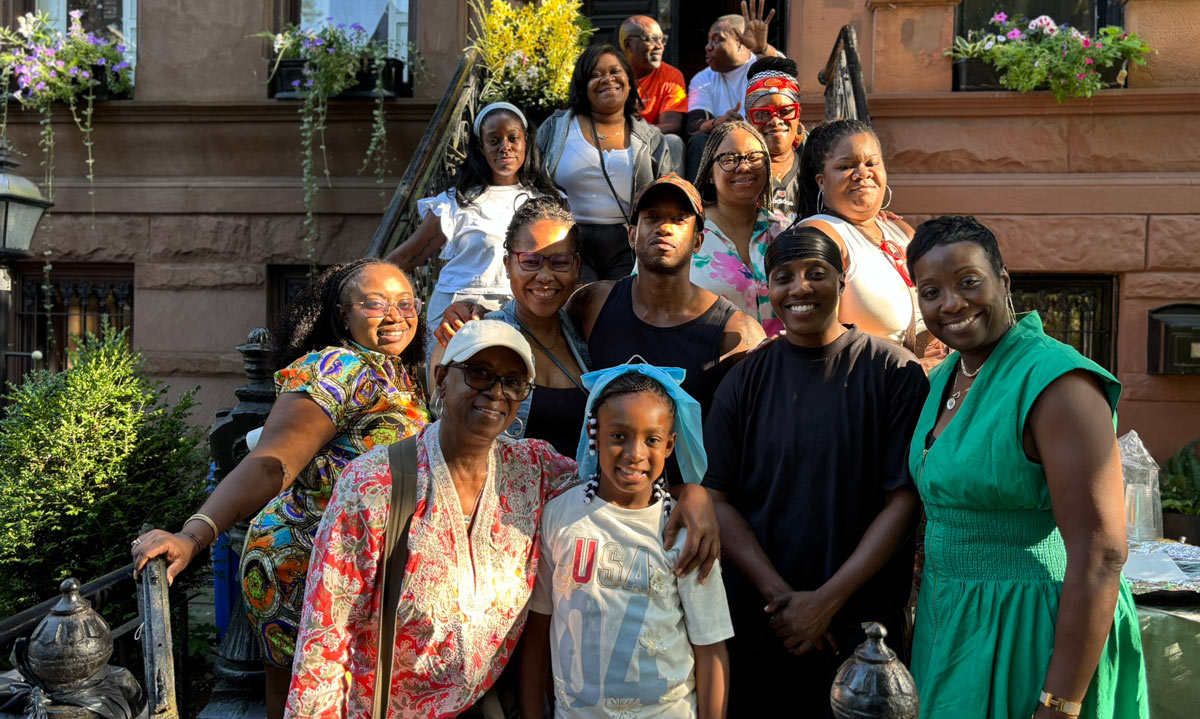
Decatur Street Block Party: Strengthening Community Bonds

0

By Pojanee Fleury
Decatur Street between Tompkins and Throop Avenue came alive on Saturday, August 9, 2025, as it transformed into an exciting celebration for its annual block party! The street buzzed with energy as neighbors and visitors gathered to enjoy a day filled with music, delicious food, and fun games for all ages.

Children laughed as they played games and participated in activities, while adults mingled and caught up with neighbors. The vibrant energy emphasized the importance of maintaining community spirit through events like these, a cherished tradition that has strengthened bonds on Decatur Street for over 60 years.


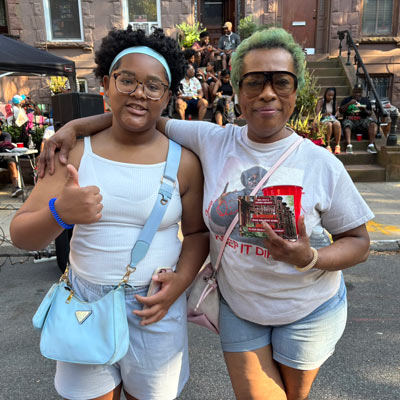
This block party was all about neighbors meeting neighbors. Block association president Gina has continued the long history of organizing on Decatur Street.

She shared, “everybody gets to meet their neighbors, we invite everyone to come out, long-time residents and new tenants, it strengthens the community feel of the block.”


Jane talked about the changes on the block in recent years mentioning that it’s another reason why the block has remained so important to the community, “you get to meet the people on your block so the next time you see your neighbor you can say hi, and actually know who is around you,” Gina explained.


Over the years, the block events have grown beyond just a casual gathering; they’ve become a powerful symbol of connection, unity, and resilience for the community.

These events have provided a space where neighbors can bond, share their stories, and celebrate their collective identity, fostering a sense of belonging that transcends daily routines.

Gina expressed her hope that these traditions will continue to thrive, bringing people together regardless of how much the neighborhood evolves.


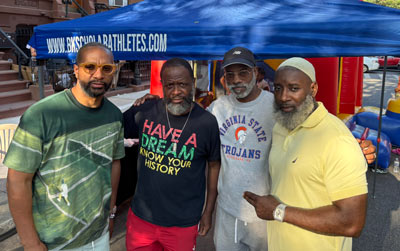
Children enjoyed a huge bouncy castle and games in the open street, neighbors cooked for one another, and bookbags filled with valuable supplies were distributed by Brooklyn Scholars Athletes (bkscholarsathletes.com), an organization dedicated to providing basketball training, academic support and team building skills to youth in Brooklyn.


This block party was a testament to the power of community and collaboration. Residents of all ages came together to celebrate their shared heritage and love for Brooklyn.

The event not only highlighted the neighborhood’s rich culture but also served as a reminder of the importance of supporting and uplifting one another. It was a day filled with laughter, joy, and a sense of belonging that left everyone looking forward to next year’s celebration!

MacDonough Street Block Party: A tradition of Unity

0

By Pojanee Fleury
On Saturday August 9, 2025, MacDonough Street between Marcus Garvey Boulevard and Throop Avenue turned into a summer oasis of music, laughter, and fun complete with an inflatable water slide for the children!

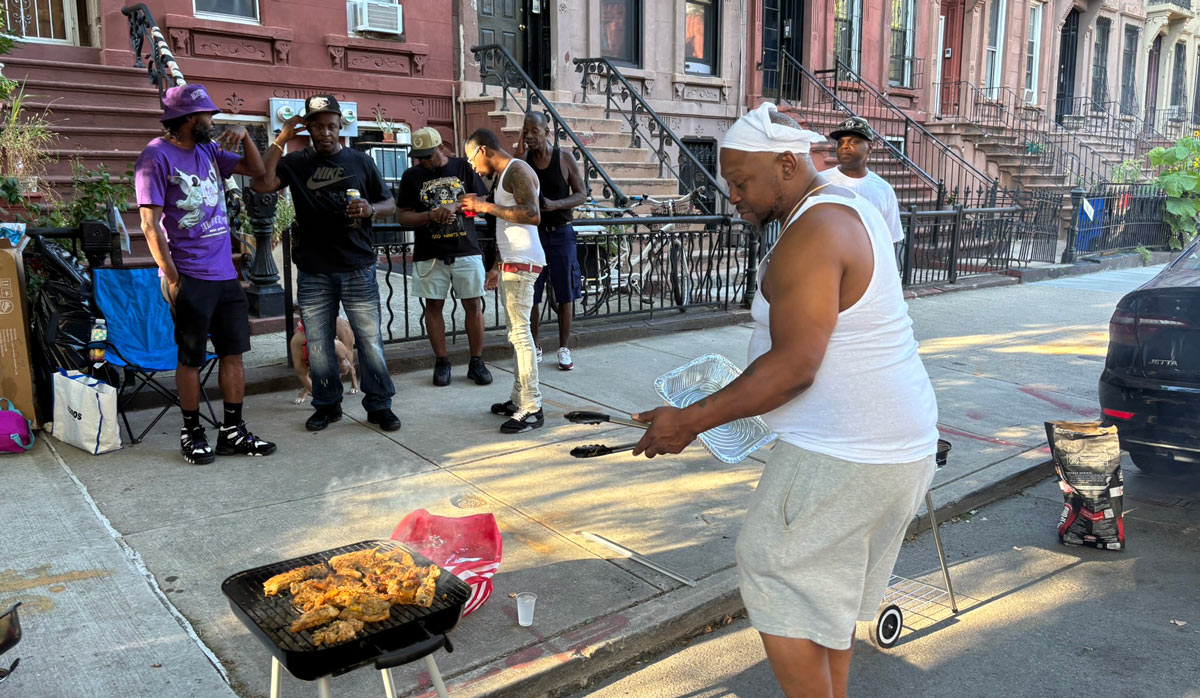
Neighbors set up chairs under stoops, kids ran freely through the street, and irresistible aromas of barbecued food filled the air. The annual block party bought residents together to celebrate community and keep a long standing tradition alive.


The newly elected block association president, Demetrius Lenard Johnson, took over from the late Wayne Hartley this year and already has hit the ground running, planning this year’s festivities. He shared, “it is a day where the community can intertwine with each other and get to know one another beyond just living next to them.”

Johnson recalls attending the block party every year since he was 10 years old – now 40 years and a community leader, he understands how important it is to continue to build a strong, knit community. “I have a lot of great things planned, I have kids and I want them and later my grandkids to grow up in a stable :environment,” Johnson stated.


Johnson also spoke about the two churches that adorn the block. On one corner sits Bethany Baptist Church and on the other Our Lady of Victory Church of St. Martin De Porres Parish which Johnson referred to as “our church,” as it serves as the block association’s meeting space and other block activities. “This is a very special block, we have angels protecting it from each side,” Johnson shared proudly.


Johnson’s deep connection to the block was evident as he continued to reflect on its unique charm. From the friendly neighbors to the shared traditions, he emphasized the sense of unity that has long defined the community and will for generations to come.


Block parties aren’t just about the fun—they are traditions that keep local communities strong. They provide an opportunity for neighbors to collaborate, share experiences, and foster a sense of belonging.

From potluck meals to games and music, these gatherings bring residents together around common goals, these events create the space needed to strengthen relationships, create supportive networks and foster a safer and happier community.

VOICE Community Activation at Raymond Bush Playground

By Pojanee Fleury
On August 9, 2025 the historic Raymond Bush Playground was filled with community members from near and far for the 3rd Annual VOICE Community Activation, a daylong event designed to support local families and celebrate neighborhood pride.

Led by organizer Jordan Pierre the activation blended sports, play, and resources to help students gear up for the new school year. The event aimed to strengthen neighborhood ties and create positive outlets for youth.


Jordan Pierre founded the VOICE Foundation three years ago, inspired by the momentum from a viral speech he gave at Syracuse University.

Encouraged by his barber to stay connected to his community and use the attention for something meaningful, Jordan set out to make a positive impact.

He launched the activation day alongside community members, including those who had moved away from the neighborhood. Jordan compared them to an alumni association, who would act as continuous supporters to help the community stay strong, no matter where they live.


Attendees enjoyed free food and snacks, while children had fun playing games and jumping on the bouncy castle. School supplies, including backpacks, notebooks, pens, and pencils, were distributed.

There was a youth basketball tournament with local players competing in spirited games that emphasized teamwork, discipline, and sportsmanship.

Neighbors connected across generations, meeting new families and reconnecting with old friends. The highlight of the day was the amazing performance by the Brooklyn United Arts Music and Arts Program’s marching band!

The band’s performance was truly breathtaking. The young, dynamic drummers and dancers were filled with electric energy, delivering tricks and musical feats with precision!


Jordan shared that the theme of this event was “We Are More Than What They Portray Us To Be.” With VOICE, he is changing the narrative and the image of those in his community.

He incorporated basketball, music and art into the event because he wanted to show the young people that they can build skills that can open doors, mentioning how several students of the Brooklyn United received music scholarships to play in bands at HBCUs.

“Most young people need a reference, to see something and say I can do that, knowing it’s possible to be successful because others in their own community can and have done it.”


By bringing together celebration with support, VOICE Community Activation showed how local leadership can foster pride, resilience, and empowerment. Events like this strengthen trust, create opportunities for youth, and keep vital resources within reach—helping the community head into the school year stronger and more united. All images/Pojanee Fleury

USA and South Africa During the Trump Administration

By Jeffery Kazembe Batts
IG: @kazbatts

Recently, the Republican-led U.S. House of Representatives voted 34 to 16 in the Foreign Affairs Committee to approve the HR2633 bill. The “United States / South Africa Bilateral Review Act” gives President Trump and Secretary of State Marco Rubio tools to attempt to micromanage the sovereign policies of Africa’s most industrialized nation, South Africa.

Under the bill, proposed by Rep. Ronny Jackson of Texas, South African policies will be routinely evaluated every two years to ensure that they have not deviated in any way from the policies promoted by the Trump administration. Ranking member of the committee, Gregory Meeks, argued that South Africa is a leader on the African continent, should be respected, and dialogue and diplomacy are needed when differences exist with the United States.


In slightly more than half a year, in his rerun as president, Trump has continued his previous disengagement and contempt for the entire African continent, now with a special negative focus on South Africa.

Earlier this year, inside the White House, he blindsided South African President Cyril Ramaphosa by showing false images of supposedly white farmers murdered, and also a film of Economic Freedom Fighter leader Julius Malema speaking at a rally.

He then incredulously arranged a first-class trip for 59 white farmers to move to the top of the immigration list so they could immediately arrive at Dulles International Airport in Virginia.

Meanwhile, mostly people of the Global South, including numerous Africans, are rounded up and deported. In February, Trump signed an Executive Order that reduced the limited amount of foreign aid the US provides to South Africa.

Digging deeper into the Trump administration’s anti-Africanness, Trump expelled widely respected South African Ambassador to Washington Ebrahim Rasool in mid-March.


A 30% tariff rate has now been imposed on exports from South Africa to the US, with notable exceptions for pharmaceuticals, semiconductors, lumber products, critical minerals, and energy products. South Africa is America’s largest African trading partner. After the European Union and China, America is the third-largest trading partner for South Africa globally.

According to Simphiwe Hamilton, Director-General of the Department of Trade, Industry and Competition, 30,000 jobs are in jeopardy of being lost because of increased tariff. “We base this on consultations with sectors of the economy from automotive to agriculture that are going to be impacted,” he shared.

America is the world’s largest importer of citrus products, a major South African export. Be mindful that prices will rocket up!


South Africa has successfully charged Israel with genocide at the International Court of Justice because of Israel’s treatment of Palestinians. The overwhelming majority of United Nations member states agree with this position.

The “S” in BRICS is for South Africa. Senegalese Prime Minister Ousmane Sonko understands the importance of BRICS, saying, “I think that today, what is being done in the Global South and at the BRICS level is quite important and must continue for a more balanced, multilateral world.” These are two examples of where the US and South Africa diverge in their policies.


Allegedly, South Africa should not undermine US national security and foreign interests while also identifying and sanctioning the corrupt African National Congress is the goal of the HR2633 bill. Can the sovereign nation of South Africa make its own decisions? The Trump administration is seemingly on a mission to sabotage the historic relationship between Black people in America and South Africa.

The world, especially Black people living in the United States, organized and supplied resources to end apartheid, free Mandela, and help South Africa to become a republic that represents all the people. Moving forward, that legacy must be built upon and not tarnished and destroyed by current American foreign and trade policy.