Home Blog Page 183

AI in the Spotlight at the 53rd Annual Legislative Conference

By Mary Alice Miller
Building on the theme “AI Renaissance: Navigating our Future,” the 53rd Annual New York State Association of Black, Puerto Rican, Hispanic, and Asian Legislative Conference hosted several workshops that dispelled myths and fears around the new technology and its impact on people of color.
“In recognizing the profound impact of Artificial Intelligence on our daily lives, we are committed to exploring its implications and charting a course forward in this ever-evolving landscape,” Assemblywomen Rodneyse Bichotte Hermelyn and Alicia L. Hyndman said in a welcoming statement.
Artificial Intelligence workshops included “Digital Equity: Increasing Equitable Access to Computer Science Literacy in the AI Era,” “Public Sector Use of AI Technology: The New Age of Government and Constituent Services,” Toward an Equitable and Just Technology: Protecting Civil Rights and Privacy in the Digital Age,” “Addressing the Gender Pay Gap in the Age of AI and Tech for Black and Brown Women in NYS,” and “Promoting America’s Competitiveness Through Inclusive STEM Education.”


The Women’s Empowerment Brunch hosted the Dr. Una Clarke Lecture Series, focusing on the Future of Workforce and AI.
Councilmember Nantasha Williams, District 27 in Far Rockaway said, “I remember life before the internet. A lot of people were very scared of the internet. Then, there was an explosion of an entire industry that existed but didn’t exist in the same way that we know it now. The technology continued to grow and expand. So many people who were early adapters to the internet and the World Wide Web are making millions of dollars right now. Regarding AI, I want to lean into it, I want to be an early adapter. Let’s all be early adapters. Let’s be critical of the platform to ensure it serves everybody in every community.”
Dr. Jacqueline Maracheau, Chairwoman of Episcopal Health Services, spoke of the ubiquity of AI in health care. “We don’t know that AI has been in health care for quite some time. It is ingrained in everything we do and has been propelled by Covid-19,” said Dr. Maracheau. “Right now, my Apple watch tells me I have a fast heart rate. AI helps make diagnoses faster, better, and with more precision.”
Kenya Handy-Hilliard (McDonald’s) told the audience about a partnership between McDonald’s and Google. “We are going to use technology in the cloud to manage the three-legged stool with more efficient communication: the corporation that manages real estate and brand, the restaurants, and large-scale suppliers,” said Handy-Hilliard. “In the back-of-house, AI will manage the machines better, faster, and safer. For instance, if there is an adjustment needed on the oil, then AI will automatically fix it and create an alarm system so that employees can attend to it.”


Beauclarine Thomas, (Facebook/Meta) said the tech company has a multi-faceted approach to AI.
“Engineering and research and development help build better products with AI,” said Thomas. “Our safety and community standards can quickly employ AI to flag content that violates our standards. Sometimes AI takes down content that shouldn’t. It then goes through a review.”
Felecia Webb, Partnership on AI’s chief strategy officer, gave an overview of the challenges and opportunities presented by artificial intelligence. “The adoption of AI is spreading fast.
AI is positioned to upend human capacity and increase our productivity, but we also know that since Covid, we had about 800,000 women leave the workforce. It is predicted that 12 million jobs here in the U.S. will be replaced by AI,” said Webb. “AI is not bringing all doom and gloom. There will be a 23% increase in STEM jobs in addition to increased financial investments in the global economy.”
Webb called AI a revolution. “There are opportunities being created. For instance, 4-year degree requirements are being waived so that there will be skills-based jobs with training. Future proofing those jobs requires critical thinking,” Webb said. “There is an uptick in women entrepreneurs. AI has helped level the playing field. The AI revolution can create immense wealth just like the Industrial Revolution.”
Webb cautioned, “Before we get to AI Utopia, we have to address the wealth gap, skills gap, and the digital divide. We have gaps in AI understanding and AI policy.” She concluded, “Thinking of human values and human dignity, we have to make sure that companies are using human-centered AI development, an ethical framework, and establish regulatory standards to make sure AI has justice, equity and shared prosperity.”
“AI is a powerful tool. College students are using ChatGPT to do first drafts of every paper they are ever going to write,” said NYS Senator Kirsten Gillibrand.


Speaking of current issues, Gillibrand said, “AI also comes with a great deal of risk and fear. Computer-generated images of famous young women are a scourge. AI-generated pictures of them have been used to harm them. For some women, it feels like an assault, a violation of their human dignity. Women, including women of color, will be targeted and disproportionately harmed by the use of AI in this way.”
Gillibrand added, “We as legislators and advocates have to fight against it because we are the only ones who will be protecting ourselves. There is currently no regulation of AI. I put together legislation that would create a Data Protection Agency, specifically to regulate Web2, Web3, and AI, so that smart people can provide oversight and accountability of these industries.”
Referring to some notable tech companies, Gillibrand said, “They do not have our best interests at heart. Their interests are making money. For school-age children, the internet has become a place of harassment where their image is constantly being assaulted. These platforms could care less. They will promise to protect our kids, but the truth is they will take our children’s data and use it against them.”
Gillibrand ended her remarks by issuing a challenge to the women in attendance. “I hope that women, mothers, and grandmothers of society can see these problems and fight against them as hard as we can,” she said. “We should make sure we are informed. The more we know about the challenges of oversight and accountability for AI, the more powerful our solutions can be.”

Langston Hughes – A Major Voice of the Harlem Renaissance

By Chaitram Aklu
Starting in 1910 during the Great Migration, Harlem had become a major destination for African Americans migrating from the US South and other parts of the world. By the 1920s and continuing into the 1930s (The Harlem Renaissance), it had become a place where African American culture flourished to the extent that it had impacted black culture and consciousness worldwide. Writers and artists’ works were encouraged and promoted in African American publications and forums.
Langston Hughes’ name is indelibly engraved in the movement, and his life experience is a powerful example for future generations of all races. He was a writer who wrote in many different genres and authored over 60 books between 1926 and 1967. He has the distinction of being the first African American writer to earn a living by writing. He and others focused on portraying black life experiences in America, which led to them being targeted as enemies by their own government. He was accused of being a communist by Senator Joseph MC Carty and was forced to testify in Congress. W.E.B Dubois was also persecuted by the US Federal Government, which indicted him as a foreign agent, tampered with his mail, and intimidated his friends and supporters to silence him. His passport was revoked. Du Bois eventually chose to exile himself in Kenya where he died in 1963.


Hughes was born in Joplin, Missouri, on February 1, 1902. His parents divorced when he was very young, and he lived with his grandmother until he was 12 years old. His grandmother inculcated many positive characteristics in him, including the importance of achieving a good education. He spent most of his time in libraries and, as a result, developed a passion for reading, literature, and writing in his formative years.
Hughes started writing poetry in the eighth grade after he moved with his mother to Lincoln, Illinois, where he lived only one year before moving again to Cleveland, Ohio. Although he moved a great deal, he remained focused academically, and at high school, he was voted class poet and editor of his school’s yearbook.
His father encouraged him to pursue a professional career. He had him enroll at Columbia University, where he studied engineering and chemistry from which he could earn a living rather than the uncertainty of being a writer.
He also moved from place to place as an adult and took a variety of jobs (on an African freighter, as a cook in Paris, and as a busboy in Washington DC.) to support himself but continued writing poetry. He learned several languages and translated the significant works.
But it was in Washington DC that he was “discovered.” On November 27, 1925, Hughes was working as a busboy at what is now the Marriott Wardman Park Hotel in the nation’s capital. The famous poet Vachel Lindsay was at a function at the hotel. Hughes quietly put three of his poems on Lindsay’s table. Lindsay was immediately impressed and, later in the evening, read the poems to the audience. He praised the African American busboy that he did not know, telling his audience he had “discovered a young man with great literary talent.” The next day, the major newspapers covering the event published the poems. The following year, 1926, Hughes published his first book.


He became a leading figure and significant voice in Harlem during the Harlem Renaissance (1918 -1937), where other writers, performers, entertainers, musicians, composers, and visual artists sought to settle during the Great Migration of African Americans from the South to the North. Between 1916 and 1970, the black population in New York increased 66 percent. The Renaissance period lasted from the 1920s to the 1930s and was a cultural, social, and artistic movement that encouraged the study and promotion of the expressions of black life.
He and Zora Neale Hurston, Aaron Douglas, WEB Du Bois, Duke Ellington, Claude McKay, Marcus Garvey, and others shaped the Harlem Renaissance with their own unique and diverse contributions. People of African descent from other parts of the world also moved to Harlem. He wrote poems, novels, short stories, plays, children’s poetry, musicals, operas, and biographies from his own experience. All of his works portrayed the African American experience from the 1920s until his death in 1967.
Some of his works include Popo and Fifina: Children of Haiti, The Dream Keeper, The Negro Speaks of Rivers (1921), other Poems, Famous Negro Music Makers, and the First Book of Negroes. He also wrote the first history of the NAACP. Fight for freedom: The story of the NAACP (1962).
One of his great poems, Mother to Son (1922), was published in The Crisis magazine – a publication that promoted Civil Rights and highlighted the difficulties African Americans faced in a racist society. The theme highlights the dangers blacks face. Mother to Son also gives hope that the difficulties can be overcome with persistence, resilience, and mutual support.


When Hughes died on May 22, 1967, his ashes were interned at the entrance of the Arthur Schomburg Center for Research in Harlem.
Beginning February 25, an exhibition billed as “The First African American–led Movement of International Modern Art” and titled Harlem Renaissance and Transatlantic Modernism will open at The Metropolitan Museum of Art.
It will run through July 28, 2024. A press release states, “This landmark exhibition celebrates the brilliant and talented artists behind the groundbreaking cultural movement we now know as the Harlem Renaissance.” It will consist of 160 works portraying black city life through various media stretching from the 1920s -1940s.
End note: February was selected as Black History Month in honor of Abraham Lincoln and Frederick Douglass. Their birthdays are the 12th and 14th, respectively.

Migrant Impact in NYC: Pitting the Poor Against the Poorest

By Nayaba Arinde
Editor-at-Large

“It is like they are creating a ‘poor versus the poorest situation,” AT Mitchell, founder and CEO of Brooklyn’s Man Up Inc., told Our Time Press. “They are pitting us against each other. The feeling that I am hearing on the street is that they are being given priority over people who have been here already. It’s like someone is promoting that.”
This is a nation of migrants/immigrants, save for the kidnapped Africans brought to these shores and the indigenous people whose land was stolen.
Since last April, opposite opinions have run parallel about the arrival of almost 170,000 migrants, defiantly transported to the city by Texas and Florida Republican Governors Gregg About and Ron DeSantis.
And so New York became the destination for tens of thousands of migrants from nations such as Venezuela, Nicaragua, Ecuador, China, Guinea, Mali, Senegal, and the Ivory Coast.
The situation has NYC housing and social service systems straining at the seams.
“This is why it’s a Black crisis,” Attorney Tareian Alexis King told Our Time Press. “This is how the system is trapping the migrants. They cannot file for workout authorization until they file for asylum, and when they file for asylum, they need an attorney. But, the Venezuelans and Hispanics have TPS and can work immediately.”
The New York-based international lawyer, with an office in Senegal, stated, “This is why this is a Black crisis. They have to wait 150 days to apply for work authorization, and what is someone going to do for 150 days?”


New Yorkers step up.
The migrants are housed in hotels, homes, mosques, and community spaces like Floyd Bennett Field, and food, toy, and clothing drives and GoFundMe accounts are created. Members of the community drive up to shelters like the Bedford Armory on Atlantic Avenue, pop their trunks, and give out food and clothes to the now predominantly African migrants. Many of the former Latino residents with TPS – Temporary Protected Status have moved on.
“The biggest issue is the lack of legal knowledge. Getting here was only one part; staying here was an entirely different part. Having all of these resources, such as IDs and housing, is not going to matter if they have a deportation – if they have an order of removal that they cannot fight – because they will get deported,” Attorney King told Our Time Press. “They have to have an attorney. Asylum is a legal fight. Immigration is legal. When our new neighbors enter America automatically when they come into the border, they are given an order of removal. Meaning that ‘We are sending you back to where you just came from,’ and so when they get in, they actually have to apply for asylum to be able to fight that order of removal. However, when they come in, they are focusing on housing because they are homeless. They focus on food because they don’t have any food. When they come in, they have to have an attorney, and to file for asylum, they only have one year to apply.”
Last week at the 53rd Annual Black, Puerto Rican, Hispanic, and Asian Legislators Caucus weekend, New York State Senator Cordell Cleare hosted a workshop entitled: “The Hidden Crisis: African Migrants in New York.” Issues like housing, the need for work permits, access to food, and culturally-sensitive support systems were discussed.
While Venezuelan migrants have been granted TPS – giving them access to funds, housing, and work permits, migrants and asylum-seekers coming from select West African nations – have not.


Sheikh Musa Drammeh, the community leader and activist, told Our Time Press that there is a movement to get TPS for the African asylum seekers from Guinea, Mauritania, Senegal, Mali, The Gambia, and Ivory Coast.” Advocates are working on it, and I believe Temporary Protected Status will be granted.”
Meanwhile, migrants selling hats and scarves and electronics like ear pods are a common sight on streets like 125th Street in Harlem. Mr. Mitchell told Our Time Press that vending is one of the best ways for a person to set up an independent business, so long as it is legal, and selling items like clothes, oils, and books.
“In the city of New York, the majority of the vendors are foreigners. What programs are in place that allow them to vend without being harassed by the police, but brothers in the hood can’t? That’s going to create more strife. I think that the solution is that there should be an equitable program that allows people who have been here and are willing to legitimately vend on the streets to have designated places where they can do that.
“I hear a lot of politicians say, ‘They are here; they want to work. There’s thousands of jobs.’ But, if thousands of jobs are willing to hire people coming here without documentation, why aren’t those jobs being made available for people who have been here already and giving them that same sort of push and support?”


Mr. Mitchell added, “It’s sad because our people are not even realizing that they are being played into a situation. People believe in divide and conquer. If we are united on these very simple issues like housing, employment, and entrepreneurship, then we would be able to take advantage of these opportunities fully. These opportunities would be more equitably distributed where the need is greatest. But, if that’s not what is being promoted, then it is ‘us versus them.’ They are being pitted against each other for the same food, for the same benefits, for the same housing, for the same opportunities, and it shouldn’t be that way at all.”

Enduring Strengths of Historic Church Captured in Legacy Journal

Bridge Street Living Legends biographical journal for this Sunday’s 258th anniversary celebration of historic Bridge Street AME’s Church became a mission-focused ministry for five writer/interviewers. As well as labor of love.
The journal includes the poignant, elegant biographical sketches of 63 elder members (four have passed), age 80 and over, from interviews conducted by Annette I. Williams, Celeste Douglas, Audrey Vaughan and Karen Brown. The Rev. David B. Cousin, Sr., the church’s pastor with his wife “Rev. Val” edited the 63 pages of typed information to 16!
The opening statement of describes the process: the interviews were conducted over several weeks and all interviewed were asked the same questions. “The responses were varied. What remained the same, and consistently so, were the indelible marks left on the interviewees as our Living Legends, with the gentlest of care and love, peeled back their time-rendered curtains and revealed their beautiful personal historic tapestries of a Bridge Street Church in a different space and time.
“It did not matter if our Living Legend joined Bridge Street Church as a baby (cradle roll), a young child, a child of a 309er (an original member of Bridge Street when it was located at 309 Bridge Street, Brooklyn, NY), as a young adult, or an adult, what was constant in the telling was the love and passion for Bridge Street that has not wavered over the years.”
So, through this effort, the age-old spiritual, “This is my story, this is my song,” is enfused with life. It was Our Time Press’ wish to print all biographies — representing more than a combined 5,000 years of faith-immersed living — but space constraints did not permit it. What follows are eight of the 63 “songs” whose “lyrics” will stay with you, possibly haunt you, but mostly inspire you to joyfully pen your own.

Baldwin, Gladys A. was born in Brooklyn, New York, on September 16, 1924. She joined Bridge Street in 1951 under the pastorate of Reverend Emmer Booker. Sis. Gladys learned of Bridge Street through her family. What she enjoys most about Bridge Street is fellowshipping with her family and other church members. She has served in many capacities at Bridge Street: Sunday School Superintendent of the Beginners Department, president of the Relief Society, Acolyte, member of the Missionary Society, administrator of the Afterschool Tutorial Program, vice president of the Progressive Women’s Club, and member of the Soup Kitchen, Nurses’ Unit, and Prayer Band. The elder who exemplified the characteristics of a Living Legend was Bro. Elker Smith because he was kind and never spoke poorly of anyone. Her words of wisdom are: “Never cease from praying, and no matter the situation, it could always be a lot worse.”

Canty, Deloris M. was born on May 6, 1931, in Brooklyn, New York. She joined Bridge Street on Mother’s Day, May 9, 1971. Sis. Canty learned of Bridge Street from her mother-in-law, Sis. Lola Canty, who was a member of Bridge Street. Before joining Bridge Street, Sis. Deloris attended Cornerstone Baptist Church. What she enjoys most about Bridge Street is the worship service, growing in her faith, fellowship with other believers, and making friends. Sis. Canty served as president of the Class Leader Board, member of the Junior and Senior Steward Boards, vice president and secretary of the Gospel Choir, member of the Foley Harmonettes, receptionist, assistant church clerk, volunteer in the Wednesday Feeding Program, hostess at the Annual Conference, and member of the First Lady’s Circle. She considers her support of organizations she was a part of as her greatest legendary contribution. The elder who exemplified the characteristics of a Living Legend was Sis. Juanita Berry because she was instrumental in getting Sis. Canty to volunteer in the administrative office. Sis. Canty lives by Psalm 51, and her favorite song is “One Day at a Time, Sweet Jesus.”

Evans, Irene was born on March 20, 1927, in Pensacola, Florida. She learned about Bridge Street in 1984 through Evangelist Edith Taylor, who brought her to church. Sis. Evans joined Bridge Street in 1984 and enjoyed serving in the Missionary Free Food Program, where she labored for twenty-nine years and four months. She found the work rewarding and fulfilling because it helped others and fostered great fellowship with the workers in the program. She served as vice president and president of the Ethelyne Henderson Missionary Society, assistant and Class Leader of Class #13, member of the Trustee Board for sixteen years, the Social Action Commission, Rites of Passage, Habitat for Humanity, where she assisted with five different projects, board member of the 575 Housing Fund Development Corporation, the Gospel Choir, the Alabama Club, and the Arthur L. Funn Lay Organization. Her greatest legendary contribution was to the Ethelyne Henderson Missionary Society. The elders who exemplified the attributes of a Living Legend were Evangelist Edith Taylor, Sis. Eunice Gray and Sis. Victoria Harris. Other elders who exemplify the attributes of a Living Legend are Deaconess Phyllis Johnson, Sis. Helen Jefferson, and Sis. Ruby Pack. Sis. Evans believes that her willingness to help people in whatever way she can is what makes her a Living Legend. Her words of wisdom are: “Treat other people the way that you want to be treated. Stay positive.” Her favorite scripture is Psalm 34:1, “I will bless the Lord at all times; his praise shall continually be in my mouth.”

Graves, Jr., S. Alonzo was born on June 6, 1941, in Fernandina Beach, Florida. He came to know about Bridge Street through his father-in-law, Bro. Andrew W. Bony, who was a long-time member. Bro. Graves joined on Men’s Day in 1985. What he enjoys most about Bridge Street is working with other organizations in the church. He is a Senior Steward, member of the Arthur L. Funn Lay Organization, and former member of the Board of Directors of Bridge Street Development Corporation and the Bridge Street Headstart Program. Bro. Alonzo considers his service to these organizations as his most outstanding legendary contribution. The elder who exemplified the attributes of a Living Legend was Bro. Willie A. Harris, Sr. because of his willingness to work for the betterment of the church and its surrounding community. He lives by Matthew 25:37-40, “Then, the righteous will answer him, saying, ‘Lord, when did we see you hungry and feed you, or thirsty and give you drink?’”

Hatcher, Elouise was born on July 17, 1932, in Louisville, Georgia. She learned of Bridge Street through her mother, Lou Ethel Hatcher, who joined in the 1970s. Before that, her mother was a member of Spring Bethel AME Church in Georgia. Sis. Elouise joined Bridge Street in 1987 and enjoys being a member and fellowshipping with others. Although her mom was a member of the missionary society Sis. Hatcher has not joined any organizations at Bridge Street. Her greatest legendary contribution was supporting her mother’s mission work. The elder who exemplified the attributes of a Living Legend was her class leader, Bro. Dwellie Benefield, because he visited his class members and prayed with them. She believes being on this earth and participating for many years makes her a Living Legend. Sis. Elouise’s words of wisdom are: “Be honest and do the best you can from day to day.”

McGaney, Harry was born on May 5, 1935, in New York, New York. He learned about Bridge Street from his mother, Gardenia McGaney, who was instrumental in bringing him to church. From 1941 to 1951, he attended with his family. He returned in 1986. He has enjoyed being a member of the Christian Education Commission, Roscoe C. Henderson Male Chorus, and serving as a Holy Steward, a position to which he was appointed by Rev. Fred Lucas. Serving as a Holy Steward has meant the most to him because it was a big part of his spiritual growth. Bro. McGaney also served on the Junior and Senior Steward Boards, which has also meant a lot to him. He considers the spiritual support he has provided to organizations to be his greatest legendary contribution. He believes that the blessing of longevity, by God’s grace, is what makes him a Living Legend. Bro. Harry lives by the Golden Rule, “Do unto others as you would like others to do unto you.”

Wallace, Paul was born on March 4, 1943, in Opelika, Alabama. He learned about Bridge Street through his brother, Henderson Wallace, who was a member and invited him. Bro. Paul joined in 1996. What he has enjoyed most about his time at Bridge Street is growing in his faith, attending worship services, fellowship with other believers, and making friends. Bro. Paul joined the Alabama Club and the Male Usher Board, where he has served as a member and the president of both organizations. These organizations mean a lot to him because of the fellowship and camaraderie among the members. His legendary contribution to those organizations is his loyalty, dependability, and commitment to their work. The elders who exemplify the attributes of a Living Legend are Bro. Charles Drake, Sis. Nancy Mclntosh-Bedden, and Bro. Henderson Wallace because they are encouraging, supportive, and friendly. Bro. Paul believes that God’s grace in granting him longevity of life makes him a Living Legend because he and his sister in Alabama have lived longer than anyone else in their family. He also believes that his patience, understanding, kindness, love, respect for others, and caring disposition makes him a Living Legend. His words of wisdom are: “Treat everyone with the same respect as you would want for yourself.”

Williams, Lonzie was born on April 21, 1931, in Swainsboro, Georgia. He learned about Bridge Street from his cousins Robert and Iola Passmore and his aunt and uncle Alberta and Lester Williams. He has been a faithful member for over fifty years. What Bro. Lonzie enjoys most about Bridge Street is the worship service, growing his faith, and making friends. He was appointed to the Junior Steward Board and has been an active member of the Edward A. Carter Veterans Ministry. He was also a member of the Georgia Club and the Roscoe C. Henderson Male Chorus. The Junior Steward Board and the Veterans Ministry have meant the most to him because of their significance in his life. His greatest legendary contribution to the church is his generosity. The elders who have exemplified the attributes of a Living Legend were Bro. Robert and Sis. Iola Passmore and Bro. Joel Nesbitt because they were God-fearing, faithful, dedicated, and supportive. Bro. Lonzie believes his discipline and obedience to leadership makes him a Living Legend. His favorite scriptures are Psalms 23 and 91.

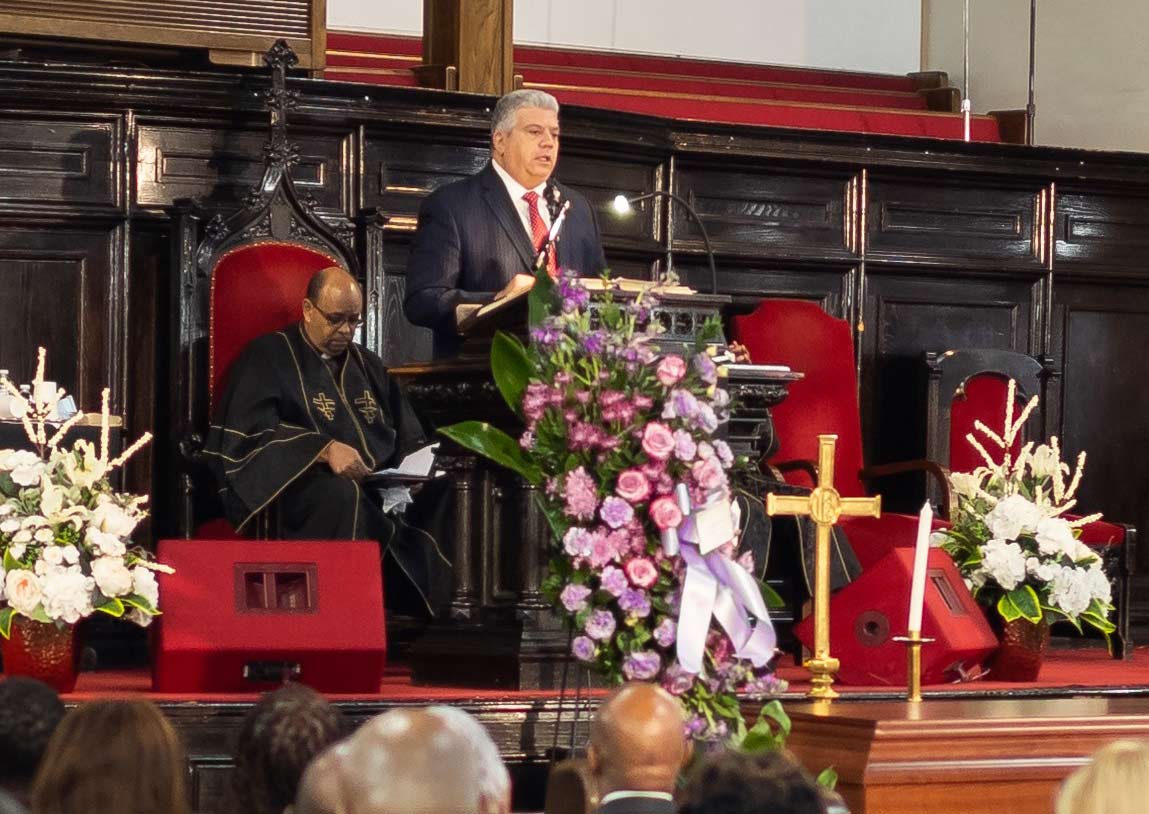
On Dr. John L. Flateau: “He Uplifted Us to Positions of Power”

Eric Gonzalez,
Brooklyn District Attorney

The collective of sorrow of the church — as people came in, paid respects, as we speak today about the man that Dr. Flateau was and what he meant to this community and what he meant to all of us in our individual capacities, it’s tremendous grief but it’s also a rejoicing of a life well-lived.
Dr. Flateau embodied what it meant to live a life of service. He was a keen reader of politics. He was a stalwart for justice and the champion of education. Dr. Flateau is rightfully recognized at this church as the giant of Bedford-Stuyvesant, of Central Brooklyn, of New York City. He touched on so many disciplines, all the disciplines that really mattered to make sure that black people, Latino people, and people of color in this city got a fair shake. He never sought the spotlight for himself. He was a wise counsel. He was an inspiration. Today, we have so much of the leadership of our city and our state represented here in church to say thank you to the family for sharing your husband, your father, and your brother.


He, as we now have learned, and sometimes it’s a generational thing, but Council and Chief of Staff to David Dinkins, a brother and a fight to the Honorable Annette Robinson, the late great Al Vann, and to my mentor, DA Ken Thompson. When I ran for district attorney, John sought me out. I said he sought me out, and that was not by accident because he wanted to make sure that the path of justice in Brooklyn would stay strong. He understood what I was asking. My goal as district attorney was to make sure that we continue to restore trust in our law enforcement systems. That our community could never really feel safe, could never actually be safe if we didn’t trust our justice system.
When I turned to him for help, he helped create what I call the Safety Plan for Brooklyn. You see, when I became DA, I issued a report. It’s called Justice 2020, but really, it laid out the goals of Dr. Flateau. What would the justice system look like if we centered fairness as the central focus point of that system? In that, we talked about the school-to-prison pipeline. How do we shut that valve? How do we prevent people from making money on the incarceration of black and brown people?
These were so central to the work, and as we continue to fight for a safer Brooklyn, it’s never been lost on me as District Attorney that we can never truly feel safe unless our justice system continues to fight and center people’s lives. The humanity in people’s lives is the core element of what justice is really about. A sense of justice has to be that we’re going to be treated fairly. For me, Dr. Flateau was a mentor as well. He talked to me about how we move this system. Brooklyn has progressed, and I’m a son of Brooklyn. I grew up and was raised in Brooklyn. My family came from Puerto Rico to Bedford-Stuyvesant and to Williamsburg, and I ultimately grew up in New York in Brooklyn. I remember what Central Brooklyn was like when I attended school in Bedford-Stuyvesant, in East New York, and in Coney Island when I went to high school. We’ve made a lot of progress, Brooklyn, but leadership like Dr. Flateau has uplifted so many of us to positions of power today.


I take this moment in front of all of you to say, as District Attorney, I recommit myself today and every day to the mission of Dr. Flateau about making the justice system work for all people. Very importantly, the mission of Dr. Flateau was to bring black and brown communities together because if we were going to really create a fair and equitable justice system, we had to speak to the values of our community. These values of justice and safety, that no child should ever lose a life to gun violence in our city, are so on point. I recommit to this community today that we will continue to do the work together, and there are a lot of partners here. There are a lot of partners in fighting gun violence, and part of that fight is to do that with the community leading the way.
Once again, I offer my condolences personally, but I don’t think that everyone knew in the community how much Dr. Flateau touched lives. How many of you understood how — and I know that his sons mentioned that — his work is really being carried out at different areas: Medgar Evers College, Attorney General Tish James’ office and the work she’s doing in fighting for redistricting and all of the work that we have been doing locally in our justice system.
And that it is his thinking, his teaching, his motivation, and his lessons that continue to push this city forward. So, thank you family, thank you all of you who feel that emotion. Know that the work continues, and as your DA here in Brooklyn, I pledge that we’re going to continue to move our city in a fairer direction and we’re going to continue to make the lives of Brooklyn residents safer. Thank you, church.