Home Blog Page 182

Clean Energy Jobs Available NOW!

By Mary Alice Miller
New Yorkers are challenged to step forward to fill renewable energy jobs as part of New York State’s mission to reach climate goals of Net Zero by 2050, said State Senator Kevin Parker, chair of the Committee on Energy and Telecommunications.
“As we battle climate change and try to reduce greenhouse gases –
particularly methane and carbon dioxide – it is going to be really important for us to replace gas, coal and oil burning facilities with more sustainable energy facilities: offshore wind, onshore wind, hydroelectric, solar, and thermo heat,” said Senator Parker. “We are building out more clean energy generation infrastructure. When we talk about how do we create full-time jobs with living wages and benefits the green economy is where it’s at.
Parker referenced a book Van Jones wrote about 15 years ago called “The Green Collar Economy”. “If we don’t prepare our people for this job market it’s going to be another 40-50 years before we get another opportunity like this again,” said Parker.
To that end, last year Parker secured $1 million for Medgar Evers College in order for them to study the issue and begin developing programming. Parker has connected Dr. Patricia Ramsey, President of Medgar Evers College, with organizations like New York State Energy Research and Development Authority (NYSERTA) and the International Brotherhood of Electrical Workers Union Local 3 with the goal of creating partnerships and build out training for the community to be prepared for clean energy jobs.


“Clean energy jobs are here now,” said Parker. “Obviously, we need engineers, but we need carpenters, electricians, pipe fitters, plumbers. All of those skills are needed at this very moment to deliver that clean energy future that we need.”
Parker described clean energy jobs as white- and blue-collar jobs with a green purpose. “So, it’s about the whole value chain. If you are an entrepreneur and you are looking for an area to make money in, clean energy is a start,” Parker said. “If you are looking for a trade – becoming a carpenter or electrician or pipe fitter – clean energy is great space to be in because clean energy jobs are needed, not tomorrow, but now. If you know a young person and they are looking for a career, whether they want to be an engineer or want to be in marketing or sales or they want to be in a building trade, all those opportunities are ripe for the taking.”
NYS encourages owners to retrofit buildings. Programs to support building upgrades to clean energy, like solar panels, can be found at NYSERTA. Those interested in retrofitting their property can also contact Medgar Evers College.
Senator Parker is concerned about what he called “the affordability gap” for utilities. “Not just in Brooklyn, but all around the city, for a lot of people – particularly homeowners – to heat and light your home has become unbearable,” said Parker. “We have legislation that would reduce those costs for seniors, veterans and everybody. We are hoping that we get some support from the assembly this year and are able to make that law.”
Parker is also working towards making high speed broadband more affordable and available to all parts of New York City and the state. “A number of years ago the state created an affordability program that was done through the budget but came out of a program that I created,” said Parker. NYS has a high-speed broadband program if you are lower income you can get a subsidy. We are getting NYCHA wired as well as homeless and domestic violence shelters are wired and some of them have free programs now.


Parker said during the pandemic the first group of people who were eligible to receive the vaccine were senior citizens, but the only way they could get the vaccine was through registering online. “That is an example of it being necessary for people’s lives. I am calling broadband a utility like gas and lights. Just like you would never put somebody in an apartment without water and electricity and heat, broadband should be an essential right for the people of the State of New York,” said Parker. “Making it affordable and available is one of the objectives of my committee. We are trying to make sure we get rid of broadband deserts.”
Parker addressed the evolution of bit coin/block chain and its types of energy consumption in NYS.
At first, then Gov. Cuomo and the Dept. of Finance effectively slowed block chains from trading willy-nilly because it was new with no protections and safeguards. Then after the state passed the Climate Leadership and Community Protection Act, block chain miners were buying out what are call ‘peaker plants’, energy producing plants that run between 4 and 12 hours a month but use dirty, air-polluting energy. Block chain miners began running these plants 24/7. Parker partnered with Assemblywoman Anna Kelles to put a two-year moratorium on using peaker plants so that the state could study the issue of block chain and figure out the best way it can be done. Then block chain market disruptions occurred, including companies going out of business and certain high-profile arrests.
“Block chain mining and the trade of crypto currency is still being done in the State of New York. It is something that we encourage,” said Parker. “I want to be clear for the record that NYS has not limited it in any way. We just demanded that it be produced in an ecologically and sustainable way. The bigger hindrance on the development of block chain has been on the market than because of anything we have done regulatorily.”
NYS handles cybersecurity for 8 other states. “As chairman of energy and telecommunications committee, we are concerned about cybersecurity regarding utilities and the national grid and making sure we are vigilant,” said Parker. “There are things that are done in the private sector and there are significant things that happen on the public sector as well. And they both need to be strong. Naturally, what we do in the public sector in the State of New York around cybersecurity is very significant and something we should be proud of.”
Looking back over the 21 years he has served as ranking member and chair of the Energy and Telecommunications committee, Parker recalled the creation of NYS’s first taskforce on Sustainable Energy in 2004. “When we began the journey of addressing some of these climate change issues,
I did know early on that the issue of sustainability was going to be a big, big part of what the state needed to deal with,” said Parker. “Over time we are seeing more weather events. The bigger danger is not weather events but climate events. Last year, summer 2023 was the hottest on record. Having more and more hot summers is more of a danger. We are addressing the impact of sustained heat waves over a period of time, like last summer.”
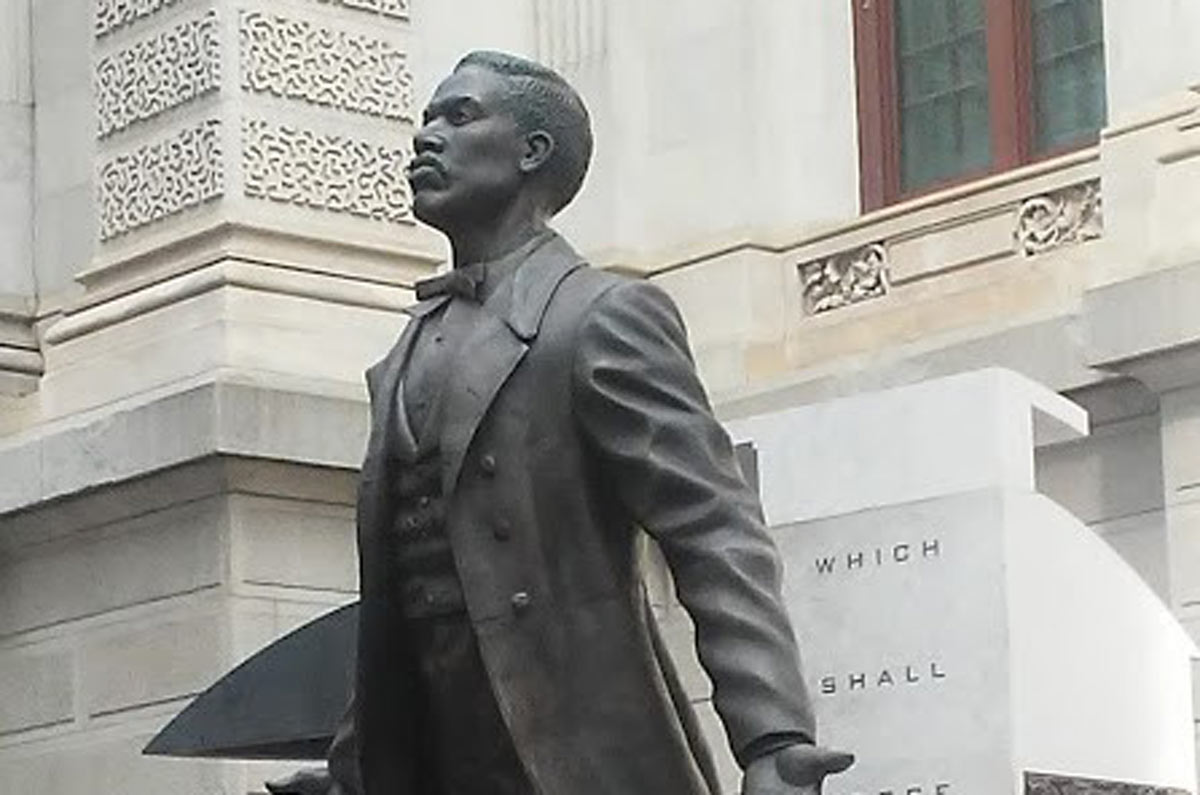
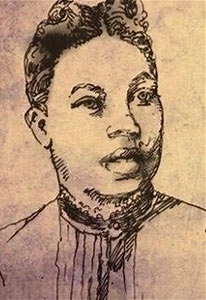
Miss LeCount & Mr. Catto

Philadelphia Residents Seek Monuments to Giants in the City’s Black History, Unknown to the Rest of the World

A member of our staff introduced us to a 19th century Philadelphia story (which observes simultaneously Black History Month and March Women’s Month), and more importantly the protagonists were the Martin Luther King Jr and the Rosa Parks of that time. That there was King before Rev. Martin, and a Parks before Sister Parks, is difficult to believe. But, in fact, Caroline Rebecca LeCount (c.1846 – January 24, 1923) and Octavious Valentine Catto (February 22, 1839 – October 10, 1871) may have been role models for the Civil Rights Era activists … if the couple’s story was ever told outside of Philadelphia.
It’s another one of those many American Black History stories that did not have a happy ending.
Ms. LeCount and Mr. Catto were engaged, but they never made it down the aisle. An assassin’s bullet took Octavius’ life just after the activist cast his ballot at a polling place. He was 32. Ms. LaCount, an educator, carried the mission forward: fighting for freedom and equity. Following are some quick notes on Octavius Valentine Catto and Caroline Rebecca LeCount.

Caroline Rebecca LeCount

Born in South Philadelphia in 1846, one of four children of a cabinet maker/ undertaker who stowed freedom-seekers fleeing enslavement in his coffins. It is reported that her childhood home on Rodman Street was considered a safe house on the Underground Railroad.
She graduated at the top of her class from the Institute for Colored Youth in 1863, was the first Black woman in Philadelphia to pass the teaching exam. She taught at the Ohio Street School which later was renamed the Octavious V. Catto School. In 1868, she became principal of the school, making her the second Black female principal in Philadelphia. She retired in 1911, and was known for defending Black teachers “from assucations of inferiority, pointing out that they were required to receive higher test scores than white teachers in order to become certified.
Caroline Rebecca LeCount, an orator, writer and poetry reader, was described in the Philadelphia Citizen’s newspaper as “Philly’s Rosa Parks 100 years before the Montgomery bus boycott, defiantly riding street cars and filing petitions to have a law against black riders repealed.”


With her fiancé Octavius Catto, she kept up the fight even after the law was changed: When a conductor refused to stop for her, LeCount—just 21 at the time—filed a complaint with the police, eventually forcing the driver to pay a $100 fine.
She also pushed for the rights of African-American teachers and students, standing up to the school board of the Wilmot Colored School to insist a black colleague become principal because “colored children should be taught by their own,” reports noted.
She became only the second African-American female principal of a public school.
She attended which later became Cheyney State University. A noted orator, her accomplishments included
Secretary of the Ladies’ Union Association, which sent aid to wounded black soldiers during the Civil War
One of the leaders in the successful fight to integrate horse-drawn streetcars. She is credited with being responsible for Philadelphia passing a law in 1867 to ban segregation on public transport.
Also with her fiancé Octavius Catto, she worked with abolitionist William Still to make petitions for desegregation.
LeCount was a researcher for W.E.B. DuBois on his study, The Philadelphia Negro.
Miss LeCount died on January 24, 1923. Recently, some Philadelphia residents have rallied to rename Taney Street after Caroline Rebecca LeCount. Taney Street currently is named for Roger B. Taney, the Supreme Court justice who decided Dred Scott v. Sandford.

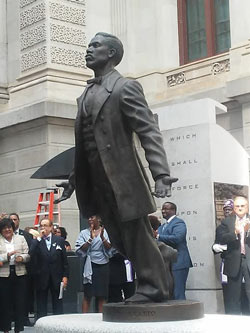
In recognition of the many contributions of Philadelphia’s own Octavius V. Catto, a prominent African-American intellectual, scholar, teacher, athlete, Civil War veteran and civil rights leader who was slain on Election Day in 1871, Philadelphia dignitaries unveiled the Octavius V. Catto Memorial — “A Quest for Parity” – on Tuesday, September 26, 2017.
The memorial sculpture — the first statue in the city’s collection dedicated to a sole African-American — is erected on the southwest apron of City Hall.
In addition to erecting the memorial monument to Octavius V. Catto, the long-range goal of the Octavius V. Catto Memorial Fund is to educate the public about Catto’s life and accomplishments, as well as highlight the contributions of other African-Americans throughout Philadelphia’s history by creating educational programs aiming at broadening the public’s understanding and awareness of African-American history..
Born in Charleston, S.C., in 1839, Catto graduated in 1858 as valedictorian of the Institute for Colored Youth, which later became Cheney University. He was a major in the Union Army during the Civil War, as well as a scholar, educator, athlete and member of the Union League, The Library Company of Philadelphia and The Franklin Institute. Catto also was an accomplished baseball player and founder of The Pythian Baseball Club.
He was a prominent civil rights leader who fought for the right to vote for all men regardless of ethnicity [women were not allowed to vote at this time] and successfully led efforts to desegregate horse-drawn street cars in Philadelphia in 1867. That was a century before the Civil Rights protests in Selma. With Frederick Douglass, Catto raised all-black regiments to fight in the Civil War; he pushed for black voting rights; and he started an all-black baseball team — all before the age of 32.
Catto, unarmed, was gunned down on Election Day — October 10, 1871 — at the age of 32 while on his way to the polls to serve in his official capacity as a National Guardsman assigned to protect newly registered African American voters.
The memorial sculpture, created by renowned sculptor Branley Cadet of Mr. Catto, is the first statue of an African-American on public land in the city of Philadelphia.

More Reflections for “Mr. Brooklyn”

0

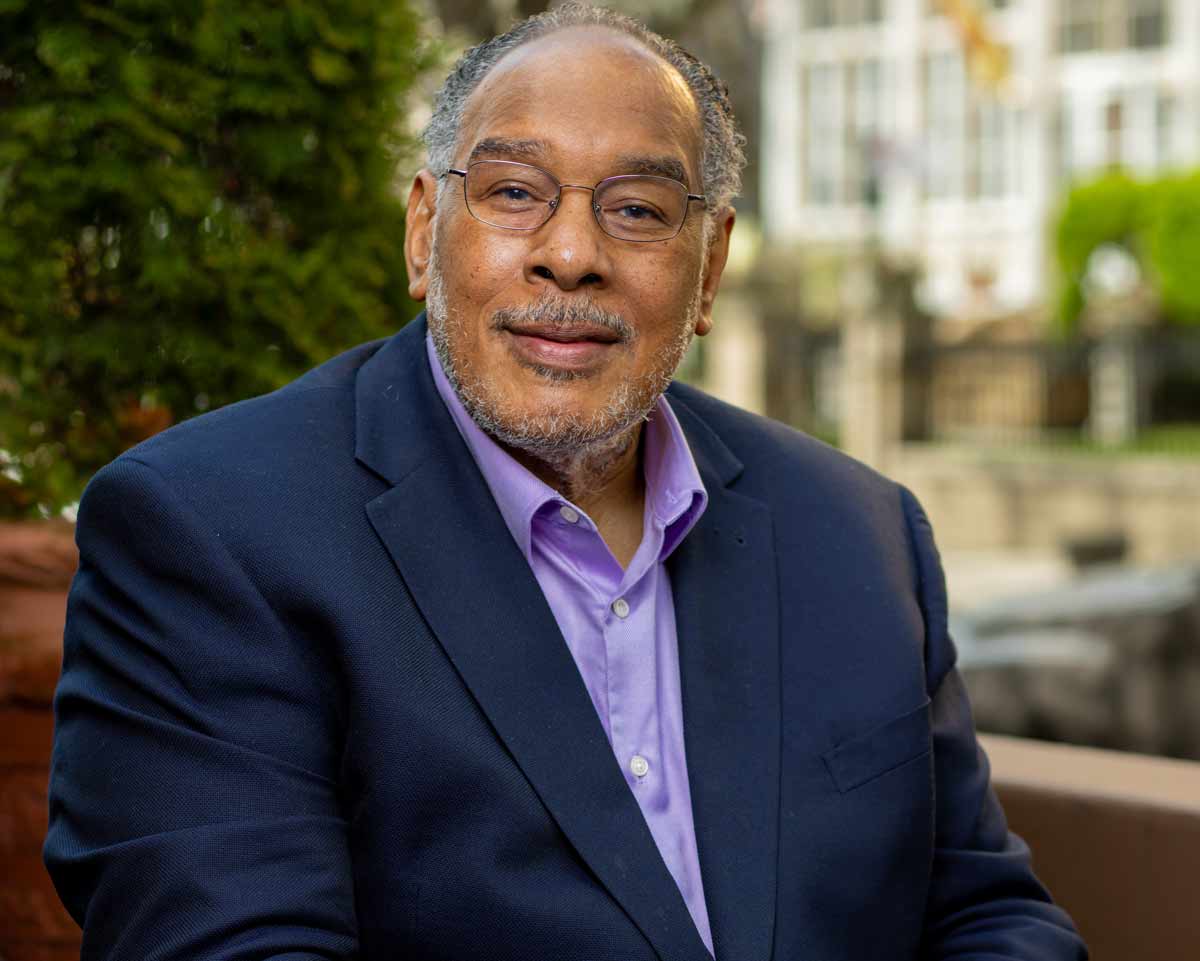
Dr. John L. Flateau (Feb. 24, 1950-Dec. 30, 2023)

“Thank you to a giant!”
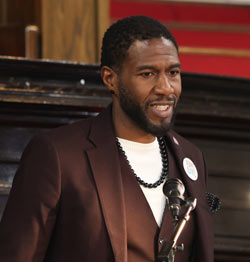
Hon Jumaane D. Williams
The People’s Advocate
for The City of New York

Death is something else. It is something else. What do you say when the people who are hurting most just want their loved one back, and we cannot bring them back?
Maybe, we can, for a moment, talk about life, because life is awesome, and it’s stunning. I hope everybody reads the bio. This is all one person. This is all one person. Phenomenal. Amazing. It stunned everyone that our brother is now an ancestor. Man, I never got to thank him. I saw him just a few months ago, doing the work at Medgar Evers: I didn’t say thank you.
One of the lessons I hope we learn is that we don’t know what’s happening tomorrow. Can we just say thank you to the giants while they’re here?
We talked about Al Vann. We talked about Jitu. We talked about so many people. Thank you. I am very clear whether politics-aligned or not, I didn’t get here by myself. It was God. The ancestors. The people who answered the call to a guy who wanted them: Thank you, Annette Robinson. Thank you, Velmanette Montgomery. Esmeralda Simmons, thank you for the work that you did. Thank you, Herbert Daughtry. Thank you to the giants who came and paved the way. .I would not be here without you doing what I do. I’m not confused about that at all.
This man’s work reverberates throughout Central Brooklyn, New York City, the State and the entire country. The work that he did right here reverberates. He was still doing the job on the Redistricting Commission, making sure that the gains that we got were not lost. To that end, he did the work.
Thank you to the family, because I know what it takes for someone who’s doing the work to be away from their family over and over again. And to you, he was dad, brother, husband, family member. To us, he was a giant, Dr. John Flateau.
It’s even more amazing because he didn’t have the titles that many of us have. As the Mayor said, all he did was give and create people who can get those titles.
Sometimes when you come up here, you make up stuff to say. How amazing it is to have a Black man who lived the way he lived, and we don’t have enough time to say thank you for all the works and good things that he did during his lifetime.
The people behind the scenes who create the power are fascinating. Family, I want to make sure you understand that I understand and so many other people understand that we would not be talking about the power we have as Black people in Central Brooklyn, New York City State, in this country… had it not been for John Flateau.
I can only imagine what he’s going to do for us as an ancestor based on what he did while he was here.

“Mr. Brooklyn: Always There
for the People He Loved”

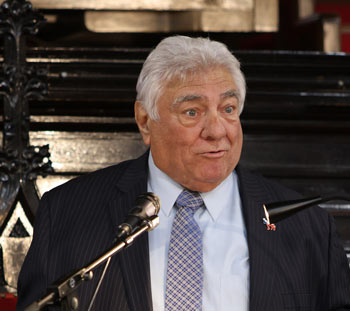
Hon. Frank Seddio
Former Chair,
Kings County Democratic Party

A lot of accolades have been given to John, today, and all well-deserved.
Of all the titles you have heard and read about in his biography the one that hasn’t been said is the one that was the most important and that was Friend. John Flateau was a great friend. I had the pleasure of meeting John back in the early ‘90s when Mayor Dinkins formed the committee which was to see if we can get the Democratic Convention in 1992, to come here, in New York City.
As the chief of staff, John and I and a number of other people from city agencies joined together and we were quite successful. That was the last convention that we had in New York City from the Democratic Party. It was a wonderful time. We nominated Bill Clinton at the time, and we have continued our friendship over the years.
I had the chance once again to deal with John on a number of occasions when they were doing reapportionment. As a matter of fact, scriptures speak of the time to live and the time to die. It’s not about how long you live but how well you live, and we all know that John lived a life that was well and suited for all of us.
As a matter of fact, if I’m guessing right, God started rearranging heaven and needed somebody to do the reapportionment work, and he brought John up there to do it. By the way, Reverend, I heard you mention the crowd earlier. I have to believe it’s killing you that you can’t make a collection today here in the church. This would be really a good one.
Ironically, a few months ago, John, Lorraine and I were talking about some of the necessities of life and some of the things that you look forward to in old age. It’s hard to believe that only these few months later, we’re standing here celebrating his role and his homecoming.
John, I can only tell you this, in all the time I’ve shared with you, both as my Commissioner at the Board of Elections and while I was County Leader, and all the times that we spoke about reapportionment and changes in the lines, I was always selfish. I wanted to make sure my Districts were taken care of. Now, we still look at you not only as a friend but as someone who was always there for the people he loved, always there for the country that he loved, always there for our borough of Brooklyn.
If there was greatly a man who could be called Mr. Brooklyn, I think they would give that honor to John Flateau.

“He Left an Indelible Mark”
Hon. Zellnor Y. Myrie
Senator
State of New York

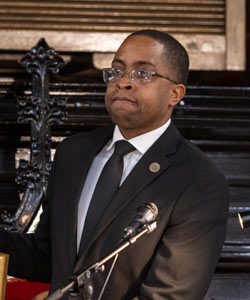
On behalf of the majority leader of the New York State Senate, Andrea Stewart-Cousins; my colleagues in the State Senate, and every constituent in my district, we offer our deep, deep condolences to the family at the transitioning of a legend, a titan, a giant amongst men.
Dr. Flateau represented the best of what this country — not just Brooklyn, not just this city, but what this country has to offer. He was a perfecter of our democracy.
I chair the Elections Committee in the Senate and my sister Latrice Walker does so in the Assembly. Again, not possible without Dr. Flateau. He was a perfecter of our democracy.
We know that the history of this country has given lip service to democracy. We have written that all men are created equal, but we have never lived up to that ideal.
It was only because black people stood up and said, “This is our country, too. We built this country, as well.” But every time the franchise was expanded, we saw retrenchment as well.
After the Civil War, we saw Reconstruction but then came Jim Crow. We had people fighting, fighting, fighting. We got the Civil Rights Act in 1960. Then we saw retrenchment after this country elected its first Black president. We live in a period that is perilous for our democracy.
We need Dr. Flateau more than ever, but what he has left is you, what he has left is in this room. He has left an indelible mark, not just on our local politics, but on the country’s politics. We have more work to do. If you know John, he’s probably up in heaven talking to the other John Lewis, going over district maps, saying, “So, how are we looking in Michigan? We want to make sure that we’re doing things the right way.”
We’re going to continue to honor that legacy by doing the work right here. Just this past week, the New York State Senate passed a resolution unanimously on a bipartisan basis, honoring the life of Dr. Flateau.
I want my colleagues both here and, in the Senate, and the Assembly, to stand up. We have a bill and the legislature to create an Elections and Voting Database and Academic Center — that would, in part. be at Medgar Evers College. We have renamed that bill The Dr. Flateau Elections and Voting Center. We are going to get that passed and we’re going to live up to his legacy and we are going to get there together. Amen. (To be continued)

Historic Bridge Street AME Church to Celebrate 258 Years of Legendary Service on Sunday, February 25

The Right Reverend Vashti Murphy McKenzie, International Preacher, to Deliver the Word

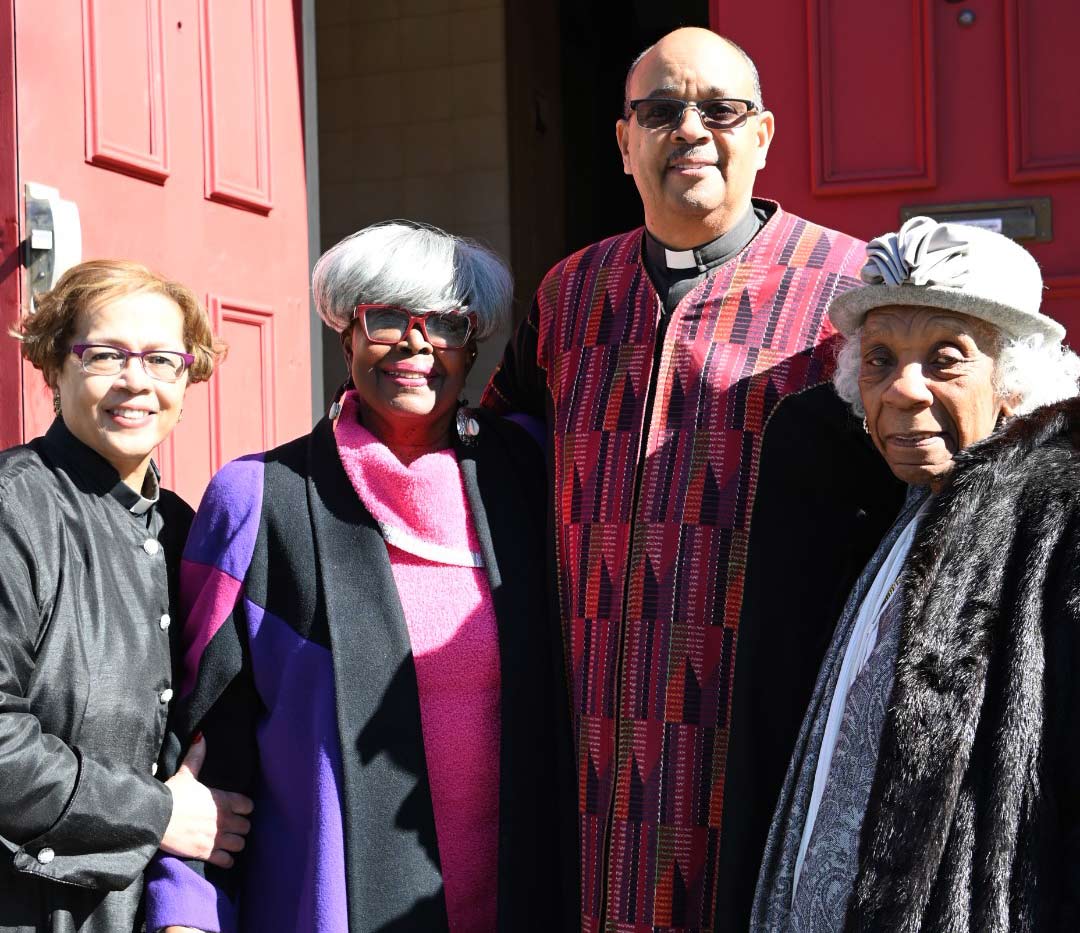
Church Triumphant: Last week, The Reverends David B. Cousin and, far left, Valerie E. Cousin, pastors of Bridge Street AME Church in Brooklyn, stood, for a few minutes, with two parishioners Sister Anna Spurling and Deaconess Phyllis Johnson, smiling, in contemplation of this coming Sunday’s 258th year church anniversary celebration. The event promises to be grand, regal and memorable. This year, 63 elders, eighty years of age and older, will be honored as Bridge Street Church Legends.
Our Time Press appreciates the pastors’ sharing the full list of Legends with our eaders. “Sadly,” The Rev. David B. Cousin told Our Time Press, “Four of our legends — Deaconess Pollie Kimbro, Edith Russell, Priscilla Sedney and Louise Spencer — have passed, but we will honor them posthumously.” (The Honor Roll of 63 is presented in this week’s centerfold.)
All Legends will receive a special gift. Also, a commemorative journal with the Legends’ biographical information will be available for purchase as part of Bridge Street’s ongoing fundraising campaign.
Internationally known, Bridge Street Church’s place in history is established and also legendary.


The faith institution claims status as the oldest continuous congregation of worshippers of color in New York State, striving since 1766 — the year America adopted the Declaration of Independence — and fully active and community-engaged a century before the Civil War.
It is a church of many firsts, among them this year’s praiseworthy tribute to elder foundation keepers.
Delivering the word will be the Right Reverend Vashti Murphy McKenzie, retired bishop of the African Methodist Episcopal Church, current president and general secretary of the National Council of Churches of the USA, and national chaplain of Delta Sigma Theta Sorority, Inc.
The public is welcome to attend the special service which begins at 10:00 am this Sunday, February 25 at Bridge Street AME Church, 277-279 Stuyvesant Avenue in Brooklyn, NY.

See more about this story here

“No One is Above the Law!”

Attorney General James Wins Landmark Victory in Case Against Donald Trump

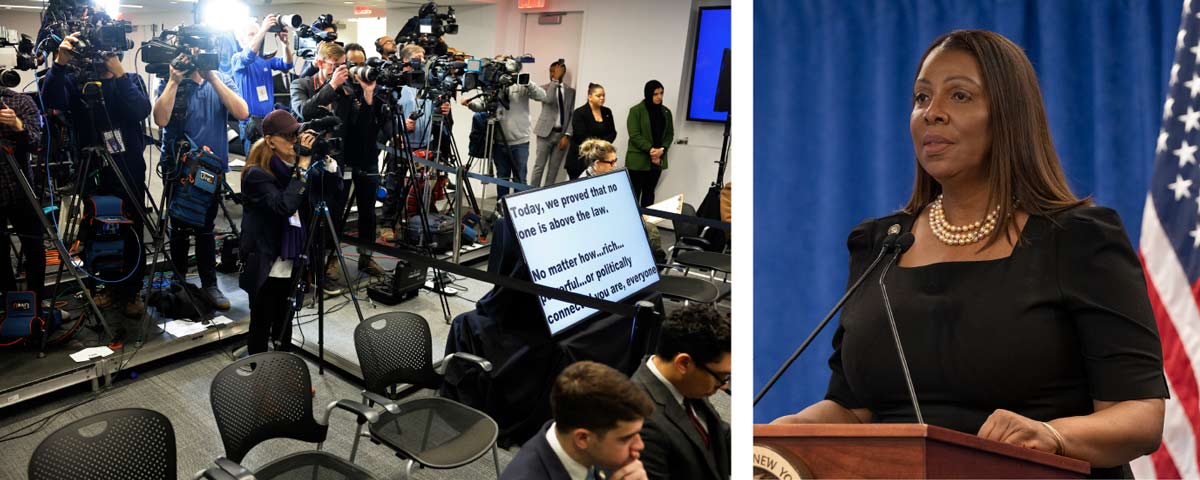
NEW YORK – Last week, New York Attorney General Letitia James released the following statement after Justice Arthur F. Engoron of the New York State Supreme Court ruled in her favor in her office’s civil fraud case against Donald Trump, the other individual defendants and the Trump Organization entities, ordering the defendants to pay more than $450 million in total, which represents $363.8 million in disgorgement and pre-judgment interest:
“Today, justice has been served. This is a tremendous victory for this state, this nation, and for everyone who believes that we all must play by the same rules — even former presidents.
“For years, Donald Trump engaged in massive fraud to falsely inflate his net worth and unjustly enrich himself, his family, and his organization. While he may have authored the ‘Art of the Deal,’ our case revealed that his business was based on the art of the steal.
“When powerful people cheat to get better loans, it comes at the expense of honest and hardworking people. Everyday Americans cannot lie to a bank to get a mortgage to buy a home, and if they did, our government would throw the book at them. There simply cannot be different rules for different people.


“Now, Donald Trump is finally facing accountability for his lying, cheating, and staggering fraud. Because no matter how big, rich, or powerful you think you are, no one is above the law.”
The decision issued today by Justice Arthur F. Engoron grants the following relief:
Donald Trump and the other defendants are ordered to pay more than $450 million in total, which represents $363.8 million in disgorgement and pre-judgment interest;
Donald Trump, Allen Weisselberg, and Jeffrey McConney are each banned from serving as an officer or director of any New York company for three years;
Allen Weisselberg and Jeffrey McConney are additionally banned from serving in a financial management role in any New York company for life;
Donald Trump, Jr. and Eric Trump are banned from serving as an officer or director of any New York company for two years;
Donald Trump and his companies are banned from applying for loans from any New York bank or financial institution for three years;
A new, Independent Director of Compliance role will be created at the Trump Organization to ensure the company establishes internal protocols and meets financial reporting obligations; and the current independent, external monitor will continue to oversee the company’s financial dealings and ensure this fraud cannot continue.


Following a three-year investigation, in September 2022 Attorney General James filed a lawsuit against Donald Trump, a number of Trump Organization companies, and senior executives for engaging in years of financial fraud and illegal conduct. In September 2023, before this trial began, Justice Engoron issued a ruling granting Attorney General James’ motion for partial summary judgment, finding that Donald Trump and the defendants committed fraud by falsely inflating the value of his assets. Today’s decision and order that Donald Trump and the other individual defendants also engaged in illegal conduct and that relief against the defendants is necessary to prevent further fraudulent and illegal conduct comes after 11 weeks of trial, which concluded with closing arguments last month.