

Darren A. Nichols
Special to the Detroit
Free Press
This day — Oct. 16, 1995 — will be etched in my soul forever because of the historic Million Man March.
For me it began on an early Sunday morning, packing my Nissan Altima, heading to Washington, D.C.
I recall three of us — me, my roommate Derek Williams, along with Corey Kennard — leaving Detroit hyped, but not knowing what to expect when we arrived in Washington, D.C. So were the guys who followed us in another car.
In 48 hours, our lives and views on how we could effectuate some change in the world were shaped.
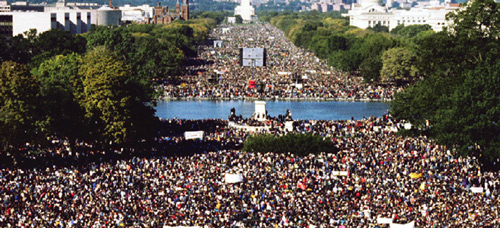
We left the National Mall in Washington changed young men, inspired by the messages we heard and the sight of about 2 million men who were ready to make a difference in our communities throughout the country.
What we never expected was to make history. We were a part of the largest gathering of African American men, from every socioeconomic level, in the U.S. The Million Man March was an event that rivals only Barack Obama’s presidential inauguration in that same space.
We were young men then. We are now husbands and fathers, who answered the call 25 years ago and made a pledge to continue to make a difference in our respective communities.
Miles and daily lives may have separated us, but the bond of Oct. 16, 1995, remains — and not just for us, but for many Black men.
The spirit of the Million Man March still is alive. That’s what we’re celebrating today, along with thousands of others locally and nationally.
Throughout the day Friday, organizers are asking Black men to shop at Black-owned businesses, open an account at a Black-owned bank or make a donation to an HBCU.
“The Million Man March was a group of Black people working together in the interest of encouraging our men to stand up and to take responsibility for our communities,” Ben Chavis, Million Man March Director, said during a “Why We Marched” panel Wednesday night.
‘A Black sunshine’
Twenty-five years ago, early on the morning of Oct. 16, we got up to catch the 5:30 a.m. train into the city for the march.
We were staying at Derek Williams’ brother’s house on the Maryland side of the DMV. They mapped out our plan so we could stand on the National Mall near the main screen.
When we arrived, thousands of men had already begun getting to the mall. The site was amazing, clearly nothing we’d ever seen before.
A few hours passed before a Detroit group who gathered at Fellowship Chapel stood with us. We embraced while goose bumps ran up my arms. By then, we were standing next to each other with little room to move.
Chavis recalls that day, too. During an event this week, he shared that feeling of having the weight and responsibility on him as the chairman of the march that was relieved when the sun began to rise.
“(But) when the sun came up out of the darkness on that Monday morning, as the sun etched upon the horizon in the east, there was a Black sunshine from the west. A sea of Black men were radiating,” Chavis said.
“By 10 that morning, I had the experience to announce that we were way over the one million Black men (goal). God (then) touched me and I started chanting: long live the spirit of the Million Man March.”
Black men were everywhere. The most intriguing were the men who climbed up trees to catch a view.
One after another, speakers began addressing us. There was Chavis, Rosa Parks, Maya Angelou, Malunga Karunga, Betty Shabazz, the Rev. Jeremiah Wright and the Rev. Jesse Jackson. Throughout the the day, they didn’t just talk at us, they talk to us; filling our hearts, minds and soul with messages of determination, vision, purpose and action.
Organizer Maulana Karenga, who is most notably known as the man who created Kwanzaa in 1966, said he was in awe to see what the day meant for Black men.
“To see how people enjoyed being together and what it meant to them and how they embraced, sang and felt as one with each other, that was a powerful feeling. It was a basis for us for building a movement,” Karenga said.
‘Shaping the vision’
Ayinde Jean Baptise challenged men to “dare to be different” in using our past struggles so that his generation can thrive.
“My fathers, you must shape the vision of tomorrow. But in order for that vision for tomorrow to become a reality, you must dedicate yourself to a new beginning,” Jean Baptise said in ending his remarks. “Go back to your families. Raise and teach your children. Go back and organize throughout this nation to bring about a new day for our people. No one can stop one million men organized and committed.”
Now, in 2020, we are the men called to lead our families and the Detroit community through its good times and struggles.
We are Khary Turner, the executive director of the Coleman A. Young Foundation, which has provided over 450 scholarships to students.
We are community activists such as Chris White, who has taken over the Coalition Against Police Brutality once led by founder Ron Scott.
We are also men such as Lamont Cole, who has since moved to Grand Rapids where he’s a former director of strategic initiatives and education for the Urban League. He is now in the private sector.
We are also the countless men who give wise counsel to the younger generation who are leading protests, while marching with them.
Twenty-five years ago today, we raised our voices and pledged to work on improving ourselves spiritually, morally, mentally, socially and politically. We also pledged not to disrespect women.
Now, we face similar challenges in our community and more. Here are some of my pledges men need to continue and can use in 2020 and beyond.
- I will vote in elections, knowing the outcome can and will help our community.
- I will use my resources and maturity to help counsel young people as they continue to be on the frontlines in the Black Lives Matter movement.
- I will protect our women, whether it’s from attacks in person or on social media.
- I will not engage in any action that degrades our women verbally, and listen as they discuss conduct they say is sexually abusive or borders on harassment.
- I will follow the NAACP’s lead and stop the usage of the N-word.
- I will hold ourselves and others accountable for our negative behavior and actions.
- I will take care of my health, knowing Black men are susceptible to high blood pressure, colon and prostate cancer.
- I will seek a better relationship with my children, knowing far too many are raised only by a woman.
- I pledge to mentor young men, knowing many need assistance in life because they may not have anyone else to turn to.
- I will continue to raise our voices against police brutality and aggressive use of force by the police.
We, as men, need to remain vigilant on issues that continue to plague Black people.
Long live the spirit of the Million Man March!
If you Go:
In Detroit today, people will gather at noon at Fellowship Chapel and at 6 pm at Akbulan-Village. Others will be on the national Million Man March 25 website, watching a session on living the pledge starting at 7 pm.
Earlier this week, the national group held sessions on Why We Marched and Organizing the March. Today at 7 pm the session will focus on living the pledge.
Darren A. Nichols is a Detroit-based freelance writer and an award-winning City Hall reporter. He can be reached at darren@dnick-media.com or his Twitter handle @dnick12.
Our Time Press was granted permission to republish, from the original in the Detroit Free Press