
By: History.com Editors
As the 20th century began, the promises of the 14th and 15th Amendments—civil rights for African Americans—had fallen well short. Reconstruction had failed, and the Supreme Court had sanctioned Jim Crow segregationist policies in Plessy v. Ferguson (1896).
Against this background of widespread racial discrimination and segregation, Booker T. Washington became one of the era’s most influential Black leaders. He argued that Black people should advance themselves through learning skills such as farming and carpentry, rather than look to legal and political means to advance as a group. “We shall not agitate for political or social equality,” Washington declared in 1895, in a speech known as the Atlanta Compromise. “Living separately, yet working together, both races will determine the future of our beloved South.”
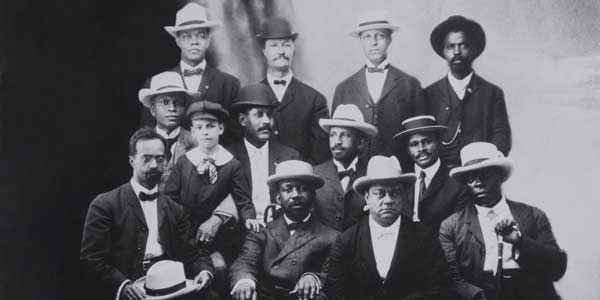
In 1905, Du Bois, then a professor at Atlanta University, and William Monroe Trotter, founder of the activist newspaper the Boston Guardian, issued a call to a select group of Black men who opposed Washington’s accommodationist stance. In response to their call, 29 men from 14 states gathered in Buffalo, New York that summer. The group then headed across the border to Canada, meeting at the Erie Beach Hotel in Ontario, near Niagara Falls, from July 11-14, 1905.
Historians have long assumed that Du Bois’ group chose the Erie Beach meeting site after being refused accommodation in Buffalo due to racial discrimination. But more recent research by local scholars found that hotel managers in Buffalo did in fact comply with anti-discrimination laws at the time, making this explanation unlikely. According to Du Bois’ own writings at the time, the group sought a “quiet place outside the city near the water where we can be to ourselves, hold conferences together” and have access to recreation; the Erie Beach Hotel apparently met these requirements.
Goals and Growth of the Movement
At their initial meeting, the founding members of the Niagara Movement adopted a constitution and by-laws and drafted a “Declaration of Principles” that dedicated the group to fighting for political and social equality for African Americans. “We refuse to allow the impression to remain that the Negro-American assents to inferiority, is submissive under oppression and apologetic before insults,” the declaration read in part. “Persistent manly agitation is the way to liberty, and toward this goal the Niagara Movement has started and asks the cooperation of all men of all races.”
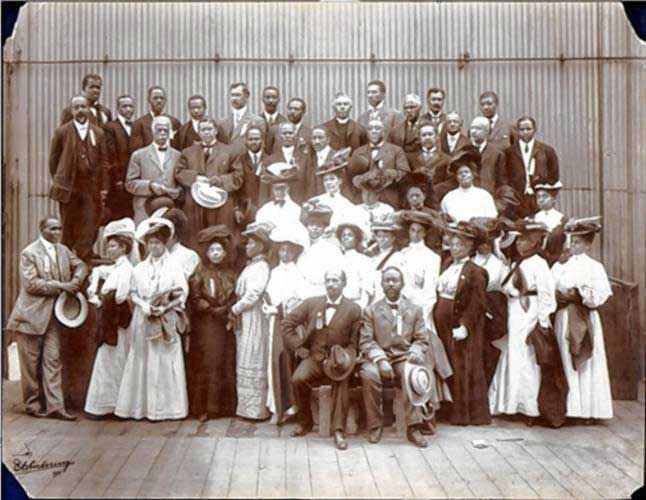
By 1906, the Niagara Movement had grown to some 170 members in 34 states. That August, the organization held its first public meeting in Harpers Ferry, Virginia, on the campus of Storer College. Its members chose the meeting site for its historical significance as the site of John Brown’s anti-slavery raid in 1859; Storer was also founded as a Baptist school with a mission to educate formerly enslaved people.
Despite some state-level success, including lobbying against the legalization of segregated railroad cars in Massachusetts, the Niagara Movement failed to gain much national momentum. The group suffered from limited financial resources and determined opposition from Washington and his supporters, as well as internal disagreement between Du Bois and Trotter as to whether to admit women. Trotter, who opposed letting women join the movement, left by 1908 to found his own organization, the Negro-American Political League.
End of the Niagara Movement and Founding of the NAACP
Though a 1907 meeting at Faneuil Hall in Boston attracted as many as 800 members, support for the Niagara Movement soon began to dwindle. Then, in the wake of a major race riot in Springfield, Illinois, in August 1908, Du Bois joined other prominent activists, including Mary White Ovington, in calling for a new civil rights organization with both Black and white members.
The result was the NAACP, founded in February 1909 in New York City. Though the Niagara Movement held its final meeting in 1908, and formally disbanded in 1911, the majority of its members would continue the fight for civil and political rights for African Americans with the NAACP.