

By Enoch Naklen
Multimedia Journalist
The line formed on the second floor of the Harlem Hospital Center by 12:15 for Saturday@Harlem Is… Presents Savoy 100 Harlem, a free touring service that brought students from Children’s Aid Milbank and longtime Harlemites into the heart of a 100-year legacy.
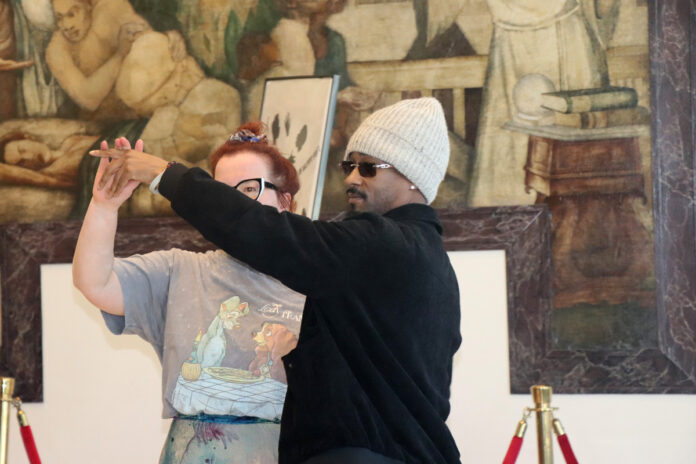
This floor houses the Harlem Is… Theatre, Music, and Dance exhibition, where ceiling-high murals immortalize a lineage stretching from the 1806 African Grove Theatre to modern legacy keepers.
Award-winning director Daniel Carlton opened the afternoon by challenging the young audience to look past the clinical nature of the building. “When you think about the hospital, what do you think?” Carlton asked. The answers ranged from doctors to death, but he quickly used the murals as evidence that the building is also a sanctuary for the neighborhood’s institutional memory.
Barbara Horowitz, founder of Community Works, explained that the exhibition was built through young people interviewing local legends about the part they play in preserving the culture. The event was a collaboration between Community Works and the New Heritage Theatre Group, spearheaded by legacy keeper Voza Rivers.
Among the crowd was Joe Porter, a lifelong Harlemite and local public school graduate who stood as a living testament to the exhibit’s mission. “I am just so thankful for the village of Harlem for raising me and teaching me how to carve out a way for myself,” Porter said.
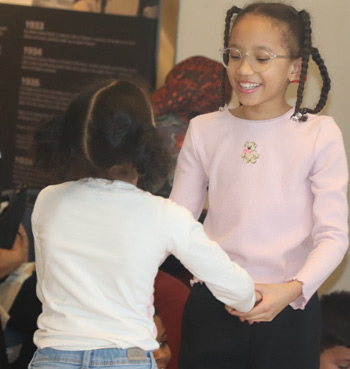
The program moved downstairs to the Mural Pavilion for the main centennial celebration of the Savoy Ballroom. While the second floor houses the massive murals, the Pavilion featured the Harlem Is… Timeline, an intensive visual and textual installation that flanked the audience with bulleted references to celebratory figures in Harlem since 1900.
In this immersive setting, Barbara Jones, branding her efforts as Savoy 100 Harlem, introduced the afternoon’s panel and film. As a guardian of the Savoy’s history, Jones framed the event as a bridge between the legendary 1926 ballroom and the preservationists of today.
The panel featured Judy Pritchett, longtime collaborator of Frankie Manning, and former swing dancer Nikki Davidson. They presented clips from Pritchett’s documentary work, which interrogated the 1937 Big Apple craze and the rapid global migration of Black dance. Pritchett offered a blunt critique of the economic disparity within the movement.
“The next thing you know it’s copied not so well and imitated by white people in the rest of the world,” Pritchett noted, tracing the shift from Black clubs to the White House. She questioned the systemic exclusion of the originators from the profits, asking, “Why is it that the black people that are starting these movements are not making money from it?”
The day concluded with the physical spirit of the Savoy led by Hamed, a dance instructor from NYU. His presence served as proof of how embedded swing culture remains in contemporary academic and social spaces. Hamed guided the room through the foundational movements of the Big Apple, noting his desire to “just have a good time, spread good vibes, and conjure the past and present spirits” of the Savoy’s 100th year.
As leads shifted to their partners for a collective choreography, the Pavilion was filled with a mix of laughter and focused rhythm. Between the timeline boards and the moving bodies, the spirit of the Savoy proved to be an unbroken continuity. Photos by Enoch Naklen