

By Rev. Phyllis I Coachman
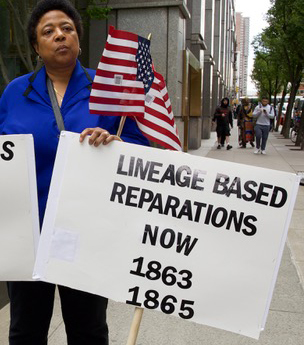
Standing outside at the press conference, in front of the African Burial Ground, with my posters demanding lineage-based reparations, I felt disappointed and determined simultaneously. The signs read, “Lineage Based Reparations Now” and “Get Reparations Right for American Freedmen.” These words were not just slogans; they represented the deep-rooted inequality and frustration that descendants of enslaved persons like myself continue to face.
My name is Rev. Phyllis I Coachman. I am a founding member of the US Freedmen Project and the Associate Minister of Spiritual Formation and Racial Justice at Safe Haven UCC. When I heard about the press conference supporting the reparations bills introduced by Senator Jabari Brisport and Assemblymember Michaelle Solages, I felt compelled to attend and make my voice heard.
However, what I experienced at the press conference was disheartening. Hostility met me, and several individuals told me I was not welcome. Someone asked me why I had an American flag in my hand, questioning my citizenship and allegiance. I felt pained by the thought that in the country my ancestors helped build with their hard labor, sweat, blood, tears, and countless inventions, they made me feel like an outsider.
The history of the American Freedmen is one of broken promises and ongoing inequality. In 1865, our ancestors were promised 40 acres and a mule to start their new lives.
Instead, they faced nakedness, terror, death, hunger, poverty, discrimination, segregation, and institutionalized racism, denying them their rights as US citizens.
Over 150 years later, the disparities are glaring. The African American community, representing 13% of the population, owns less than 3% of the nation’s total wealth. Black homeownership rates are reminiscent of 1968 levels. In New York State, where the press conference occurred, Black individuals comprise 15% of the population but account for a staggering 43% of those incarcerated. These statistics paint a grim picture of the ongoing effects of slavery and systemic racism.
Reparations are not just a matter of morality; they are a matter of justice. They are a way to acknowledge the historical wrongs committed against the American Freedmen and rectify the deep-rooted inequalities that persist today.
However, the bills by Senator Brisport and Assemblymember Solages fall short in their approach to reparations. Senator James Sanders also recently introduced A new reparations bill on June 6, 2023. All three NYS reparation bills fail to accurately identify the eligible community for reparations, limiting it to all people of African descent. This broad definition dilutes the focus on rectifying the historical injustice faced by American Freedmen, descendants of persons enslaved in America.
It is crucial to recognize that the experiences and struggles of American Freedmen are unique and distinct. Our enslaved ancestors were stripped of their land, peoples, culture, and language, and in 2023 we face the potential erasure of our ethnicity, culture, and identity being stolen by less subtle but dangerous methods. By denying American Freedmen their right to reparations, we perpetuate the erasure of a specific group of people with a unique lineage.
Reparations should be lineage-based, explicitly targeting the American Freedmen descendants of persons enslaved in the United States. This approach ensures that reparations address the specific historical injustices endured by our community. It aligns with the principles of justice and is supported by Title VI, Section 601 of the Civil Rights Act of 1964.
The California Reparations Task Force has shown us the way forward by voting on lineage-based reparations. NY must follow suit and ensure that it implements reparations in a manner that respects the unique struggles of the American Freedmen.
We must continue to advocate, to have our voices heard, and to ensure that reparations are implemented in a way that genuinely addresses the historical injustice faced by American Freedmen, Descendants of Persons Enslaved in America. It is a matter of justice, and it is a matter of finally getting reparations right.