
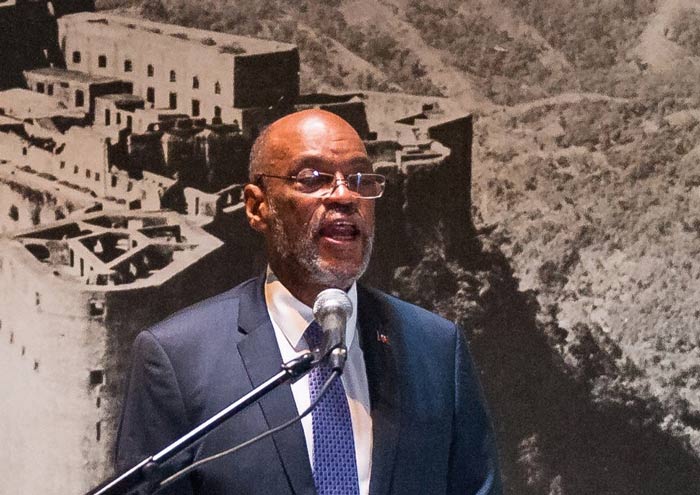

A few months ago, Guerlinz Affriany returned from southwestern Haiti, where he helped provide relief after the Aug. 14 earthquake. But looking at a country plagued by gang violence, kidnapping that has only increased, he doesn’t know when he will go back.
“They have the power to do whatever they want,” said Affriany, a retired military veteran in Elmont, New York, about the gangs. “Nobody wants to go to Haiti right now.”
As Affriany noted, the kidnapping of American and Canadian missionaries in October went unresolved for about two months before the remaining 12 missionaries were freed Dec. 16. Analysts have also said the episode highlighted the weakness of the Haitian state, in a year plagued by instability and the assassination of President Jovenel Moise.
The year 2021 has also been one of displacement for the diaspora as nearly 30,000 Haitians, many of whom lived in Chile or Brazil for years, attempted to cross the U.S. southern border in September. The crisis has led to deportation for thousands of migrants and new demands on the diaspora to assist those seeking asylum.
Thus far the U.S. has stayed fairly silent on the crises facing Haiti, although the U.S. State Department has pledged to send technical and financial assistance to support the Haitian National Police. Brian A. Nichols, State Department secretary of Western hemisphere affairs, has met with the diaspora, encouraging them to play a role in rebuilding Haiti.
Analysts say the crises facing Haiti will test the stated American commitment to democracy.
“Haiti is a litmus test because of the current crises facing the country,” said Francois Pierre-Louis, a political science professor at Queens College, during a Dec. 7 conference call. “Haiti is facing an unprecedented crisis. The whole country is held hostage by gang leaders.”
Political crisis in Haiti
Instability reigned well before the July 7 assassination of Moise. The former president’s penchant for decrees, attempts to rewrite the constitution and the controversy over his term limits provoked protests in February of this year.
Led by the U.S., the international community backed Moise’s right to remain in office until February 2022 and later backed interim Prime Minister Ariel Henry, who was hand-picked by Moise, shortly before his assassination, to lead the country after the head of state’s murder.
Now, Henry is tasked with forming a new government, in collaboration with opposition leaders, per the terms of a Sept. 11 consensus agreement. Henry installed eight new cabinet members in late November, including representatives from the FUSION, Popular Democratic Sector and ruling PHTK political parties.
At the same time, a competing vision for a transitional government has been put forth by a civil society group, Commission for a Haitian Solution, which formed early this year and met at the Hotel Montana in the wake of Moise’s assassination. In a Dec. 1 op-ed, the group’s leader Monique Clesca proposed a transitional government that includes civil society representatives.
None of the three factions vying for power — not the “Montana group,” Henry’s consensus formation and not the “Jovenelist” wing of PHTK represented by Martine Moise — appear to have strong popular support, said Robert Fatton, a political science professor and Haiti scholar at the University of Virginia.
“We don’t have a state quite frankly, it’s not even a weak or failing state,” said Fatton. “The crisis persists as far as I can tell. Nothing has been resolved in terms of security, in terms of establishing a legitimate basis for elections.”
Gang violence and kidnappings have occurred throughout the year, including unprecedented kidnappings of clergy and the American missionaries. Non-governmental organizations in Haiti reported more than 800 kidnappings in total this year.
Both the Henry government and the civil society Commission have proposed elections. Henry himself has vowed elections by the second half of 2022 and the fulfillment of Moise’s promise for a referendum on a new constitution.
U.S. urges crisis-laden diaspora to help Haiti
But international actors, including the U.S., have largely refrained from weighing in. During a Dec. 17 call, Nichols urged the Montana Group and Henry’s government “to come together” and name an electoral council to organize next year’s elections.
Concerned about rising insecurity, some people like Affriany have asked the U.S. to do more to limit arms trafficking.
“You have all kinds of American agencies in Haiti, how do the guns get there?” asked Affriany. “The guns do not come from Haiti.”
This fall, State Department officials including Nichols have met with diaspora leaders in Brooklyn and in Miami. During the meetings, officials vowed not to determine Haiti’s future unilaterally.
“We hope that Haitians with ideas and dreams about building a democratic future will engage broadly with each other to chart their own path to restoring democracy through free and fair elections when conditions permit,” wrote Nichols, in an op-ed.
The Haiti Tech Summit has also called for greater diaspora engagement in Haiti, holding a “Galvanizing the Diaspora” panel to its 2021 programming for this December. And, nonprofits like Kellogg Foundation have doubled down on their commitments to Haiti, asking potential donors to support its many grant programs for health and economic development.
But the diaspora is facing multiple crises at home, including the need to care for at least 10,000 asylum seekers released into the U.S. this year. The diaspora has made demands for immigration reform.
The year began with hopes that were only partially realized. In January when Biden was inaugurated, Haitian-Americans expressed hope for addressing the root causes of migration, a pathway to citizenship and additional protections for Temporary Protected Status (TPS) holders.
Extending TPS in May was “low-hanging fruit,” and Haitians living in the U.S. still need a pathway to permanent residence, said Ludmilla Paul, a board member of the political advocacy group Avanse Ansanm.
Echoing sentiments voiced by other Haitian-Americans, Paul also advocated for the repeal of Title 42, a law which fast-tracks deportation on public health grounds.
“There are definitely some concerns that Biden is not doing enough, especially around Title 42,” said Paul, of Miami.
Among those who cannot benefit from TPS protections are the roughly 13,000 who were released into the U.S. for asylum in September. Haitians have been migrating from South America to the U.S. border for at least five years, leaving service and construction jobs in Brazil and Chile due to economic hardship and changes in those countries’ immigration laws.
Jensen Desrosiers, an activist who helped found the Haitian Powerhouse, recalled Biden’s fall 2020 visit to Little Haiti in Miami, where the then-candidate promised to give Haitians an “even shot.”
“They had the opportunity with Texas to show that, to show that they were holding to their promise,” said Desrosiers, who is based in Brooklyn.
Within two months of the Del Rio, Texas, immigration crisis in September, more than 8,500 people were deported back to Haiti, according to the United Nations.
“They know to tell the American people not to travel to Haiti,” Desrosiers said. “Why are they sending these people back? Only because they are less than Americans? So these are the missteps.”