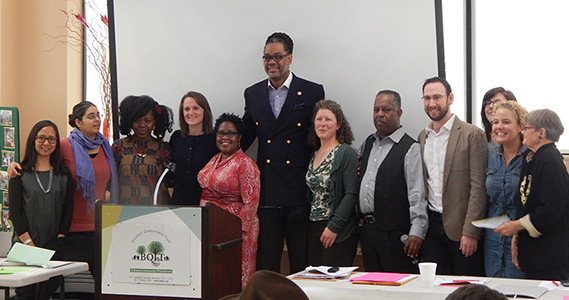
Call Them Phenomenal, THESE DAUGHTERS of TUBMAN

March 5, 2010 by Bernice Elizabeth Green  
Filed under featured

“Freedom or die a slave!,” declared  Harriet Tubman (1819/20-1913) who freed herself and 300 others from enslavement in the mid-19th century.  Tubman’s legacy resounds today in the lives of heirs who move unrestricted and make choices with few constraints. 
Call them daughters, sisters, wives, mothers, aunts, educators, nurses, doctors, entrepreneurs, environmentalists, bakers, filmmakers, artists, chefs, librarians, homemakers, landowners, students, realtors, musicians, even First Ladies – in roles nonexistent for women of color in America at the time of Harriet Tubman’s birth.
Call them liberators, revolutionaries, strategists, rainmakers and deep thinkers (as Tubman was), qualities considered “uncharacteristic” for Black women even a little more than a century ago at the time of her death in Auburn, NY in 1913.

The bronze Harriet Tubman sculpture by Alison Saar stands 10-feet-tall in Harlem on 122nd St and St. Nicholas as a symbol for freedom-taking.

Mrs. Tubman was this nation’s first nationally known woman leader, soldier, strategist, counselor, social worker. And beginning March 10, the 97th anniversary of her death, New Yorkers will join other groups throughout the nation in celebrating Tubman by honoring women of conviction.
 Dr. Olivia Cousins, the artist/photographer/educator, comments:  “In celebrating Harriet, we carry forth her legacy in the day-to-day work that we do to protect, nurture, advocate and uplift our people.”  Following are March events that honor our journey and the Tubman legacy. See page 6.
Tuesday, March 9 at 7pm: The Spelman College Glee Club performs at Emmanuel Baptist Church, 279 Lafayette Ave. (corner of St. James Place).  Concert is free and open to the public!!! Note to parents and guardians of young women:  The Spelman College Glee Club has maintained a formal reputation of choral excellence since its inception in 1925. Its repertoire consists of secular choral literature for women’s voices with special emphasis on traditional spirituals, music by African-American composers, music from different cultures and other commissioned works. The Spelman legacy of song is inextricably entwined in the institution’s history. The founders of Spelman College, Sophia B. Packard and Harriet E. Giles, sought to establish and teach a curriculum that ensured a well-rounded educational experience. The beginnings of the Spelman College Glee Club can be traced back to 1882, just one year after the college opened.

Wednesday, March 10, 9:00am – 11:30am: The 7th Annual Harriet Tubman Day Celebration, In Bedford-Stuyvesant, Brooklyn, hosted by Councilman Al Vann at Boys & Girls H.S., presents comments from Pauline Copes-Johnson of Auburn, NY and her sister, Geraldine Daniels of Rochester, NY, the great-great-grandnieces of “Aunt Harriet.” Brooklyn Public Library chief Dionne Mack-Harvin will keynote.
Wednesday, March 10, 10:00am: Wreath Laying in the Harriet Tubman Memorial Park at the base of the only statue in New York City of Harriet Tubman, a two-ton 10-foot-tall bronze sculpture designed by Alison Saar, at the intersection of Frederick Douglass Boulevard (formerly Eighth Avenue), St. Nicholas Avenue and 122nd Street.  The event will include the participation of schoolchildren, City Government officials and the New York City Parks Department. Adrianne Riddick of Harlem, Ms. Tubman’s great-great-great-grandniece, will speak at the wreath-laying event.  The statue is the brainchild of former Manhattan Borough President C. Virginia Fields.  Omoye Cooper of Albany, NY and Elizabeth Fulcher-Rankin of Brooklyn are co-chairs of the Black Women’s Leadership Caucus, Inc. (BWLC) host organization which was formed in 1999 during a meeting at the Tubman Homestead in Auburn, NY of women and men involved in the history of the Underground Railroad and Harriet Tubman.  Currently, the group is producing a short documentary about Harriet Tubman, featuring interviews with  descendants, historians and and distinguished educators, including  Adelaide Sanfor, former Vice Chancellor, NYS Board of Regents. Open to the public.
Thursday, March 11, 11a-2p: Network Journal’s  “Influential Women in Business Awards” Publisher/CEO Aziz Adetimirin and editor Rosalind McLymont will honor business leaders at the “Twelfth Annual 25 Influential Black Women in Business Awards” luncheon at the New York Marriott Marquis Hotel, 1535 Broadway (between 45th & 46th streets). Among the honorees: Jackie Carter, Vice President & Publisher, Nonfiction Books, Scholastic, Inc.; Susan E. Chapman, Global Head of Operations, Citi, Realty Service, Citi Inc.; Chrysa Chin, Vice President, Player Development, National Basketball Association (NBA); Denise Coley, Director, Global Supplier Diversity Business Development, Cisco Systems, Inc.; Michelle Drayton, President & Publisher, Today’s Child Communications; Angela E. Guy, Senior Vice President, General Manager, SoftSheen-Carson; Gale Stevens-Haynes, Esq., Provost, Long Island University, Bklyn Campus; Vy Higginsen, Executive Director, Mama Foundation for the Arts; Hilda Hutcherson, M.D., Associate Dean, Clinical Professor of Obstetrics & Gynecology, Columbia University’s College of Physicians & Surgeons;  and Mavis T. Thompson, Esq., President, National Bar Association; and others.
 Saturday, March 20, 1p-4p: 2nd Women of Distinction Scholarship Luncheon at Boys & Girls H.S.  The luncheon salutes distinguished women for their unwavering support of and service to the community and Boys & Girls High School and supports a great scholarship- creation opportunity for some of New York’s best and brightest graduating students. Money raised through ticket sales, a Silent Auction adn donations at the event go to the scholarships.  As we see it, The Women of Distnction Awards refers to both the students and the distinguished honorees, who include Pamela Green, Weeksville Heritage Center; Crystal Bobb-Semple, founder and owner, Brownstone Books; educator Dr. Renee Young; guidance counselor Dorothy Harper, (celebrating 43 years in the education field); Miss Kelly Roberts, school safety agent; Dr. Sheila Evans-Tranumn, retired associate commissioner for the NYS Education Department; and Ms. Nebert Jackson, retired educator who taught for some 30 years at Boys & Girls H.S.  The Boys & Girls H.S. graduating seniors who worked hard throughout the school year to raise funds for college needs, include:  Alicia Rogers, Areya Cortes, Shatiqua Watson, Brittany George, Adana David, Melissa DeVore, Amandla McMillan, Shardei Lewis and Deborah Akinbowale. The event is the culminating activity of the year-long campaign, and anyone wanting to support the effort can donate items or services for the silent auction; food for the March 20 luncheon;and/or contributions to the students’ scholarship fund. Contact:  Miss Andrea Toussaint of The Sisterhood.Tickets: $25. 718-467-1700.
  

Sunday, March 28: “Harriet’s Place: Underground Railroad and Beyond” at Magnolia – New exhibition of photographs capturing the essence of Harriet Tubman, the woman, by educator/artist/historian/preservationist Dr. Olivia Cousins, opens today at Magnolia Tree Earth Center of Bedford Stuyvesant.  Details to be announced. Contact: Andrea Brathwaite at 718-387-2116 or Bernice Elizabeth Green at 718-599-6828.  (See Cover)
Monday, March 29: Herbert Von King Park’s Third Phenomenal Women Awards Brunch: Culinary and Drama Teens at the Park, and Parks Administrator Lemuel Mial with volunteer instructor-wife Charlotte Mial, with community friends DBG Media and Legacy Ventures, at a closed, invitation-only event, will honor media women, the communicators, whose on-going good works keep positive stories and information about our communities at the forefront. Among the honorees:  Mrs. Esther Jackson, Founder and Publisher, Freedomways; Nayaba Arinde, Editor, NY Amsterdam News; Freelance Journalist and Media Consultants Victoria Horsford and Fern Gillespie; Dr. Brenda Greene, Founder, National Black Writers Conference; Medgar Evers College, CUNY; Aminisha Black, columnist, Our Time Press; author-entrepreneur Monique Greenwood, now celebrating her  popular Akwaaba Inns’ 15th year; writer Susan McHenry; Janel Gross, The Challenge Group; Jeanne Parnell, anchor, WHCR; Dr. Teresa Taylor-Williams, publisher, Trend Newspaper; and Gayle DeWees of the NY Daily News, also the former employer of the late Joyce Shelby, the adored journalist to whom this event is dedicated.
Mrs. Jackson  and Tupper Thomas, head of the Prospect Park Alliance, will receive the Hattie Carthan Awards.
  -Bernice Elizabeth Green

Cheikh Anta Diop Celebrated

February 13, 2010 by Bernice Elizabeth Green  
Filed under Uncategorized

THE GREAT AFRICAN SCHOLARS DR. YOSEF BEN JOCHANNAN (“DR. BEN”), SISTER KHEPRA, DR. LEONARD JEFFRIES, DR. RANDY WESTON URGE GLOBAL FAMILIES OF COLOR TO RECONNECT WITH OUR PAST IN ORDER TO “RESURRECT OUR PEOPLE”

World-Class Scholars Gathered to Remember the Life and Legacy of “Pharoah” Cheikh Anta Diop at Le Grand Dakar Restaurant in Brooklyn on 24th Anniversary of His Transition

On Sunday, February 7, 2010, history was made at Pierre Thiam’s Le Grand Dakar Restaurant in Brooklyn. At a gathering of The Wise, hosted by Dr. and Mrs. Randy Weston, and attended by special guests Dr.Yosef Ben-Jochannan (“Dr. Ben”); Sister Khepra, co-founder of New York City’s first CommUniversity (The First World Alliance) in Harlem; Professor Leonard Jeffries, Yaa-Lengi Meema Ngemi, Mamadou Ndiang and others, Black History Month was never mentioned. The perspective was much different. Longer, sharper and through a many-thousand-year-old prism.

Sister Khepra, co-founder of the First World Alliance knowledge-exchange center, Dr. Leonard Jeffries, Professor at City College, center, and Dr. Ben, noted historian of the Civilizations of the Nile Valley brought The Knowledge to the people.

Sister Khepra, co-founder of the First World Alliance knowledge-exchange center, Dr. Leonard Jeffries, Professor at City College, center, and Dr. Ben, noted historian of the Civilizations of the Nile Valley brought The Knowledge to the people.

The scholars drew together to celebrate the life of one of the greatest thought-leaders of all time — Cheikh Anta Diop who passed at 63 in 1986. Usually, there is a pilgrimage to Senegal for this occasion, but this year, a small cafe-restaurant was the site.
And it felt good being there, being in the valley and the heavens of knowledge, where even the Kora music asked the question: So what are you doing with this history, how are you making it your own? — Far away from the banality of black-history-month trivialities of self-congratulations for corporate “diversity” and discount sales. Bernice Elizabeth Green
See Notes From Dakar

Update and More on MacDonough St. Landmarks

February 7, 2010 by Bernice Elizabeth Green  
Filed under featured

Two weeks ago, the Department of Buildings (DOB)determined that renovation work performed in the cellar of 329 McDonough Street by ANC Construction, a contractor hired by the building owner, undermined the shared party wall between 329 and 331 McDonough Street causing it to partially collapse on Wednesday morning, January 20.
DOB engineers immediately determined that the damage to the party wall compromised the structural stability of both buildings and created a “perilous” public safety hazard. According to DOB spokesperson Ryan Meredith Fitzgibbon, “The contractors dug a ravine next to the party wall causing instability.”
DOB vacated 329 and 331 McDonough Street because they said damage posed a risk to the lives of the tenants and the property owners.
Rumors were rampant that the bookend buildings 327 (with four condo owners) and 333 (vacant and up for sale) might be adversely impacted if 329 and 331 were demolished, as noted in postings.
· Property owners of 327, 329 and 331 joined forces with engineers and lawyers to sue to stop the demolition, and show the properties can be saved. The plaintiffs include: the owner of 329 MacDonough St., Robert Providence; 327 Mac-Donough LLC; and owner of 331, Doreen Prince.
Meanwhile, last week, the plaintiffs’ engineers submitted a plan to pour concrete in the basement for shoring. The DOB reviewed the plan and determined “it was comprehensive and safe,” according to Fitzgibbon. Last Friday 29, DOB allowed the engineers to have the work done.
· On Tuesday, February 2, Supreme Court Justice Bert Bunyan extended a stay on demolition until Monday, February 8 to allow further time for submission for a shoring and bracing plan that would pass DOB approval. Announced Fitzgibbon yesterday, “The buildings are being closely monitored, and there are no signs of movement at this time,” adding, “The owner of 329 McDonough Street is currently working with his engineer to develop a plan to salvage the buildings.”
Joining block residents in the courtroom on February 2 were Borough President Marty Markowitz and City Councilman Al Vann (D-Bedford-Stuyvesant, Crown Heights). Both, it was learned, had monitored the MacDonough Street situation and had been in conversations with City Buildings officials – Vann, from out of the country — since reports of the crisis two weeks ago.
The View From There
Krystal Coddett’s window has a view of two of Brooklyn’s loveliest landmarks: the great stained-glass window of St. Philips Church , itself a home to one of the nation’s most precious legacies — a history that embraces the Brownstones, some unchanged in their century of existence, and a section of the village of Bedford Stuyvesant’s ancestral roots.

Exiting historic St. Philips Church on to MacDonough Street, Sunday, January 25, entrepreneur and environmentalist Sherri Hobson-Greene(right sister and her son), a Bedford-Stuyvesant resident, was staggered by the news that two brownstones on the block may be demolished.  “If there’s something that can be done to save them, then it should be done – not just because they are brownstones, but because it is a signal to our children that working together, we can own and maintain where we live. This block is a jewel in New York City’s crown.”   Photo credit:  Barry L. Mason

Exiting historic St. Philips Church on to MacDonough Street, Sunday, January 25, entrepreneur and environmentalist Sherri Hobson-Greene(right sister and her son), a Bedford-Stuyvesant resident, was staggered by the news that two brownstones on the block may be demolished. “If there’s something that can be done to save them, then it should be done – not just because they are brownstones, but because it is a signal to our children that working together, we can own and maintain where we live. This block is a jewel in New York City’s crown.” Photo credit: Barry L. Mason

Before the lofty term gentrification collapsed into a racial pejorative during the late 80’s meaning wealthy people purchasing properties mainly for cheap in poorer areas, there was another wave of gentrification, this involved aristocracies of color from the Caribbean and the South who purchased properties along MacDonough, Macon, Decatur, Bainbridge, Stuyvesant, Lewis and other blocks.
In appreciation and respect for the natural woods, and the artistry and craftsmanship, detailingslargely remained unharmed by most of these property owners.
As Tremaine Wright, owner of Common Ground café on Tompkins Avenue, and heir to a legacy of longtime brownstoners on Jefferson Avenue, “They held on to the real estate, so the next generations would not have to launch from the starting line. They worked hard, maintained and did their business.”
MacDonough Street former resident Mother Singleton, the late Bridge Street Church icon, who owned several properties, created a “museum” in her MacDonough St. home base with artifacts from her lifelong journey. She probably knew the parents of community organizer Sam Pinn who residents, with his wife, Doris, in the same MacDonough brownstone that his ancestors purchased in 1929.
Pinn, in a recent interview with Our Time Press, recalled watching Junior High School 35 going up in stages right across the street from his house, where beautiful brownstones once stood. There’s now a Brownstone School, there, and the nearby Brownstone Books, owned by McDonough resident Crystal Bobb-Semple and her husband Walter, MacDonough Street homeowners.
Before the Pinns, a young Lena Horne walked down MacDonough to get to the Macon Library, one block over. Her father owned a store near there, and she grew up in a house in the Weeksville area, an area coming back to life due to work of the late Joan Maynard and the current executive director of the Weeksville Heritage Center, Pam Greene. The Center, on Bergen, is about to build the first “green” museum devoted exclusively to an African-American village.
Pre-Civil War Weeksville’s ancestral connection to Bedford-Stuyvesant reminds that the community’s roots did not begin with the textbook description of the migration of people of color to the area during the 1920’s or just a few years earlier. In the early 19th century, black stevedore James Weeks purchased land from the Lefferts family, and started a self-contained village from the ground up. In doing so he began the pathway that ambled down a Native American trail into what is now Stuyvesant Heights, where eventually Miles Davis and Max Roach jammed in a forgotten after hours spot; “Native Son” author Richard Wright’s secretary, Mrs. Leach, according to Ms. Maynard, typed his manuscripts; Thomas Russell Jones and Elsie Richardson motivated Robert Kennedy to “restore” the neighborhood; the founder of the first magazine devoted solely to Black business, and Richard D. Parsons, the current CEO of Citigroup, were raised, and so on.
And all who are associated with 329 and 331, and their bookends 327 and 333, are part of the history and the soul of that area. Their stories, too, are about utilizing all of the talents and skills they have to survive, and the strength to prevent two strong village teeth to be yanked from their sockets. If possible.
When the residents of 329 and 331 evacuated their space on Wednesday morning of January 20, they fully expected to soon return home. They were at first told it would be a few hours. Then, later that morning, they were assured it would be a a few days before they would be able to go back. So they went to bed Wednesday night without the benefit of the small luxuries that come from having a place to be and call your own, and the belongings that come with it. There was no reason to believe that they and their things would not be safe and sound, or that the crisis in the cellar discovered by Mrs. Prince early Wednesday morning was over for them. On Thursday morning, they carried on: went to work, shopped for clothes, searched for avenues to access accounts. After all, backpacks, IDs, passports were in “safe places” – at home. Thursday they repeated the routine of Wednesday, with some uncertainty and a great deal of discomfort with their displacement.
By Thursday afternoon, texting, emails and phone calls reached them wherever they were staying, working or trying to make a way. Postings had gone up; 329 and 331 houses would be demolished; rumors flashed that 327 and 333 might be impacted.
Architect Michael McCaw, who has an office in the area, and designed plans for the upper floors — not the cellar — of 329, heard the news, and reacted swiftly placing a call to Henry Butler, chair of Community Board III. CB3 district manager Charlene Phillips dashed off a stunner of an email to various organizations and to Our Time Press; we had just completed the distribution work on the day’s issue. When we arrived on the block people were reeling, as we were, about this life-changing announcement.
329 owner Doreen Prince kept vigil from a van as demolition companies, apparently learning of the news showed up to survey the houses and place bids on the demolition work. One hurt bystander said, “They were like vultures circling a dying corpse!” “It’s all about money,” others opined, after learning later that an out-of-borough contractor erected the wood partition barring the entry to the buildings and protecting pedestrians from any falling debris, earned, “$4,000, more or less” for the job. That partition would be moved closer to the curb, twice over the course of a few days.
“I think if they were in a different neighborhood there’d be a much greater effort (to find an alternative to demolition),” said another. Nobody knew what was really going on, how could they? But all agreed there was an alternative to tearing down, and wondered why they did not have a say in discussing another way. But they said these things in shock, more than anger.
Alan Greaves, Mrs. Prince’s son, who with Krystal Coddett, would lead the effort to find out what was going on and, then, what to do, later said, “We had no time for anger, blaming, criticizing or hysteria. Tearing down the buildings was not an option. But we knew we had very little time to devise a course of action; we had to be clear about what to do.”
But Alan, a fire safety official, also knew something else: while carpenters, contractors, plumbers huddled on MacDonough Street in discussions on how the buildings could be shored, he knew that his and their opinions and solutions didn’t matter unless they could be proved in a courtroom. He silently began to work on a plan and consult with his associates in Downtown Brooklyn at Metro Tech.
By late Thursday night, the shockwave had reached area politicians working in Albany; Councilman Vann who was out of the country; and more community groups. Behind the scenes, they all geared up to have a hand – if not a say – in preserving the buildings. Evelyn Collier, President of the MacDonough Street Block Association, was on the phone with Borough President Marty Markowitz; Vann talked to commissioners and deployed staff members James Crandle, Carl Luciano and other to get on the street; the Brownstoners of Bedford Stuyvesant were mobilizing to have a presence in force at the hearing they were told was to take place the next day, then the day after that; and CB3 was fielding calls and informing its community advocates, who in turn reached to the highest rungs in the city to get the information needed to put wheels in motion carefully and stealthily.
And the people’s movement had only just begun. If Coddett’s home was the nerve center, then area businesses were her satellites, including Brownstone Books, Bread Stuy Café, the CB3 office, Peaches Restaurant. Everyone was aligned – as McDonough Street homeowner Daphne Daniel said, “to work through the system to save legacies.”
In this week’s Community Board 3 meeting, Vann said, “The people on the block should be commended for pulling together and we should recognize, as well, the support from various organizations. And Justice (Bert Bunyan) is being fair; we can never underestimate the total benefit when people come from the community.”
At the hearing on February 2, Vann and Markowitz blended in with the people of McDonough Street and their supporters.
In an e-mail, educator and community leader Brenda Fryson, former chair of the Community Board 3, wrote: “The heart of the story is of a community pulling together around a crisis.  Folks took off from work and other things to pack the courtroom to show support; others stood vigil on MacDonough Street, some worked behind the scenes to provide technical assistance.  This is the true spirit of Bed-Stuy.  The story is not finished.”
With the next hearing set for February 8, Our Time Press, in its February 11 issue, continues this journey.

MacDonough Street Buildings Still Stand

January 29, 2010 by Bernice Elizabeth Green  
Filed under featured

New York City is a mosaic of stories.  And one of the most heartrending  yet heartwarming  can be seen in action on MacDonough Street, between Lewis and Stuyvesant Avenue in historic Stuyvesant. 
It began early Wednesday morning, January 20, when Mrs. Doreen Prince, owner of 331 MacDonough, awoke and could not go back to sleep. 
She got up to get a glass of water, and when she returned to bed, she smelled gas.  She went back to the kitchen and then decided to check the boiler. As she opened the door to the basement, the gas odor was powerful. 
She looked down the stairs, and saw the wall her building shared with 329 was now mostly a mountain of rubble and brick.  She could see into neighbor Robert Providence’s house through the gaping hole.   Even at that point it did not hit her how dangerous the situation was.  Stunned, she could only think of alerting her tenants and Mr. Providence next door.  But what was to develop into a nightmare unfolded very quickly. Within hours, it was determined that the two buildings were in eminent danger of collapsing under 100 tons of weight, that Mrs. Prince and her tenants, who left the building only with the clothes on their backs and their keys to the house, could not return. Ever.  The building would be demolished.   There were rumors the adjacent buildings sandwiching 331 and 329 might also be razed.
And the story had only just begun.
The buildings were slated to go down on Thursday in compliance with Buildings Department regulations concerning public safety.  And the tenants were restricted from entering the building to retrieve their belongings.
On Thursday, Mr. Providence secured a stay so the buildings would not be torn down.  On Friday another stay was granted until Monday.  On Monday, a stay until yesterday, January 27 when Justice Bert Bunyan ruled that  property owners’ structural engineers could have until Tuesday, February 2 to come up with a viable plan to save the structures.

It’s a story of people working together to find solutions; it is a story of compassion; it is a story where there are no enemies; it is a story about being on the brink; it is a story about “stuff;” keeping legacies alive, heritage intact and the quest to build new foundations; and more than bricks and mortar, it is ultimately the story, said 331 renter, Omalara Reginald Rose Deas, of grace under pressure. “And people.”

Two of those people were Lieselle Pascal, Mr. Rose’s neighbor, and Mr. Tim Lynch, a buildings forensic expert.  Mr. Lynch personally brought the tenants’ and Mrs. Prince belongings out of the building.  The very first items came from Miss Pascal’s apartment.

The cardboard box Lynch thought Miss Pascal requested contained the bible her grandmother had given her 10 years ago.  
Keedra Gibba of the December 12 Movement was seated comfortably in Bread Stuy Caf‚ at about 1pm, Friday (22), when 327 McDonough Street condo owner Suzette Hunte, entered and implored diners to come out to the  hearing that was taking place in an hour. Gibbs, without hesitation, responded to Miss Hunte’s “call to action.”

And then there are Krystal Coddett, Crystal Bobb-Semple, Eddie and Bea Atwell, Daniel and Jordana Rosen, Michael Charles, Doris Pinn, Dan Durett, Councilwoman Tish James, Kenny Kweku, Frantz, and Alan Greaves, Mrs. Prince’s son and stalwart protector — all playing a part in the drama.
The Department of Buildings told Our Time Press, “The stay on demolition has been extended to Tuesday, February 2. The buildings are being closely monitored, and there are no signs of movement at this time. The property owner will continue to submit monitoring reports to the Department. Meanwhile, the property owner (Robert Providence) must submit plans to the Department that show how the buildings can be stabilized.”  The results of the Tuesday hearing will be reported – and some of the individuals who brought the MacDonough Street story to this point will be introduced — next week in Our Time Press.

P.U.R.G.E. EXPANDING MISSION TO ELIMINATE GUN-VIOLENCE

January 23, 2010 by Bernice Elizabeth Green  
Filed under Other News

2010 Speak-Out Campaign Launched from Calvary Fellowship AME Church
Rest-in-peace elegies and images embellish exterior  walls of buildings throughout New York City.  To some these are fitting work-of-art memorials to lives once lived. But to so many others, like members of the anti-violence organization PURGE, founded in 1993 by community activist and child advocate Freddie Hamilton, these tombstone murals are tragic reminders of young lives cut short – mostly by senseless gunshots triggered by lovelessness, ignorance, fear and dysfunction.
“Every time a bullet cuts down a child, it is piercing a bullet into our inheritance, our legacy and the future of our community,” said Graham Weatherspoon of Black Law Enforcement Alliance, guest speaker at a Community Speakout on Saturday, January 16, hosted by PURGE (Parents United to Rally for Gun-Violence Elimination) partnering with Voices in Action Against Youth Violence, and Calvary Fellowship A.M.E. Church, where the initiative took place. “We talk of heroes,” Weatherspoon emphasized. “We talk of leaders. We talk of our future.  That boy or girl who is shot by another boy or girl could have been that hero, that leader, a future President, the bodega owner, the educator, the organizer, the faith leader.  They are our heirs, but what are we doing to stop the violence, and take the power back from the media’s images, and put it back into the institutions that shaped all of us who are here?”
The remarks were forceful, tough. “But the PURGE meeting was purposed to do just that. It was designed to provide a forum for acknowledging the problem of gun violence, to develop action strategies and to involve disparate voices in a dialogue about how we move our youth from the line of fire,” said Rev. Joseph Walston, pastor of Calvary.
Ms. Hamilton, who lost her 17-year-old son Njuzi Ray to a fatal gunshot wound in the early 90’s, organized sixty-five other parents whose children had met the same fate.  PURGE commenced a federal lawsuit against gun manufacturers arguing the proliferation of guns in our communities was a deliberate act against the community.  Although the lawsuit was dismissed after trial, many organizations joined in by supplying supportive briefs.  The gun manufacturers remain a powerful lobby and force through NRA and other groups. 
Since 1993, according to the Children’s Defense Fund, the number of people killed by gun violence either through bystander status or direct young adult victimization has increased several times over, and PURGE is still on the frontlines seeking to educate and eliminate gun violence and most importantly, says Ms. Hamilton, “to remove the stigma that all youth shot or killed by gun violence are gang members. Many innocent youths are killed by guns daily.” 
The Reverend Jacquelyn R. Bullock, an attorney, and Rev.Dr.Yoreel T. Fraser, a health advocate and womanist theologian, hosted the session, and are working with Ms. Hamilton in organizing and getting the message out.  Rev. Fraser, who understands gun violence as a health issue, says PURGE is committed to putting “feet to our faith.”    Rev. Bullock, an attorney, mother of two sons, understands the need for community healing; she works with persons with disabilities, and families with violent histories.
Many community persons and family members of persons lost to violence were present, including, Geoffrey Davis, the brother of slain NYC Councilmember, James E. Davis, and an elder who lost two sons, one to gunshots, in Harlem.  She called for PURGE and other community to work on the ground level where “the problems and the people are.”
NYS Senator Velmanette Montgomery, chair of the State Senate’s Children and Families Committee and one of the founding members of the New York chapter of State Legislators Against Illegal Guns, and City Councilwoman Letitia James, were present and pledged to assist in future group community speak-outs. Senator Montgomery shared insights about the issue and opportunities for collaboration with state agencies, and Councilwoman James suggested that the youth further define what segments of youth they are targeting, and offered outreach strategies to interest youth and parents in attending PURGE meetings.  Among other strategies proposed were establishing one-on-one mentoring programs, the need for the youth to be engaged and involved in the process, and the issue of how to address and educate our communities in Bedford -Stuyvesant and Central Brooklyn about gun violence elimination.
Others attending the meeting included representatives from all segments of the community: education, faith, media, state, parents, and three young people.  And they brought their stories, many noted on police blotters in precincts all over town.  Three of the most poignant made headlines within the past 18 months and within a radius of 10 blocks from Calvary Fellowship at 790 Herkimer Street and Rochester, Central Brooklyn’s southeast corner portal to the great Weeksville Village founded and developed in the early 19th century by Africans and Americans of African descent.
In the Weeksville Houses in August 2008, a nine year old was caught in a crossfire and struck in the head by a stray bullet.  On September 11, 2009, across the street from the church 18 year old Jahlal Lee, Boys & Girls H.S. student, was gunned down by one of four assailants; he collapsed in front of his doorway.  Several days, later on Bainbridge Street, two young men were shot and killed, and a third wounded by a drive-by perpetrated by teens in an SUV.
Pastor Walston reached out to the family and held prayer vigils with other local clergy, including close family friend and member of the clergy, Damon L. Cabbagestalk, Pastor of Joppa Christian Ministries.  And he has noticed that cries for action are coming out of these vigils and wakes, more than acceptance that “this is the way life is.”
 Other clergy members attending the community speak-out all joined in by expressing that gun violence is a problem near their church homes.  They included:
Rev. Octavius Heyward, St. Paul AMEC; Rev. Maurice Douglas, Bridge Street AMEC, and chair of the Brooklyn Economic Development Corporation; Rev. Mariella Rogers, St.James AMEC; Evangelist Barbara Brown of Bridge Street AMEC; Pastor Damon L. Cabbagestalk, Joppa Christian Ministries, and Ministers Francetta Hairston and Darlene Desmond of Calvary Fellowship AMEC (coordinating on behalf of Voices in Action Against Youth Violence).
Rev. Fraser set the tone for the strategy-development session of the meeting. “In the past, our elders, as knowledgeable and giving as they were, did not listen to us, though they spoke to us,”: she said. “Today, we must listen to young people.
“I strongly believe the issues we are facing today stem from the lack of knowledge of the in and outs of our young children lives,” said Cherylann Welch of the Patricia Lezama Foundation and who is a mother of five.  “Children face challenges on a daily basis, peer pressure, dysfunctional homes and more. Sometimes their desire to want to belong or feel worthwile might lead them to make the incorrect decisions or path.
“I believe that if we are to work with our leaders today, we need to investigate and understand what are the underlying causes that are leading our children astray,” she continued. “We need to reach out to all types of youths today and the best strategy will be to go into the schools and educate them on the issues, today. Another suggestion is to create a tool kit based on their concerns.  Where are they?  They are in Cyberspace: Facebook, Twitter, and other Social Media. As Mr. Weatherspoon stated we will have to go to them, rather than tell them to come to us. We owe this to the children of this generation, and thereafter.”
Pat Llanos, a Public Health Educator for the NYC Department of Health and Mental Hygiene, personally witnessed a young man die of a gunshot wound. The experience haunts her.  “Witnessing gun violence first-hand has increased my sensitivity to the problem.  This is a very complex issue: it involves finding out how young people get their hands on guns to defending the Second Amendment. No one can ignore the loss of so many young people to senseless acts of violence. Many people say ‘that’s just the world we live in’ however, it doesn’t have to be. The highest price, death, is being paid by too many of our young people.”
At the PURGE speak-out, Ms. Llanos offered to tutor children, as part of her personal contribution to making a difference.  It’s an experience comes easy and with passion: she mentored young women detainers in the Jackson County Court System in Kansas, Missouri, and has worked with pre-schoolers and high school students.   “It is imperative that we reach out to the young people in our communities and engage them in being a part of the solution and not a part of the problem. 
And it may surprise some us that many young people would like to be on the side of solution than on the side of the alternative.
It was reported that the brother of the 9-year-old who was shot in Weeksville Gardens Houses summer 2008, told supporters at a vigil for his brother that they “made a difference.”  He said, “You think the chips are down (when) things like this (happen).  People like y’all show me why life and love is important.”
PURGE’s future plans call for speak-out sessions; an anti-gun violence forum for and by youth; a “Know Your Rights” lunch and Black History film presentation.  The organization also will conduct a community-organizing workshop for youth around such issues as education, transit passes, making elective officials responsive, and more.
Mr. Weatherspoon, who is a retired NYPD detective, also spoke about the need for faith leaders to overcome fear and to develop dialogue with youth by reaching outside of the church and going out into the community, improving relationships between parents and youth, and understanding the political structure or lack thereof in our communities. He also spoke about controlling the spread of firearms; strategies organizations can pursue targeting illegal guns, breakdown of the family structure and the accountability of the church.  He agreed to return to conduct a workshop with youth on how to interact with the police in the future.

On the PURGE 2010 Calendar: 
Thursday, February 4, 2010, 6:00pm: PURGE general meeting at the Mt.Carmel AMEC, 121 Chauncey Street, (718) 771-8061.Open to all. Rev. Kenneth John, Pastor.

April 2010 (Date TBD): PURGE Community Summit at a site TBD will convene faith-based and community groups to discuss issues impacting the quality of life in New York.

Saturday, September 25 and Sunday, September 26: GOD NOT GUNS SABBATH WEEKEND in association with faith organizations in Brooklyn and beyond.

TWO FRIENDS, TWO JOURNEYS, ONE BIRTHDATE

January 2, 2010 by Bernice Elizabeth Green  
Filed under Other News

1925 was a very good year for milestones: The Harlem Renaissance was in swing; Louis Armstrong and Duke Ellington produced their first recordings; the first working television was invented;  Civil Rights icons Malcolm X and Medgar Evers were born; the first potato chip factory opened, thanks to African-American pre-Civil War chef George Crum; A. Philip Randolph organized the Brotherhood of Pullman Sleeping Car Porters; the popular song “Sweet Georgia Brown” was composed; and on December 16 of that year,  in Cairo, Georgia, “City of Hospitality,” Grace and Arch Weatherspoon gave birth to Jane Lee Weatherspoon (“Janilee”) and, in Asheville, N.C., “Land of the Sky,” Macon and Gertrude Roseboro welcomed Alma Roseboro.

Jitu Weusi muses with Alma Carroll during her birthday event.

Jitu Weusi muses with Alma Carroll during her birthday event.

Infants Alma and Janie shared more than a birthdate.  They were destined to marry jazz lovers, Joe “Bebop” Carroll (Alma) and Daniel Cal Green (Janie); live within two blocks of each other; help shape Central Brooklyn’s antipoverty programs of the ’60s; and become outspoken Bedford-Stuyvesant community organizers and education activists. 
At 84, they are still determined and fighting.  Pictured inside this issue  are Ms. Alma Carroll at her rousing afternoon birthday celebration with Jitu Weusi, the nationally known educator, community organizer and founder of Brooklyn Jazz Consortium, inside Herbert Von King Park’s Cultural Arts Center. (at left).

U.S. Congressman Edolphus  “Ed” Towns (NY-10) with and his wife, Gwendolyn Forbes Towns, visit Janie Green at her 84th birthday celebration.

U.S. Congressman Edolphus “Ed” Towns (NY-10) with and his wife, Gwendolyn Forbes Towns, visit Janie Green at her 84th birthday celebration.

And Mrs. Janie Green regales guests at a family-hosted Sunday church buffet and dancing birthday celebration, with U.S. Rep. Edolphus “Ed” Towns  (NY-10), chairman of the Committee on Oversight and Government Reform and his wife, educator Gwendolyn Forbes Towns  at Eleanor Roosevelt Houses’ 400 Hart Street Community Center. 
Currently, Mrs. Carroll, working with community organizer Sydney Moshette Jr. of the Oldtimers Foundation, is committed to naming the amphitheater in Herbert Von King Park after the late educator Almira Coursey, who was instrumental in introducing Mrs. Green to Mrs. Carroll in 1965 at the then-newborn Bedford-Stuyvesant Youth-in-Action program. These pioneers were longtime board members of Community Board #3.  

Also, their late husbands Joe, the jazz great, and Danny, the jazz buff and collector, were close – if not best -  friends.
There was another milestone in 1925: Countee Cullen, sometimes quoted by  Mrs. Green, published Color, his first volume of verse.  That year, he wrote the following excerpted from I Have a Rendezvous with Life.
.
I have a rendezvous with Life,
In days I hope will come,
Ere youth has sped, and strength of mind,
Ere voices sweet grow dumb.
I have a rendezvous with Life,
When Spring’s first heralds hum.
    Birthday well-wishers to both women included Assemblywoman Annette Robinson, Councilman Al Vann, Hon. Jim Sullivan, Rev. Taharka Robinson, Sydney Moshette Jr. and scores of other friends and community leaders.
  -Bernice Elizabeth Green

Join the forum discussion on this post - (1) Posts

STORY OF SAM COOK REACHES FAR BEYOND MUSIC BOUNDARIES

January 1, 2010 by Bernice Elizabeth Green  
Filed under Archive

During the early 1960’s, he ..
. encouraged Black people to support Black Press.
. read voraciously from early childhood and believed that reading enlarged the world.
. was a great student of  Black History, inspired by John Hope Franklin’s From Slavery to Freedom.
And the works of Paul Laurence Dunbar and Langston Hughes.
. was the first African-American artist to achieve crossover success, reaching #1 on the pop charts. 
. refused to appear before racially-segregated audiences in The South.
. was a self-determined entrepreneur in the record industry.
. wore a natural at the height of his success before Black “became” Beautiful in 1964, the year he died at age 33.
And there’s more to Sam Cooke’s story, so much more we would have learned had he lived to reach his 79th birthday this January.
“Sam Cooke: Crossing Over” will be presented on THIRTEEN’s American Masters series, Monday, January 11 at 9:00pm on PBS.  Narrated by Danny Glover, the film features archival footage and interviews with Cooke’s family and intimates including Muhammad Ali, James Brown, Smokey Robinson, Bobby Womack, Jimmy Carter, Billy Preston, Sam Moore, Dick Clark, Jerry Wexler and more. 
The documentary follows the composer-lyricist-performer’s music career and shows how “game-changer” Cooke “created a new American sound.” With his “You Send Me” selling over a million records in 1957, the young gospel star alienated some fans by embracing “the devil’s music,” but he forever altered the course of popular music in America, and he still impacts today, 45 years after his death.
His “Change is Gonna Come” of 1962 was featured in Spike Lee’s 1992 biographical film Malcolm X and the same song inspired President Obama’s 2008 historic speech on race. 
Cooke’s career was meteoric at every stage.  From early childhood, his silky, soaring voice electrified the congregation at his father’s First Baptist Church in Chicago.  By age 19, he became the lead vocalist for The Soul Stirrers gospel group.  He redefined the genre and became gospel’s first iconic, and ironically, sexy superstar.  Women flocked to his concerts to experience Sam, not Jesus.
Cooke had twenty-nine top-40 hits in the U.S. between 1957 and 1964. Major hits like “You Send Me”, “Cupid,” “A Change Is Gonna Come”, “Chain Gang”, “Wonderful World”, “Another Saturday Night”  and “Bring It on Home to Me” are some of his most popular songs. Cooke was also among the first modern Black performers and composers to attend to the business side of his musical career. He founded both a record label and a publishing company – accomplishing what no other Black performer had ever attempted -as an extension of his careers as a singer and composer. He also took an active part in the American Civil Rights Movement. His poignant, biting lyrics, especially on “Change” and “Chain Gang” were fashioned out of the depth of personal pain.
The film also shows his courageous stand against racism, and how he opened doors for Other artists, including mentoring Aretha Franklin and launching Otis Redding.
A great companion piece to the documentary is Peter Guralnick’s masterful biography Dream Boogie that captures the music scene of the late 1950s and ’60s and the “evocation of harsh realities” faced by Black musicians at that time.
In a phone interview with Our Time Press in November 2005, Guralnick said, “If the world had been a different place in the ’60s, Cooke would have been at a stature higher than any other performing artist in the world.   He was a lot smarter, more attractive, more talented, and definitely a genius and visionary. Today he would have been doing great things.  He might have been the Mayor of Chicago.”
Certainly, he would have been speaking out, as he did back then through his music and through his work.  He was not afraid to speak about Black love and Black women. At the end of his life at 33, he was already beginning to work to empower the lives of other musicians, writing songs for them, encouraging them to go into their own businesses.
But you also know his pain: following Sammy Davis around, according to Guralnick, to get him to rehearse with him to no avail; and joy – hanging out at the home of the Rev. C.L. Franklin, the father of Aretha;  meeting Muhammad Ali, then-Cassius Clay.  The late-night road shows with Hank Ballard and the Midnighters, Garnet Mimms; radio interviews with the Magnificent “Burn, Baby, Burn” Montague disc jockey and so on.
To put together his portrait, Guralnick went to the people who knew him best, his brother, Bobby Womack, the Simms Twins, Magnificent Montague, his friend and business partner JW Alexander, Barbara Campbell.
But there is an abrupt end to Cooke’s life story in Guralnick’s book and the AMERICAN MASTERS documentary: Cooke was gunned down and killed by the manager of a California motel under questionable circumstances.  She claimed self-defense.
Four-time Grammy-winner Etta James’ autobiography Rage to Survive reveals and shares another view.  James says she viewed Cooke’s body in the funeral home.  She said he was so badly beaten that his head was nearly separated from his shoulders, his hands were broken and crushed, and his nose was mangled.
Etta James, writes Myra Panache on her Panache Reports Web site, talks about the special friendship she shared with Cooke in her autobiography Rage to Survive.
 ”Me and Sam were walking from the parking lot into a club in California; we had to pass this little alley. Sam stopped and said, ‘Wait here, I’ll be right back.’ He strolled back to the alley and started shaking hands with all the bums. They loved him. He knew a lot of their names and they knew all of his songs. When one offered Sam a sip of wine, he didn’t hesitate. Sam reached right down, took the bottle in his hand and turned it up to his mouth and took a big swig. He gave you the impression that he was blessed to be Sam Cooke but he was always for the underdog in ways that weren’t showy.”
“Sam was also smart; he understood that ownership was the name of the game. He wanted to control his own record company and publishing and he wanted to cut the wiseguys out. I was devastated when he was murdered. One theory is that someone slipped him a mickey.
“No woman could have inflicted the injuries he suffered; I figured that (someone slipped him a mickey and it) had worn off at some point. That’s when Sam started struggling with the guys who were trying to kill him. They beat him and shot him and concocted this far-out story that no reasonable person could believe. At his inquest, they argued that Sam was drunk but when they tried to determine what was in Sam’s body, the court refused to hear the evidence, calling it irrelevant. The mickey would have led to more questions, questions that couldn’t be answered.”
A casual conversation here in Brooklyn back in 2005 revealed that Ms. James’ version is likely more factual than not.  The Rev. of Crossover Baptist Church on Marcus Garvey here in Bedford-Stuyvesant lived in the same South Central neighborhood as the Figueroa Street motel where Cooke was shot dead.  “Rumors were widespread that the greatest performer of that time was the victim of a hit.”
Maybe that story will be the subject of another book or documentary on the man who would be King of Pop music and the pop business world.   For now, read Etta James’ autobiography Rage to Surivive and Guralnick’s book, Dream Boogie.  But also watch AMERICAN MASTERS’ Sam Cooke: Crossing Over, executive produced by PBS’ Susan Lacy, on January 11.   -      
                 Bernice Elizabeth Green

A GREAT TIME FOR ALL AT OLDTIMERS ANNUAL FUNDRAISER

December 26, 2009 by Bernice Elizabeth Green  
Filed under featured

More than 250 supporters and devotees of the Brooklyn Oldtimers Foundation, Inc. gathered Sunday, December 13 afternoon at Antun’s in Queens Village to applaud the group’s exceptional record of stellar service to New York City during its 37 years of existence.
The classy annual affair recognizes young people, business owners, educators, professionals and association members who have made outstanding contributions to the communities they serve, said Mr. Reuben C. Bankhead, BOF President. 

On Sunday, December 13, the Brooklyn Oldtimers Foundation, Inc., honored several community servants, including this paper, Our Time Press.  The Oldtimers' distinguished history of giving  and support for higher education principles and standards, is unparalleled.  Pictured here, at the event, are the organization's  Board of Directors, including, left to right: Reuben Bankhead, President, Darnley Osborne,James Tempro, Al"Duke" Welch, Garvey Clarke, Esq., Barry Stanley-Honoree, Sydney Moshette Jr., Charles Foster, James Dupree, Dr. Thomas Leach, J. Nesbitt :"Nes"Benjamin, Edwin Douglas, Dinner Chairman, John Johnson, Chales Coombs, Richard Gibbs, David Hurd, Roger Montgomery, and Lawrence Boatwight, Master of Ceremonies.

On Sunday, December 13, the Brooklyn Oldtimers Foundation, Inc., honored several community servants, including this paper, Our Time Press. The Oldtimers' distinguished history of giving and support for higher education principles and standards, is unparalleled. Pictured here, at the event, are the organization's Board of Directors, including, left to right: Reuben Bankhead, President, Darnley Osborne,James Tempro, Al"Duke" Welch, Garvey Clarke, Esq., Barry Stanley-Honoree, Sydney Moshette Jr., Charles Foster, James Dupree, Dr. Thomas Leach, J. Nesbitt :"Nes"Benjamin, Edwin Douglas, Dinner Chairman, John Johnson, Chales Coombs, Richard Gibbs, David Hurd, Roger Montgomery, and Lawrence Boatwight, Master of Ceremonies.

Over the past 37 years, the BOF, through these annual fundraising events, has awarded 124 scholarships totaling nearly $350,000. “In each of these years, the BOF with the help of its friends, has granted financial assistance to more than 200 Central Brooklyn High School graduates,” he said.  “We have also acknowledged and celebrated the work of  a pantheon of prominent community leaders by listing them on our distinguished Honoree Scroll.   “It’s the chance to recognize our own.”
The scholarship awards were presented to Naytira S. Baker, from George Wingate H.S. and on her way to Daemon College; Keith G. Salhab, graduate of Boys & Girls H.S., who is now at Howard University; Paul Robeson High School alumnus Avion Alexander of NYC College of Technology and Robert Garcia, who attended Thomas Jefferson, and now is excelling at NYC College of Technology.  Each student received $1,000 per year for a period of four years.
The Foundation’s in-kind work with the students, including nurturing them, positioning them, counseling and being a phone-call away if there are any problems can easily bring the total scholarship gift over the past 37 years to $1 million dollars.
This year, the Foundation honored Jennifer P. Small, one of its former scholarship recipients, now a Client Service Representative with Citi’s Prime Finance Division, by listing her with the Honoree Roll Class of 2009.  That list also included Doris D. Bell, Director of the Frank R. Bell Funeral Home; Dyrnest K. Sinckler, Executive Vice President and Chief operating Officer of Bedford Stuyvesant Restoration Corporation (BSRC); Bernice E. Green and David M. Greaves, publishers of Our Time Press; and architect T. Barrett Stanley, BOF Board Member and Founder/President of Stanley Architects/Planners of Brooklyn, NY.
Our Time Press publishers were very proud of their induction with fellow and sister community servants into the Oldtimers’ Honoree Roll and to be in the company of previous inductees Sydney S. Moshette, Jr., MSW, an Oldtimers’ Board member; Samuel Pinn, chairman, Fort Greene Council, Inc. and award-winning athlete Mary DeSaussure Sobers, who were present at the December 13 event.
Others in the tony crowd included: community activists Doris Pinn andEdna Moshette; The Rev. Johnny Youngblood, pastor, Mt. Pisgah Baptist Church and pastor emeritus of St. Paul’s Community Baptist Church; Writer Matrice Brooks; Colvin Grannum, President and CEO, Bedford Stuyvesant Restoration Corp.; Councilman Al and Mildred Vann; socialite Barbara Sidbury; Bernard Gassaway, principal of Boys & Girls H.S.; Father Garver Israel of St. Philips Episcopal Church; and so many more.
Brooklyn Borough President, an unfailing presence at the Oldtimers’ annual events, was sidelined by a minor traffic accident that rainy day, but his fond wishes made it to the event and were well-received.
Highlighting “the afternoon of nostalgia and remembrance” was a rousing “Circle of Brothers” ceremonial march; and call and shout by the Oldtimers Foundation. Board and associate members.
Board Member deftly handled the Lawrence Boatwright master of ceremonies duties at this lively, classy event, which featured the lively music and rhythms of The Ron Anderson Band.
This year’s event was organized and elegantly hosted by BOF’s Board of Directors, including Mr. Bankhead, James N. Tempro, Alfred S. Welch, Mr. Stanley, James Dupree, Mr. Moshette, Roger P. Montgomery, G. Nesbitt Benjamin, Charles P. Coombs, Edwin S. Douglas, Jr., Charles A. Foster, Elisha R. Gill, Thomas R. Leach, Darnley Osborne, Mr. Boatwright and John Johnson.         Bernice Elizabeth Green

In the Giving Season, Some Step Forward

November 25, 2009 by Bernice Elizabeth Green  
Filed under Archive, At Home

Local “givers” in this photo took five minutes away from their work for this beautiful pre-Thanksgiving Day portrait, but as Michael Siekiem Kortom McKinney, 36 (left), said — and all here agree, “True giving is not about photo ops.” 

Ironically there is no photo record of what each person accomplished over the last few days in tribute to this season of giving.   But memories for the hundreds they are impacting, this season, will be fresh for many years to come. 

From left, McKinney, a community-youth empowerment advocate who grew up on Lexington Avenue, gave away a hundred turkeys and bags of produce on November 18; Herbert Von King Park’s Neversee Davis, special events coordinator, and Charlotte Mial, volunteer culinary instructor, coordinated Von King’s annual afternoon dinner event for the homeless, working poor and neighborhood residents, complete with the Brooklyn Repertory Ensemble, a 16-piece orchestra directed by Wade Barnes and featuring star vocalist Tulivu and the presence of royalty, the elder Mama Amy Olatunji; Lisa Everett, director, Human Services & Community Development, NEBHDC, hosted and cooked- with the aid of Golden Harvest Food Pantry coordinator Frances Wright  (unpictured)-  Thanksgiving “wish-dish” dinners for area  residents.

Volunteer Tara Talib (far right) is the face of countless volunteers, who show up, grab aprons and support feeding efforts in schools like CS21-Crispus Attucks School; soup kitchens like Bread and Life on Lexington Avenue; churches like First Corinthian Baptist, across the street from Von King (see photo, above right); and centers throughout New York City, then return to do the same in the fall of the next year.

But the story does not stop there.  The folks in this photo met each other last Saturday (21), and have moved quickly to set up future working partnerships.  After all, that is how community advocates thrive: they constantly think about what more they can do to support the community, and  hurdle  lack-of-fund challenges and cutbacks (as Von King has experienced  for the first Thanksgiving in many years).

McKinney arrived early Saturday, before heading to work, to donate bags of potatoes and cabbage –  left over from his Wednesday turkey giveaway — to Everett’s pantry and Von King’s kitchen.  Those meetings quickly turned into discussions about future joint initiatives and partnerships, including McKinney’s offer of children’s books for Davis’ Von King Christmas toy giveaway.  (So on December 13, Davis’ efforts to “push” knowledge first, play second for school-age children later will be reinforced by McKinney’s donations and keynote to parents).

Among other planned projects activated that day, McKinney and Magnolia Tree Earth Center Project Director Andrea Brathwaite will develop a motivational program for youth empowerment spearheaded by McKinney.

Generosity of heart and spirit, as martial arts instructor Master Sabu of the Humble Arts School of Martial Arts says on page 6, does not take a rest; it is ongoing, day-to-day, an art form.  

Our Time Press applauds all who facilitated the success of these grassroots initiatives, including, among so many, the tireless Ms. Rachel Smith and family, Bruce Guarino of Guarino Sons, Restoration Corp., the Lafayette Avenue Builders’ Block Association,  NEBHDCo.’s Golden Harvest Food Pantry volunteers Julia Whidbee and Betty Baxter, Miss Tammy, Mr. Lemuel Mial …

And that 16-piece orchestra truly worked the moment at Von King, evoking the meaning of the day with their controlled, moving version — and vocalist Tulivu’s poignant rendition — of Thom Bell/Linda Creed’s “People Make the World Go Round.”                                                                            Also, Happy Thanksgiving Birthday to euphoniumist Kiane Zawadi!               

                        - Bernice Elizabeth Green

BROOKLYN RETIREES FIND SUCCESS IN EMBRACING LIFELONG PASSION: UPSTATE HERB FARMING

November 12, 2009 by Bernice Elizabeth Green  
Filed under At Home, featured

wellington540He was a successful university dean; she was a prominent health professional. They both were entrenched in the comfort zone of a Crown Heights brownstone they loved. 

Their labor of love is the Wellington Herb & Spice Farm “which sits atop a hillside” offering “breathtaking” views of the Catskills’ Schoharie Valley.   Annually they have offered visitors from around New York State and beyond a place to visit their “landscaped gardens” and “pristine grounds,” fish in their ponds and shop at their 4,000-sq. ft. country store for garden products, antiques, collectibles, herb and spice products, and jewelry.   They also have herb classes, tours for all ages, a wonderful high-end art gallery and Carolyn’s great teas and homebaked goods.

 They are farmers now, but they also are part of a new generation of older Americans who are opting to fulfill their passions in “encore careers.”


When we asked them if they had considered setting up a bed-&-breakfast to complement the hugely profitable and well-trafficked business, Carol answered with a question: “Why?”  The Wellingtons are where they want to be in life, doing what they want to do, living their lives far away from the maddening world albeit in the midst of the bucolic wilds.

For baby boomers who want more to do than what they are doing, and have the means to do it, the Wellingtons offer six points to consider before realigning those dreams to match star positioning:

• Define your life goals

• Be clear on your life priorities

• Know as much as you can about your career interest

• Create a personal road map

• Identify ways to work through the challenges and it’s never too late until it’s too late.


·         Gardens are not made by singing, “Oh how beautiful” and sitting in the shade.


- Bernice Elizabeth Green


Publisher’s Note: The following story was written by an African-American artist whose work was presented as part of an African-American exhibit, “Black Dimension in Art”, presented during 2008 in the Wellington’s Art Gallery facility which stands adjacent to the shop.

Couple Keeps Vanishing African-American Farming Traditions

Strong, Profitable and Green in Upstate New York


Farming, once a proud tradition in the African-American community, is rapidly disappearing or gone altogether in the United States.  However, the spirit limps along, buoyed by the tireless efforts of the older generation, who through community gardening try persistently to keep a grand tradition alive.


Recently, quite by accident, I encountered an African-American who is bucking the trend and succeeding in spreading the joy of farming/gardening to small groups of African-Americans who periodically visit his farm.


Dr. Frederick Wellington, an American of Caribbean descent, arrived in the U.S. in 1961 from the island of Grenada to pursue a course of study in veterinary medicine.  He discovered only weeks before he began his studies that even with long hours of employment and his savings that he would not be able to afford the programs required.  So with half of a soccer scholarship to Long Island University, he elected an alternative career path, hoping that he and his passion would be reunited at some point in the future.


He earned instead a Baccalaureate degree in Psychology, and Master’s & Doctorate degrees in Education.  Along the way, he became a college dean and an Associate in Higher Education with the New York State Education Department with responsibility for the review of undergraduate and graduate degree programs.  In 1998 and 1999, he played a significant role in the review of the new, higher teacher-education standards, and shepherded the entry of the fledgling and innovative “Teach for America” program into the state.


Now retired, Dr. Wellington with his Georgia-born wife, Carolyn, live on a 45-acre farm in the fertile Schoharie Valley region between the Catskill and Adirondack Mountains, after having restored the land from its former abandoned state.


Eighteen of those acres are now certified for organic production.  Wellington’s Herbs and Spices, a business which the Wellingtons operate on the farm, sits on top of a hillside that overlooks this beautiful valley aptly dubbed the “Breadbasket of the Revolution” for the role it played in providing sustenance to the stalwart continental soldiers.


Dr. Wellington, now 70 years young, works as hard as a much younger man.  He is motivated largely by his desire to see African-American and Caribbean communities consume more fruits and vegetables, and to choose whenever possible those that have been produced organically.  Whenever he speaks to groups who visit the farm, his message is simple – “If your fruits and vegetables are not protected by a thick skin (i.e., banana) that could be removed, or by a shell, let your food choices be organic.”  He especially recommends organic collard, mustard & turnip greens, lettuce, arugula, kale, thyme, mints, beets, scallions, basil and string beans.  He also urges that people with the following conditions make organic choices:

·       Pregnancy

·       Parents of children 5 or younger

·       Living with a compromised immune system

·       Senior citizen

·       Suffering from a chronic disease/allergies

·       Have a family history of cancer


WHS is considered a very small producer in the grand scheme of New York State farming.  Almost 100% of their crops are grown organically.  When for reasons of climate or other influences they cannot grow an organic product, they exercise an unwavering vigilance in the selection of a produce source before they offer that product to their customers.


The largest crops grown by the Wellingtons are collards, hot peppers, basil, string beans, rosemary, mints, oregano, lemon-verbena, thyme, cherry tomatoes and leaf lettuce, but thyme is numero uno!  During my visit to the farm, more than five thousand plants were being transplanted that day by a team of students from the neighboring SUNY Cobleskill College.


“Why so much thyme” I asked, “and who buys it all?”  “Well”, he responded, “many local restaurants are looking for fresh local herbs and spices and as a matter of fact some chefs do come here and pick it themselves.  As for capacity, we can produce less than one percent of the thyme consumed in New York State.  Nevertheless, we try to produce even that small quantity because of the growing interest in organic foods.  Most consumers don’t know that fresh green produce entering the U.S. is routinely fumigated to protect the U.S. Agricultural Industry from exposure to insects that may have hitched a ride from their country of origin.  It is for the informed that we produce what we do to give them an option in the marketplace.”


“Food selection can no longer be a casual decision. Safety, security and combating chronic diseases such as hypertension and diabetes have become an important part of the equation.”


Wellington’s Herbs and Spices also sells a large variety of imported teas and herbal tea blends.  For more information about the complete inventory of merchandise and service, visit their Web site: www.wellingtonsherbsandspices.com, now being redesigned to accommodate online shopping.  E-mail: ginger@midtel.net, or telephone: 518-295-7366.

But when they decided to retire, Carolyn and Frederick Wellington didn’t hang it up. They went to work, joining nearly 9 million Americans between the ages of 45 and 70 who have reentered the workforce in recent years.  But this second time around, they are in careers that are more personally meaningful and have social and far-ranging community impact.  


Next Page »